
Only safe source will curb overdose crisis

Only safe source will curb overdose crisis

Only safe source will curb overdose crisis

Courtenay parents, nurse petition Ottawa for system to prevent opioid deaths

BY SHANYN SIMCOE

Over 7,000 Canadians died of opioid overdose in 2016 and 2017. Courtenay parents John and Jennifer Hedican’s eldest son, Ryan, was one of them.

He was 26-years-old and a third-year electrician. He had completed eight months of recovery, returned to work, experienced a relapse, and was found unresponsive on his job site in Vancouver during a lunch break on April 24th, 2017.

Relapse is a normal and anticipated stage of the recovery process and the Hedicans believe that if he had access to a safe source of narcotics, Ryan would not have died by fentanyl-poisoning that day.

In Ryan’s honour, the Hedicans have partnered with me to author a petition to the House of Commons demanding that a system be created to ensure a safe source of substances so that people who use drugs experimentally, recreationally or chronically, are not at imminent risk of death due to a contaminated source.

FURTHER READING: How could this happen?

The Hedicans and I believe that access to a safe, regulated and monitored source is the only solution to prevent overdose and fentanyl-poisoning deaths.

We are astounded at the lack of aggressive action by our federal government in response to such devastating, preventable and continuing loss. We are asking Canadians to join their call to action by signing the petition and pressuring their MPs to demand that our prime minister and government make the policy changes needed to save lives now.

We recently held a signature drive in downtown Courtenay, Campbell River and Cumberland, collecting 781 new signatures.

We are also asking that personal possession be decriminalized to reduce the stigma resulting from the criminalization of substance use. They want our government to adopt a model similar to that used in Portugal, which treats problematic substance use as a health, rather than criminal justice issue. Fear of stigma and punishment currently prevents people from accessing health care services and treatment.

The third ask is that the opioid crisis be declared a national public health emergency.

The number of preventable overdose deaths to date has far surpassed the total number of deaths of all other public health emergencies in the last 20 years including SARS, H1N1, and Ebola, yet the crisis has not achieved national emergency status. Despite the expansion of the Take Home Naloxone program and the establishment of Overdose Prevention Sites, approximately four people die each day from opioid overdoses due to fentanyl-poisoned sources.

Males aged 19-49 are at the highest risk. Sixty-three percent of overdose deaths occurring in private residences. 120 Canadians are dying every month, each one a child, sibling, spouse, parent, colleague, client, friend.

Our online petition has over 2,100 signatures and many paper versions have been mailed in.

FURTHER READING: Sign the online petition here.

MP Gord Johns tabled the petition in the House of Commons for the first time before the summer sitting. You can see his speech here. 

The online petition closes July 25th and the government is required to respond within 45 days. This petition has recently been endorsed by the British Columbia Nurses’ Union.

Shanyn Simcoe is a Comox Valley nurse activist. She wrote this article for the Comox Valley Civic Journalism Project. She can be reached at shanyn.simcoe@gmail.com

 

Furstenau Sets Tone at Green Party AGM

Furstenau Sets Tone at Green Party AGM

Furstenau Sets Tone at Green Party AGM

Comox Valley Green Party members hear about sustainable futures

BY PAT CARL

More than 30 people attending the North Island-Powell River Green Party AGM in Campbell River on June 16 heard from the David who defeated the provincialGoliath and saved the Shawnigan Lake watershed.

Not so David-like anymore, Sonya Furstenau, Deputy Leader of the provincial Green Party and the MLA representing the Cowichan Valley, held listeners enthralled as she related a conversation she had with her 12-year-old son.

When asked by Furstenau how he was feeling about his future, her son responded “not so good.”

“Why not?” Furstenau asked.

“Because of pollution,” he said, “and climate change, and Trump.”

A sobering assessment for one so young. His response, though, prompted Furstenau to think of her own experience in organizing community members. Such organizing in Shawnigan was successful and taught Furstenau the value to hope.

While the federal government continues to “look backward by doubling down on the decreasing returns” associated with resource extraction, Furstenau claims new approaches rooted in education must encourage the development of innovative technologies to secure a healthy, sustainable future for our child and the planet.

To refuse to embrace such a future is to “download the cost of climate change onto local communities” leading to the numerous forest fires and the catastrophic flooding that plagues Canada and the rest of the globe.

Most worrisome for Furstenau is the Trumpian tendency of our elected representatives in provincial legislatures and parliament to “mistrust” each other and to avoid “working together across party lines.” Good ideas die on the vine because our elected representatives see collaboration as a weakness.

The lack of collaboration leads to polarization. Observing this at first hand fuels Furstenau’s support for proportional representation. The provincial referendum, scheduled in six months, gives voters a chance to reform BC’s electoral system.

Such reform will lessen the “community fractures along party lines” as candidates will “no longer seek to destroy the opposition” because they will need to work together, if elected, to develop long-lasting policies that benefit British Columbians.

According to Furstenau, “Fear drives the anti-proportional representation campaign. The antidote to fear is hope.” Despite challenges, Furstenau continues to be hopeful about her son’s future.

Accompanying Furstenau to Campbell River was Sonia Theroux, the Green Party of Canada Director of Mobilization, who describes herself as loving governance, but not politics. She encouraged Green Party members to step-up their organizational and volunteer efforts within their communities. Don’t look to others to do the work. “If it’s your idea,” Theroux said, “it’s your project.”

Business conducted at the AGM included the election of a slate of candidates to the North Island-Powell River’s Electoral District Association.

—-

PHOTO: (Left to right) Members of the Green Party of Canada North Island-Powell River Executive: Doug Cowell, Terry Choquette, Jay Van Oostdam, Mark de Bruijn, Guest Sonia Theroux, Megan Ardyche, Mark Tapper, MLA Sonya Furstenau, Blair Cusack, Cynthia Barnes, and Gail Wolverton.

Pat Carl is a Citizen Journalist with the Comox Valley Civic Journalism Project. She can be reached at patcarl0808@gmail.com


Is Fairness Enough?

Is Fairness Enough?

Is Fairness Enough?

Canada has evolved over the years, our voting system hasn’t

By PAT CARL

I walk a great deal. It’s my exercise. While walking, I sometimes meet my neighbours.

They are older couples, mothers pushing babies in their prams, students on their way to school, bicyclists and runners. Some are dog walkers and, when encouraged, I pet the dogs and talk with their owners.

The other day, I spoke with one man out walking his dog, with whom I’ve talked before. He asked me how my retirement was going.

“I don’t feel retired,” I said. “I’m busy with a local group getting the word out about the referendum to change our voting system coming up in November, so I’m pretty busy.”

Just as I said this, a woman with her dog came up and stopped. I thought she knew the man I was talking with and was stopping to say hello. Slow on the uptake, I didn’t realize until a bit later that he didn’t know the woman at all.

Maybe the man sensed what was about to happen and that’s why he didn’t even say goodbye as he scurried away. He knew somehow, as I didn’t, that I was about to get an ear-full. It went something like this:

“My friends and I want to know what the question is going to be,” she said. “I get that proportional representation is fairer than first-past-the-post. But that’s not enough for me and my friends. We like things the way they are. Some of my friends are Conservatives, but I’m not. But I agree with them. Just because first-past-the-post isn’t fair, well that’s not enough.”

Fairness isn’t enough.

I admit I got stuck right there, but she continued.

“We think the question should list all the different types of proportional representation and put first-past-the-post on the list too and then everyone votes and whichever type gets the most votes, then that’s what we’ll have. But just saying that proportional representation is fairer than first-past-the-post isn’t enough for me and my friends. Fairness isn’t enough.”

I had difficulty getting a word in edgewise because the discussion was less a conversation than a lecture. Besides, I really don’t think quickly on my feet. That’s one of the reasons I write, so that I can carefully consider my thoughts and consider carefully how I express those thoughts.

Consider this: Canada, like all Western democracies, is governed by the rule of law. In turn, the rule of law governs our voting system, the way we select those who govern the provinces and the country.

As a young colony, Canada inherited the rule of law governing its voting system from Great Britain. Not only did that rule of law include the overarching system informally called first-past-the-post, but it also included legal guidelines that, for all intents and purposes, restricted the vote to wealthy white men,

As a country matures, what is defined as legal changes. Some countries develop values that are fairer. For example, Canadian voters now come from all ethnicities, voters include women as well as men, and, while many of us voters have barely two cents to rub together, lack of wealth no longer prevents us from voting.

I think we can agree that Canada, as a nation, and Canadians, as its citizens, are overall more concerned about values which acknowledge human rights, justice and equality than we were even 100 years ago.

And what is justice and equality but fairness when you boil it down to its essence?

While Canada and Canadians have changed, our voting system hasn’t changed since first-past-the-post was adopted. First-past-the-post does not match what we value as a society because, dare I say it, it isn’t fair.

We teach our children in kindergarten to be fair – to share their toys, to play nice in the sandbox, to give others an equal chance, to listen when others speak. All of these guidelines teach our children to be fair. Why don’t we expect the same of our voting system?

While fairness may not be enough for some people, it’s a damn good start.

Pat Carl is a member of Fair Vote Comox Valley and a Citizen Journalist for The Civic Journalism Project. She may be contacted at pat.carl0808@gmail.com.

A caregiver’s hard decision: help wanted

A caregiver’s hard decision: help wanted

A caregiver’s hard decision: help wanted

Is it okay to strap a loved one into a wheelchair?

BY DELORES BROTEN

So we have come to a point where my love is walking … meandering, staggering … around with his eyes sometimes closed. His legs are buckled, he leans sideways or backwards and it is truly scary. It looks like he could fall any minute, and he could. Not all the time but a lot. And he sometimes does fall, and quite often nearly does. He usually won’t sit down for long.

The care home aides and nurses want … or suggest, that he needs to be strapped into a wheelchair. To prevent falls. They are as terrified as I am when walking beside or behind him. He could hurt himself or them.

And he has fallen a few times … kind of sliding to the ground in confusion when his legs don’t work. No injuries yet. “I don’t know what is wrong with my leg,” he says.

Neither does anyone. It is a guess but probably it is a possible bout of sciatica, part the pain meds, possibly the dementia closing down another segment of the mind, but mostly because he can no longer orient vertical, up and down. That was an early problem. Now he doesn’t know where is upright and can’t tell his legs what to do. The dementia is taking away even that.

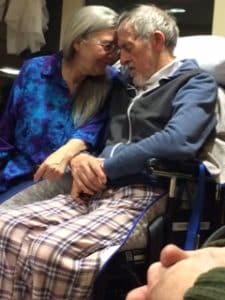
Top photo: Don Broten at Miracle Beach in better days. Above photo: A more recent image

So it is a safety issue. But I cannot see the advantage or the care in strapping him down like the worst kind of tortured prisoner and I am refusing to sign the paper.

It is illegal to restrain him without my okay.

And I am NOT okay with this.

Over the two-and-a-half years we have been there I have seen this. The patient starts strapped down for safety but is taken out and up on their feet for a walk 20 minutes a day. At most. Soon of course they can’t walk at all and life becomes a Brody chair. Where they lie swearing and trying to get out, while the care machine rolls on around them and staff gossip and go for breaks.

Then, unlike when they were mobile, the patient-victims really ARE swiftly parked and ignored. Oh fed and cleaned and cooed at from time to time, but that’s about it. No interaction except with family. Even the recreation aides don’t have much to offer once they are parked.

I want to puke. This is not humane.

Many of the parked recognize that I am a friendly face and make some kind of happy contact. But like everyone, I walk on by, with other things to do.

Part of me thinks wildly that i could bring him home, transform our house … foam on the floors and clear out the furniture such as it is, and extra care aides. Let him wander and fall safely in his strange fragmented world. Bring him home.

But foam doesn’t clean well and it is not that simple. It is the 36-hour job.

We don’t have family willing or able to take shifts and we don’t have that much money to get a suitable house, transform it and hire help. That is for the one percenters. For us, we are beyond lucky to have public care. Many don’t.

There is also my own slowly eroding remnant of a life to consider – although at moments like this it doesn’t count for much, and those who depend on my work. That must count too.

On the other hand my own mother was strapped in a chair because she kept trying to walk when she was totally paralysed on the left side, with resultant dementia. And there was no other choice. But she was not drugged and never parked. She had my father with her 24/7.

I have no idea what kind of love and determination that took. After she died he regained a huge amount of mental capacity and resilience. He did see what was coming for my love and me and told me not to do as he had done.

Comments and advice are welcome, here (on her blog), on Facebook, or by personal email. I need some help with this.

Delores Broten is one of British Columbia’s many thousands of unpaid caregivers. She is the editor of the award-winning Watershed Sentinel magazine published in Comox. She wrote this for her blog “CaringCV,” and is reprinted here with permission. She may be contacted at editor@watershedsentinel.ca. 


FURTHER READING: Read Delores Broten’s blog, “CaringCV”  


Game changer, but not a game winner

Game changer, but not a game winner

Game changer, but not a game winner

If voters pass electoral reform, the work just gets started

By PAT CARL

I’m a big-time college basketball fan. Men’s or women’s basketball, it doesn’t matter. If a college game’s on, I’m glued to ESPN. Other big-time fans know that a basket at the buzzer won Notre Dame the 2018 NCAA Women’s National Championship on April 1. What a way to win the game!

Unlike Notre Dame’s game-winning Hail Mary basket, if the majority of voters support electoral reform in BC’s November referendum, we will have only a game changer, not a game winner. In fact, the game would not be over at all because the hard work would just be beginning.

Why?

If electoral reform passes, British Columbians must learn to trust those who have worked hard to maintain the first-past-the-post status quo. Supporters of the status quo must, in turn, learn to trust those who supported proportional representation. Beyond that, legislators must learn to collaborate, to find common ground, in order to complete government business.

That won’t be easy.

Let’s try to understand how difficult that might be by using a personal example: my family.

Like some of yours, I’m sure, my family is split down the political middle. For years, my parents were confirmed Democrats (most like Liberals in Canada) because they loved Franklin D. Roosevelt and his necessary social reforms. Later, they became Republicans (most like Conservatives in Canada) because they couldn’t morally support a woman’s right to choose.

They raised four children. Two of us strongly believe in social justice, economic safety nets and environmental stewardship, while the other two believe just as strongly in individualism, growing the economy and small government.

I don’t know how to have a conversation with two of my brothers.  They don’t know how to have a conversation with me.

Sound familiar?

Now take that family dynamic and apply it to BC. How can we avoid creating an unbridgeable divide between first-past-the-post supporters and proportional representation supporters?

For one thing, during the lead-up to the referendum vote, both sides could refrain from exaggerating how wonderful its position is and how terrible the other one is. There’s enough of a difference between first-past-the-post and proportional representation to simply state the unembellished facts and let the voters decide.

Why not embrace nuance rather than exaggerated claims that sound like first-past-the-post and proportional representation are characters in a Shakespearean tragedy?  

We need to ask: What portion of the first-past-the-post arguments and what portion of the proportional representation arguments are true; what portion is exaggerated to the point of being untruthful or divisive?

Finally, the general electorate must take seriously the gift we enjoy and the responsibility we have living in a democracy. We must challenge ourselves to become politically literate by investigating the issues, by understanding that issues are seldom black or white, and by voting thoughtfully and wisely.

We and our legislative representatives will be far more likely to work collaboratively post-referendum if, during the lead-up to the referendum, we honestly and civilly discuss the issues. The less baggage we accumulate as we debate electoral reform, the easier it will be to accomplish good governance after the referendum.

Remember: Unlike a game-winning basket, if electoral reform happens, the game changes, but it’s not over.

Pat Carl is a member of Fair Vote Comox Valley. She wrote this for Decafnation’s Civic Journalism Project. She may be contacted at pat.carl0808@gmail.com.