The Week: Save 58% on the ‘The 12 Days of Christmas’ gifts, and other useless information

The Week: Save 58% on the ‘The 12 Days of Christmas’ gifts, and other useless information

Photo Caption

The Week: Save 58% on the ‘The 12 Days of Christmas’ gifts, and other useless information

By

Decafnation has searched high and low for some good news this holiday season. And we found it! The 2020 Christmas Price Index has dropped 58.5 percent over last year. Wait, is that good news?

It will cost $22,825.45 less to purchase all the items named in “The 12 Days of Christmas” song this year. The PNC Financial Services Group prices the items every year as a measure of the economy.

The 12 items will cost $16,168.14 this year ($38,993.59 in 2019). Most of the decrease came from the “cancellations of many live performances. It’s a silent night at most symphonies and the lights have dimmed for many dancers this holiday season, which contributes to the year-over-year decline.”

Partridge in a Pear Tree — $210.18 (0.0% change)
Two turtle doves — $450.00 (+50.0%)
Three French hens — $210.00 (+15.7)
Four calling birds — $599.96 (0.0%)
Five golden rings – $945.00 (+14.5%)
Six geese-a-laying — $570.00 (+35.7%)
Seven swans-a-swimming — $13,125 (0.0%)
Eight maids-a-milking — $58.00 (0.0%)
Nine ladies dancing — Not available in 2020
Ten lords-a-leaping — Not available in 2020
Eleven pipers piping — Not available in 2020
Twelve drummers drumming — Not available in 2020
Total — $16,168.14 or $105,561.80 if you count all the repetitions in the song


Some of the dream gifts we hope are under the Comox Valley tree this year include a COVID vaccination for everyone, a regional parks service, a transformed Economic Development service that actually helps all local businesses (not just a special few), fully-functional laboratories in the Courtenay and Campbell River (restored onsite pathologist services), municipal governments with a heightened climate change mentality that results in action on rainwater management, traffic improvements at the 17th Street Bridge, a BC Supreme Court victory for the Mack Laing Heritage Society and an enlightened Comox Council.


But here’s a gift you can give yourself: Passes to the 30th edition of the World Community Film Festival, virtual edition. This year, you can watch films from the comfort of your home at any time during the festival. Audience members can purchase festival passes or tickets for individual films and decide when to watch, in any order, from Feb. 5 through Feb. 13.

It’s “your festival, your way,” says Programmer Janet Fairbanks. “We are excited to be offering a great lineup of international documentary films addressing social and environmental justice, LGBTQ+, Indigenous issues, food security, climate change, music and arts. Bonus features will include interviews with filmmakers and other resource people.


This tree that kept on giving … for two years. A high school teacher in Scotland kept the same Christmas tree up and decorated from 2007 to 2009. After a friend kidded him about still having his tree up by Twelfth Night, he decided to leave it up … for more than 750 days.


From our collection of Lame Christmas jokes, which are not only for kids.

Q: What did Adam say on the day before Christmas?
A: It’s Christmas, Eve!

Q: How do you make an idiot laugh on boxing day?
A: Tell him a joke on Christmas Eve!

Q: What do you have in December that you don’t have in any other month?
A: The letter “D”!

Q: What does Father Christmas suffer from if he gets stuck in a chimney?
A: Santa Claustrophobia!

Q: What do you call a letter sent up the chimney on Christmas Eve?
A: Blackmail!

Q: Who delivers a cat’s Christmas presents?
A: Santa Paws!

Q: Why does Father Christmas go down the chimney?
A: Because it soots him!

Q: Who delivers elephants’ Christmas presents?
A: Elephanta Claus!

Q: Why is Santa like a bear on Christmas Eve?
A: Because he’s Sooty!

Q: What is the best Christmas present in the world?
A: A broken drum, you just can’t beat it!


Our favourite Christmas quote:

“Then the Grinch thought of something he hadn’t before! What if Christmas, he thought, doesn’t come from a store. What if Christmas … perhaps … means a little bit more!” –Dr. Seuss, How the Grinch Stole Christmas!

Happy Holidays

SUBSCRIBE TO OUR NEWSLETTER

Enter your email address to subscribe to the Decafnation newsletter.

More
B.C.’s 150th anniversary provides an opportunity to right a historic wrong

B.C.’s 150th anniversary provides an opportunity to right a historic wrong

B.C.’s 150th anniversary provides an opportunity to right a historic wrong

BY PAUL MANLY, MP

As 2020 draws to a close, it’s become a cliche to say that it’s a year to forget. But we would be remiss if we did not recognize the progress we made this year as people took the time to reflect on the things that really matter. As COVID-19 shut down our world and the dramatic political divisions south of the border came to a head, we spent more time contemplating the changes needed to build a more compassionate, peaceful society.

In particular, one of the bright spots of 2020 was a much wider acknowledgement of the need to address systemic racism. We must now look for every opportunity to address our own history of racism and advance tangible reconciliation.

As the 150th anniversary of B.C. joining the Canadian confederation approaches in 2021, our federal government has an opportunity to advance reconciliation with First Nations on Southern Vancouver Island, while also protecting local drinking watersheds and endangered species, and fostering sustainable economic opportunities.

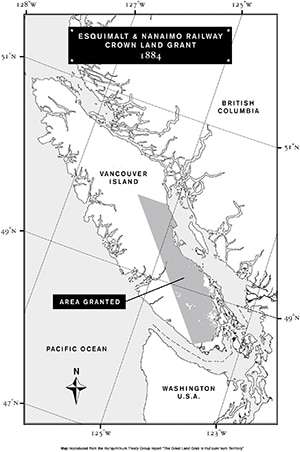
The negotiation of modern treaties in our part of the province is impeded by the lack of Crown Land due to the historic E&N Land Grant. The grant, which disregarded the rights and title of all First Nations in the area, is a legacy of B.C. joining the confederation. As part of the deal, the government awarded coal baron and government minister Robert Dunsmuir more than 20% of Vancouver Island, two million acres of land, along with $750,000. In exchange, Dunsmuir built the E&N railway, completing the rail link between Canada’s provincial capitals.

Today, the remaining undeveloped land is at risk due to logging and the potential sale of mineral rights. Local watersheds have come under threat from these activities, with communities being forced to invest millions on filtration and treatment plants to maintain their access to clean drinking water. Unsustainable development and resource extraction also threaten fish estuaries and animal habitats. Restoring the land to local First Nations could be done in a way that prioritizes vital conservation efforts, while also providing sustainable economic opportunities including selective forestry, recreation and tourism.

There are already programs in place to make this happen. The federal government has committed to protecting 30% of our natural areas by 2030 through Canada’s Nature Legacy program. A key part of this commitment is the creation of Indigenous Protected Conservation Areas (IPCAs), which fall under the jurisdiction and authority of the local First Nations.

Through a First Nations-led process the government could acquire a minimum of 30% of the existing forest lands that were privatized under the E&N land grant and place them under the jurisdiction and control of the affected First Nations. Land acquisition could focus on the critical habitat around rivers, watercourses and catchment areas for community drinking watersheds, with special consideration given to placing community drinking watersheds under co-management between First Nations and the cities and towns that rely on the water supply. Under the successful Land Guardian program, co-management could be coordinated between First Nations within the Hul’qumi’num, Kwakwaka’wakw and Nuu-chah-nulth territories of the land grant region.

The acquisition process could include the use of carbon offsets, land transfers, tax incentives and cash purchases to assemble the land. User fees generated by recreational use of the lands for activities such as camping, rafting and kayaking company tours, and parking fees for day use could also help fund ongoing land management through the Land Guardian program.

The acquisition of a portion of the E&N lands as IPCAs would be a significant step towards advancing reconciliation on Southern Vancouver Island. It can be done in a way that advances other goals that are important to Islanders, like protecting wild salmon, conserving the habitats of endangered species and preserving biodiversity, while also ensuring our communities have access to clean drinking water and outdoor recreation. This ‘rise together’ strategy has environmental, social and economic benefits.

If we take one lesson from 2020, let it be that honouring our history means looking at it with clear eyes. If we forget the full reality of our history, we are doomed to repeat it. So, what better way to celebrate the anniversary of our province joining the Canadian confederation than to address the historic wrong that was perpetrated as part of it? If we do, we can move forward together as a more just and sustainable province.

Paul Manly is the MP for Nanaimo-Ladysmith. He wrote this version of his op-ed column for Decafnation.


MORE ABOUT DUNSMUIR AND THE LAND GRANT

A rail link between Nanaimo and Victoria had been planned as early as 1873, but no serious effort to start construction was made until December 1883 when the province transferred to the federal government sufficient crown lands for the project. To safeguard control of the island’s economic future, and prevent the possibility of the Northern Pacific Railroad gaining the contract, many businessmen and politicians urged Robert Dunsmuir to build the line.

Dunsmuir was reluctant to accept the task, thinking it of little benefit to his colliery operations. He submitted a proposal to the Canadian government, however, and despite the severity of his terms he emerged as the sole acceptable alternative to foreign builders. After much shrewd bargaining in Ottawa Dunsmuir agreed to construct the railway in return for a subsidy of $750,000 in cash and a parcel of land comprising some two million acres – fully one-fifth of Vancouver Island. Significantly, the land grant came with “all coal, coal oil, ores, stones, clay, marble, slates, mines, minerals, and substances whatsoever in, on or under the lands so to be granted.”

He received also all foreshore rights for the lands, all mining privileges (including the right to mine under adjacent seabeds), and the retention of all coal and other minerals taken from the land. Additionally, as contractor he was permitted to cut whatever timber and erect whatever structures he saw fit to build the line. To promote settlement, provision was made for the sale of farmlands to homesteaders at one dollar per acre. Squatters of at least one year’s residence were allowed to buy up to 160 acres, and those settlers with title were allowed to retain their holdings, but virtually all else would go to the contractor in right of performance.

It was, in short, a major give-away of British Columbia’s natural resources.

— From the website, Biographi

SUBSCRIBE TO OUR NEWSLETTER

Enter your email address to subscribe to the Decafnation newsletter.

More
The Week: We toss together the COVID virus, vaccine promises and new grimmer predictions

The Week: We toss together the COVID virus, vaccine promises and new grimmer predictions

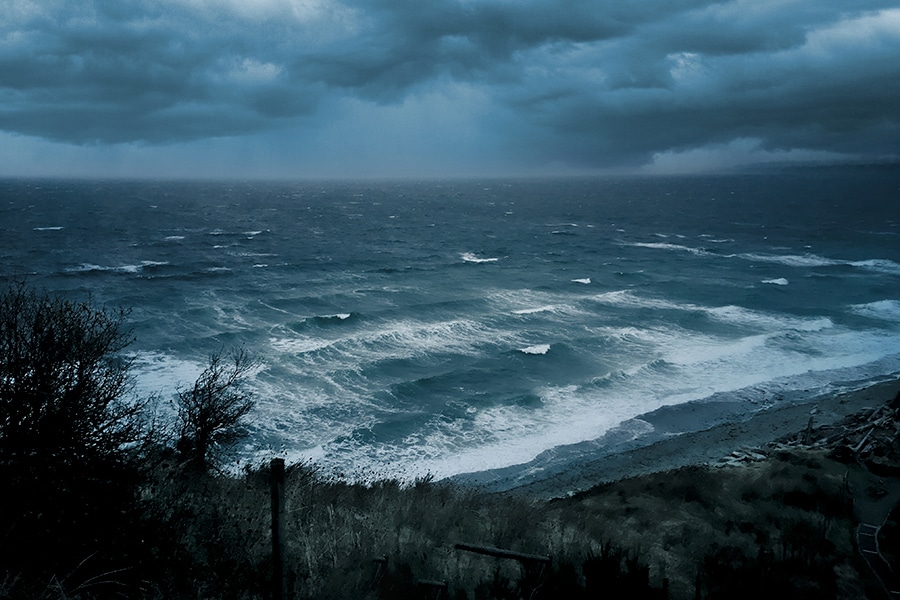
You can’t travel to Tofino or Ucluelet to watch winter storms. But you can visit the Goose Spit  |  George Le Masurier photo

The Week: We toss together the COVID virus, vaccine promises and new grimmer predictions

By

These last few weeks of 2020 may be the most confusing of a year when reality and insanity got tossed in an unappetizing and emotionally unhealthy salad.

Here we are, counting down the days to Christmas, Hanukkah, Bodhi Day and New Years with a longing to celebrate with family and friends. But we can’t. The COVID-19 virus is spreading faster than it did in March and April when public health orders locked everyone at home and turned our streets into ghost towns.

But we are also euphoric that science has produced effective vaccines. Is the world as we used to know it just around the corner?

These competing developments might create a strong temptation to take a sneak peek into our lost world over the holidays. Just a quick visit with family. Travel off this island rock. Invite some friends over — just our safe six — for some holiday cheer.

We’re so close to being liberated from our pandemic prisons and releasing our pent-up desires that some of us are already gnawing at the bars of Dr. Bonnie Henry’s cages.

So what’s the harm in bending the rules just a little? The vaccines are coming.

What the harm?

Well, the Institute for Health Metrics and Evaluation (IHME) at the University of Washington predicts that new COVID infections and deaths will get much worse over the next few months and that vaccines won’t provide any relief until later next spring.

The IHME predicts COVID-related deaths will triple in Canada by April 1, 2021. The number of Canadians dying every day will quadruple into mid-February.

And the prediction gets grimmer. In British Columbia, COVID deaths will increase by 10 times! Daily deaths will leap to six times current levels until peaking some time in January.

Why will this happen? Because despite Dr. Henry’s tighter restrictions through Jan. 8 and her pleas for people to wear masks and keep a safe physical distance many of us can’t help ourselves. We’ll cheat a little and justify it because we’ve suffered for so long.

Also, our province has the lowest mask compliance (61 percent) of any province in Canada. Anti-masking demonstrations by groups of morons don’t help either.

Don’t you just marvel at people who, in the face of a worldwide pandemic that will eventually kill more than three million people, are able to conjure up some version of scientific rebellion or machismo? The virus won’t hurt me, “I’ve got west coast logger blood.”

If the death rate isn’t alarming enough for these people, maybe they should think about the long-term effects of a COVID infection.

Recent studies have discovered that 50 percent to 80 percent of people who survive COVID symptoms continue to suffer unexplained ailments — fatigue, body aches, shortness of breath, difficulty concentrating, inability to exercise, headache and difficulty sleeping.

There’s a new name for these people: Long Haulers.

Doctors don’t know yet how long these ailments will last. A few months, a year, several years? We won’t know until they stop, if they ever do.

And, so far, the BC Health Ministry doesn’t mention Long Haulers in their reports nor does Dr. Henry in her daily updates. But these unfortunate victims of the pandemic will be suffering long after the rest of us receive our vaccinations.

So, don’t be confused. Don’t be lured into thinking you can bend Dr. Henry’s public health orders. Don’t gather with family members that don’t live with you. Or friends. Or travel anywhere.

Stay home, wear a mask and rejoice, not just in the spirit of whatever religious holiday speaks to you, but in the knowledge that with a little caution, you can get through this infectious nightmare.


Should British Columbia restrict access to people who don’t take the COVID vaccine? In lieu of making vaccination mandatory, Ontario plans to issue a certification document to those who have been vaccinated.

People without proof of immunization may not be allowed to travel or enter communal spaces, such as cinemas, performing arts centres, art galleries or other public spaces.

Will that policy face a human rights challenge? Possibly, but by giving people a choice, the province makes it clear that there are consequences for potentially endangering other people’s lives.


Thank you, MP Rachel Blaney, for challenging Transport Canada’s order prohibiting passengers from remaining in their vehicles during BC Ferry sailings if parked on a closed deck.

That order never made sense to us. Why force people into situations that increases their exposure to the COVID virus?

In a letter to the ministry, Blaney questioned “the value and logic of using ministry resources to process and potentially punish people who are simply doing their best to follow public health orders and keep their contact with others to a minimum.


Does the Comox Valley need a regional parks service? Electoral Area A Director Daniel Arbour appears to think so.

At the regional district board’s meeting on Oct. 27, Arbour made the motion (second by Area C Director Edwin Grieve) to direct staff to present a draft property acquisition policy to fund a regional parks service. That report is expected at next week’s CVRD board meeting.

Meanwhile, the Puntledge River Forest Protection Society made an excellent presentation to the regional board this week.


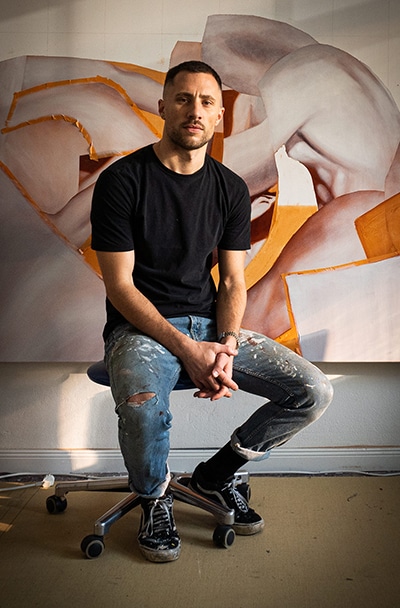
A European art world magazine, Metal, recently featured a story about up-and-coming artist Andrew Moncrief, who was born and raised in the Comox Valley.

Moncrief’s solo and group work has been exhibited throughout the world, and recently at the Utah Museum of Contemporary Art. He was a finalist for Canada’s Salt Spring National Art Prize last year and won a Canada Council grant for the Arts on his first try. He is currently contemplating launching shows in Germany and other parts of Europe.

It’s an insightful and personally revealing article. Here are a few excerpts:

METAL: How much of your early life and adolescence in Canada helped shape you as an artist? Are there any memorable personal experiences or other artistic influences that inspired your approach to painting and drawing, or that motivated you to pursue a career as an artist?

MONCRIEF: As far as I can remember, I was always doing something artistic or crafty. I grew up with a mother who was extremely creative and a father who was dexterous. In order to keep me occupied as a kid, my mom used to plunk me down on the counter with crayons, pencil crayons, construction paper, scissors, and I would just make things.

I definitely owe this to my parents and I definitely think I got a solid balance of artsy creativity from my mother, and I can safely say that I owe my work ethic to my father. He was a logger who built four family homes himself; he was always building or fixing, even on the weekends. He had a love of pouring concrete and could never sit still. I definitely am the same though – less the concrete. My mom was extremely creative or crafty, as she would say, we were always doing artsy things after school from as far as I can remember – painting rocks, clay pots, pieces of wood that were laying around the many construction sites that I grew up in.

Briefly, I am mostly consumed with issues of identity, queer identity, masculinity, body dysmorphia, and the internal struggles in reconciling what these mean to me personally, and my struggles with accepting myself as a gay man growing up. I first started my Bachelor of Fine Arts at North Island College in my hometown, and then eventually landed in Montreal in 2009, where I was subsequently accepted into Concordia University’s Painting & Drawing program in 2010.

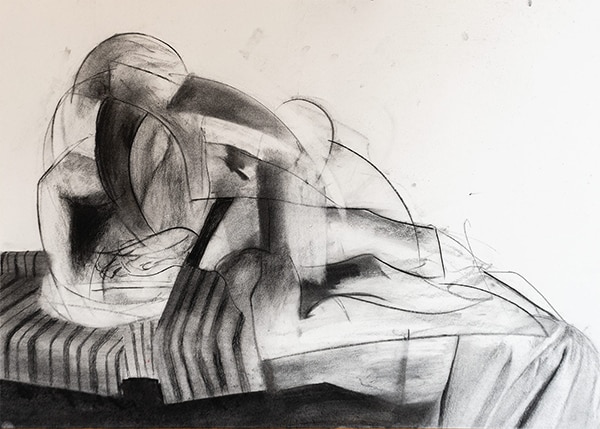
Drawing by Andrew Moncrief


SUBSCRIBE TO OUR NEWSLETTER

Enter your email address to subscribe to the Decafnation newsletter.

More
Why can’t our Elf on the Shelf be a role model instead of an accomplice?

Why can’t our Elf on the Shelf be a role model instead of an accomplice?

All over the Internet, Elves are leaving their shelves to engage in nightly mischief

Why can’t our Elf on the Shelf be a role model instead of an accomplice?

By

It’s that time of the year when I reevaluate my relationship with Ruby, our Elf on the Shelf. Like any relationship, Ruby and I have had our ups and downs.

I was smitten with Ruby, at first. It was fun thinking up funny and adventurous places for the kids to find her. One morning she was swinging from her ankles on the pendant light in our kitchen. Another morning she was discovered in a pile of chocolate chips after sneaking into the baking cupboard overnight.

As we got deeper into December, my interest and energy waned and soon Ruby stopped pulling all-nighters. She wasn’t even moving.

After Christmas, I decided to chalk Ruby up as a parenting fail and move on. We would make different Christmas traditions that were less guilt-inducing and created less resentment towards an inanimate object. I gave Ruby away.

When December rolled around the next year, my kids were confused by Ruby absence. “Was it because we’ve been bad this year?” they asked. “Do you mean the time you tried to sell your brother for five cents? Yes, that probably had something to do with it.” I answered, half-joking.

But I was surprised that they remembered Ruby. I started to doubt how I ended things with her. With the discomfort of the previous Christmas season far enough in the past, I headed back to the store for another Elf on the Shelf.

I know what you’re thinking. I’m a glutton for punishment and a very, very slow learner.

The second go-around with our Elf on the Shelf left me feeling more frustrated than before but my kids were invested and to break up with her again feels complicated. One morning I found a hand-written note and drawing from our eight-year-old daughter to Ruby.

“Dear Ruby, I hope you get presents from Elves. If you don’t, I got you one.”

This tiny gesture from my little girl made me realize that Ruby meant something to her, and also that I should have ended things when I had the chance.

“At the heart of the matter though, is my doubt as to the value of her actual job”

According to the book she comes with, Ruby is supposed to serve as Santa’s eyes and ears. She monitors the children’s naughty and nice behaviour and reports back to Santa. As her name clearly suggests, she is supposed to do this from her superior vantage point of THE SHELF.

Unfortunately for me and other parents, the societal expectation is to hide Ruby in creative and amusing places for the children to find. THE SHELF is no longer good enough.

There are websites, Instagram and Facebook posts dedicated to Elves NOT on the shelf. These Elves are usually involved in some kind of mischief that is often not even kid-appropriate. What started as a simple holiday game of hide-and-seek for children has become an entire industry.

And another thing: Ruby takes 11 months of leave. She can’t live in the Christmas box because she’s magic and supposedly returns to the North Pole. She has to be carefully stored away in a box not labelled ‘Christmas’ until the following Nov. 30 when you begin searching for her whereabouts.

This year, I couldn’t find Ruby. Back to the store. Buy a third one.

But the real difficulty with the Elf on the Shelf is remembering to move it. After a long day with kids and work and the multitude of other jobs that need to get done before your head hits the pillow, the Elf on the Shelf is one more thing to do.

I have tucked myself into bed on more than one occasion only to realize that I didn’t move the effing Elf. There have been even more nights when I just plain forgot. It is in those moments that I truly resent this skinny red waif and plot her banishment from our home.

At the heart of the matter though, is my doubt as to the value of her actual job. If she is supposed to be Santa’s eyes and ears, watching out for bad behaviour, why is she herself getting into mischief? The only message I can imagine my kids get from seeing Ruby in a mess of her own making is that she’s just like them and therefore not someone they need to impress.

In other words, instead of a role model, my kids have an accomplice.

To truly live up to her life’s purpose, Ruby should be setting a good example for our children. I would like my children to find her doing the chores that I so often have to nag them to do.

Imagine if they found Ruby taking it upon herself to empty the dishwasher without being asked, making her own lunch or cleaning up the Lego. That kind of goody-two-shoes behaviour may be just the ticket to turn my kids against Ruby forever.

Possibly the surest sign that a relationship has soured is when you start to resent the mere presence of the other person. As I write this, we are a few weeks away from the holiday season and I can already feel the stirrings of resentment.

I long for the simpler days when the chocolate Advent calendar was magic enough.

Sarah Seitz has two children. She lives in Victoria and also writes a column for Island Parent magazine.


Origin of Elf on a Shelf

The Elf on the Shelf: A Christmas Tradition is a 2005 children’s picture book, written by Carol Aebersold and her daughter Chanda Bell, and illustrated by Coë Steinwart. The book tells a Christmas-themed story, written in rhyme, that explains how Santa Claus knows who is naughty and nice. It describes elves visiting children from Thanksgiving to Christmas Eve, after which they return to the North Pole until the next holiday season.


Mensch on a Bench

A Jewish counterpart to Elf on the Shelf was designed by Benjamin Goober Elikns: “Mensch on a Bench”, a stuffed toy that looks a bit like a rabbi or a Hasidic Jew. Jewish father Neal Hoffman, a former Hasbro Toys toy marketing executive, raised more than $22,000 using the crowdfunding website Kickstarter to fund the creation of the toy in 2011. “Mensch”, in Yiddish, means a person of integrity or honour.

— Wikipedia


SUBSCRIBE TO OUR NEWSLETTER

Enter your email address to subscribe to the Decafnation newsletter.

More

No Results Found

The page you requested could not be found. Try refining your search, or use the navigation above to locate the post.

The Week: Does the Comox Valley need a regional park service … and quickly?

The Week: Does the Comox Valley need a regional park service … and quickly?

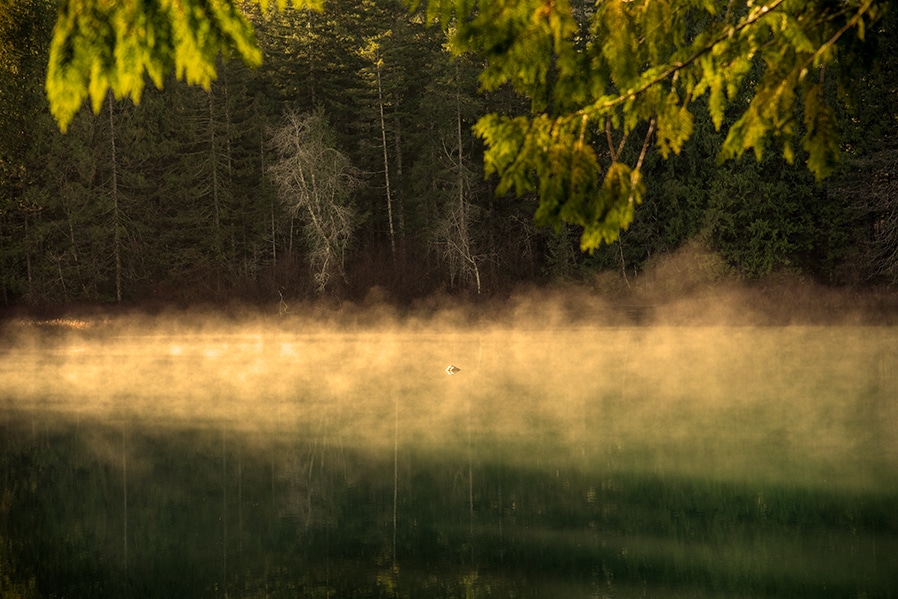
Low-lying fog on the Puntledge River seen from the popular Bevan Swing swimming area  |  George Le Masurier photo

The Week: Does the Comox Valley need a regional park service … and quickly?

By

This week we’re talking about regional parks and zeroing in on what 3L Developments Inc. actually paid for their Puntledge Triangle land. We’re being curious about an interesting twist in the school trustee by-election on Saturday and a missed opportunity for the Town of Comox. And what happened to Ronna-Rae Leonard?

Meanwhile, it’s opening weekend up at Mt. Washington.


Does the Comox Valley need a regional parks service? Given all the recent attention to popular recreation areas along both sides of the Puntledge River, it seems that we do. And it’s probably inevitable.

We reported this week on a new society that hopes to save the Bevan Trails area from imminent logging by Hancock Forest Management. There’s also a public interest in preserving the current state of the Puntledge Triangle and its access to Stotan Falls.

These two areas — both located in Electoral Area C — certainly warrant public acquisition. The Puntledge River runs through the heart of the Comox Valley and we already have several parks along the river’s lower reaches.

But here’s the problem: There is no Comox Valley regional park service. So it’s currently up to rural taxpayers to fund the purchase of any land for parks in Electoral Areas A, B or C. Because the three Comox Valley municipalities do not contribute to the rural parks fund, its funds are limited.

Other regional districts on the Island have regional park services. For example, consider this language from the Regional District of Nanaimo:

“A regional park function was established in the RDN in 1989. In 1995, the Regional Board adopted a Parks System Plan to guide the development of Regional Parks. The vision back then was of a park system that “secures, protects and stewards lands within the Region that maintain livability, provide environmental and natural resource protection and accommodate outdoor recreational pursuits”.

“Then, in 1998, the Board approved a plan for acquiring up to nine regional park sites over the next seven years. The sites were intended to serve a variety of outdoor activities, and protect a range of habitats and natural features.”

A regional park function makes sense for us, too. And we might already have one.

Area C Director Edwin Grieve believes the Comox Valley Regional District has an inactive regional park service bylaw. He told Decafnation this week that regional directors adopted a bylaw in the 1990s but it lapsed because they couldn’t decide which projects to fund. The bylaw could be re-activated because the regional board has never rescinded it.

Regional district staff plan to present a report on this topic at the board’s Dec. 15 meeting.

It’s fair to say that those people living in the densest and highest populated areas of our community are just as likely — some would argue more likely — to use parks and other recreational sites in our rural areas. Shouldn’t they contribute to the purchase and maintenance of regional parks?

Of course, this is going to spark a whole new community conversation. But it’s one we must have if we’re going to consider preserving large areas like the Puntledge Triangle or Bevan Trails.

Is it possible for local governments to make all of this happen in time to preserve either of the areas currently on the chopping block? Stay tuned.


Speaking of 3L Developments Inc., In last week’s commentary, we speculated that the company had paid around $1.5 million for the four parcels comprising their proposed Riverwood subdivision. We were wrong.

According to new information from two separate sources, tax records show the company paid almost $3.7 million. The sales mostly occurred in 2006. One of the parcels shows a sale as late as 2012 but that could be the result of an internal transfer of titles, according to one source.

BC Assessment records show the properties were valued for tax purposes at $4.646 million in 2019 and at $4.222 million in 2020, a drop of $424,000.


There’s an interesting twist to Dec. 12’s general voting in the Area C school trustee by-election.

When voters go to the polls on Saturday, Dec. 12 they might not recognize the name of one candidate: Cristi May.

Cristi May-Sacht is definitely among the six candidates seeking election. But not Cristi May.

According to our source, May-Sacht was told her name was too long to fit on the physical ballot so it was shortened. That’s a curious decision.

What happens if May-Sacht falls just a few votes short of winning? Could she demand a new election with her proper name on the ballot?


The Town of Comox has missed an excellent opportunity to resolve their Mack Laing Trust problem; specifically, what to do with the famous ornithologist’s heritage home, called Shakesides.

The BC Government has set aside $90 million to provide fully-funded $1 million grants for local government projects that support economic resilience during the pandemic. The idea is to create immediate job opportunities for those negatively impacted by COVID public health orders. Eligible projects have to begin by the end of next year and complete within two years.

The government specified four key categories of shovel-ready projects that would qualify. One of those is Unique Heritage Infrastructure.

Restoring Shakesides in accordance with the Laing Trust agreement would have surely qualified. There’s already a comprehensive business plan for the project and more than 30 volunteer skilled craftspeople and businesses, including Lacasse Construction, are ready to go.

But the only application submitted by the town was to construct a new marine services building on the waterfront.

The town needs to deal with its failure to resolve this outstanding issue. Two years ago, the Town Council couldn’t get back to the BC Supreme Court fast enough for a ruling on their petition to vary the trust agreement and demolish Shakesides. Now they’re doing nothing.

Why? Probably because a few early Supreme Court orders went against them. A Justice ruled that the Mack Laing Heritage Society could participate in the court hearings and present their mountain of evidence, some of which looks very bad for the town.

So, after spending nearly $300,000 of your tax money on legal fees, the town realized there was a high probability the court would deny their application. The court could also order an independent financial audit of how the town handled the financial aspects of the Mack Laing Trust agreement.

No surprise then that the Town Council is avoiding a trip back to court.

That’s what makes this missed opportunity so sad. A $1 million grant from the province to fund a Shakesides restoration project along with the Heritage Society’s volunteers might have made this 38-year-old lingering problem go away. And it could have healed a few community wounds.


Courtenay-Comox voters might have noticed an interesting change in Premier John Horgan’s new government. Absent from the list is MLA Ronna-Rae Leonard.

She lost her position as the government’s Parliamentary Secretary for Seniors’ Services and Long-Term Care to Mable Elmore, an 11-year MLA for Vancouver-Kensington. No reason was given for the change.

This article was updated to correct the general voting date to Saturday, Dec. 12.


SUBSCRIBE TO OUR NEWSLETTER

Enter your email address to subscribe to the Decafnation newsletter.

More
The Week: Strong CV women in charge.  What did 3L pay? Plus, CVEDS bungles, Comox raises

The Week: Strong CV women in charge. What did 3L pay? Plus, CVEDS bungles, Comox raises

“You realize that our mistrust of the future makes it hard to give up the past.” — Chuck Palahniuk, Survivor  |  George Le Masurier photo

The Week: Strong CV women in charge. What did 3L pay? Plus, CVEDS bungles, Comox raises

By

This week we’re all about 3L Developments (again), more head-shaking activity from the CV Economic Development Society (again) and ditto (again) for the Comox Town Council.

But first, let’s congratulate Jesse Ketler and Arzeena Hamir on their re-election as chair and co-chair of the Comox Valley Regional District board. Two strong women at the helm. We’re in good hands.

And kudos to another strong woman who joined the CVRD board this week. Courtenay Councillor Melanie McCollum replaced David Frisch as one of the city’s four regional directors.


Decafnation has received information that back in 2007, 3L Developments Inc. might have paid somewhere around $1.5 million to purchase the four parcels of land totalling nearly 500 acres in what’s being called the Puntledge Triangle.

We have not verified that number, nor have we seen any official documents that list the 2007 sale price.

But for the last 13 years, the company has tried to persuade the regional district to abandon its Regional Growth Strategy and rezone the properties for a dense urban-style subdivision.

Those four parcels today have an assessed value of $4.222 million. We got those numbers directly from the BC Assessment website.

If the sale price is even close to accurate, then 3L has enjoyed a significant increase in value. Of course, it’s nothing near the profit the company would have realized if the regional district had approved a rezoning.

Did 3L ever really plan to develop the property itself? Or, was its end-plan only to get the parcels rezoned, which would have made the land much more valuable, and then flip the parcels to some other developer?

We’ll never know.

Instead, the debate now shifts to whether the regional district should attempt to purchase the property from 3L Developments. Buying the property for parkland and securing public access to Stotan Falls would certainly win popularity points with the general public. But taking on more parkland is expensive.

There’s no indication yet that regional directors have any interest in negotiating a purchase.

And who knows how they feel after hearing company spokesperson Rob Buchan’s sales pitch to them this week. Buchan said 3L prefers to sell the land to the regional district. But, if you don’t buy the property, he intimated the company would clear-cut the trees and turn the site into a gravel pit. We’ll turn your jewel into a blight.

Not exactly a feel-good proposition.

But the company is certainly entitled to do those things. And if their only interest is self-interest, then that’s probably what will happen.


Does the CV Economic Development Society need to fold its tent? Representatives of the three electoral areas, Courtenay, Comox and the regional district will start seeking an answer to that question on Jan. 19.

Regional directors had planned for the full board to assess the future of CVEDS over the next year. But the Comox Town Council decided unanimously to derail that plan and trigger a quicker statutory service review.

What’s the difference? First, a smaller group will negotiate whether there’s any common ground to save the 32-year-old society; and, second, if Comox doesn’t like the outcome of the review, then they can officially withdraw from the service.

Given the Economic Development Society’s recent missteps, the outcome may already be a foregone conclusion. The directors from Courtenay and Electoral Areas A and B are not happy. While the directors from Comox and Area C would preserve the society in its present form if they could. That’s a 3-2 straight-up vote.

And CVEDS has not helped its chances for survival recently. Consider that:

1) CVEDS staff planned a three-day seafood festival during the second pandemic wave in November without the knowledge of its own board of directors or the CVRD or the Comox Valley Regional District. The North Island Public Health department had to step in and when hoteliers got uncomfortable, the event was shut down.

Bringing in guests and featured chefs from the Lower Mainland and Ontario had the potential to create a COVID super-spreader event.

2) The society’s board of directors have not seen or approved any financial statements for 11 months. This not only contravenes the Societies Act, but it’s also an affront to Comox Valley taxpayers who fund the organization.

3) The society has not held an Annual General Meeting for 17 months. Again, in conflict with the Societies Act.

4) CVEDS signed a new two-year contract with the regional district in late July, and then quickly forgot most of it. The society is already in contravention of the agreement and has missed several contractual deadlines.

And then there’s this:

5) On March 12, the local hotels and assorted other accommodation facilities that voluntarily contribute funds to the Municipal and Regional District Tax program (MRDT) — often called the “hotel tax” — decided at their annual budget meeting to help fund mountain biking in Cumberland.

The MRDT group voted to donate $10,000 per year for three years to support the United Riders of Cumberland (UROC) that maintains the biking trails in the Cumberland Forest and organizes events.

The hoteliers also agreed to donate an additional $5,000 per year for three years as prize money for those events to increase participation and potential overnight stays in the Valley.

But several months later, UROC hadn’t received any money. After Cumberland Mayor Leslie Baird phoned some of the hoteliers about the funds it was discovered that CVEDS staff had apparently and unilaterally decided to withdraw the donations.

This infuriated the hoteliers because, well, it’s their money and they get to decide how to spend it.

Does this sound like a well-run organization, one that deserves to continue receiving more than a million dollars a year of local taxpayers’ money?

If you have strong feelings about that one way or the other, you might want to let your representative in Comox, Courtenay or the three electoral areas know before Jan. 19.


Finally, this week, the Comox town councillors think they might be underpaid.

At its Nov. 18 meeting, the council voted to undertake a review of remuneration for the mayor and council. Keep in mind that one of the first things this council did after taking office in 2018 was to vote themselves a 14 percent pay increase.

We’re in the middle of a pandemic. People have lost jobs. Businesses have closed or lost significant profitability. If this second wave of COVID infections continues to surge, the province might impose even more negative economic impacts.

It’s possible this council might be tone-deaf.

But it is true that Comox council salaries are a little below the average of comparable municipalities. Of course, chasing the average just raises the average. You never get there. It’s like a dog chasing its tail.

That said, however, we have no argument with compensating elected officials fairly. The good ones put in long hours.

Maybe it’s just the optics that feel wrong about this. Comox councillors obviously want to raise their salaries early next year because municipal elections loom the following year. And from a political perspective, it’s better if voters forget about two wage hikes during one term in office before the polls open in 2022.

The citizens advisory group that will study and recommend whether Comox councillors deserve a second raise will comprise just three people, including one former councillor. We think a larger, more representative group of Comox taxpayers might be more objective.

And who will choose and appoint this (nudge, nudge, wink, wink) neutral group? Why the town’s chief administrative officer, of course, who is employed at the pleasure of the mayor and council.


SUBSCRIBE TO OUR NEWSLETTER

Enter your email address to subscribe to the Decafnation newsletter.

More