Will Manno Theos win Courtenay in vote split?  And are these candidates using AI?

Will Manno Theos win Courtenay in vote split? And are these candidates using AI?

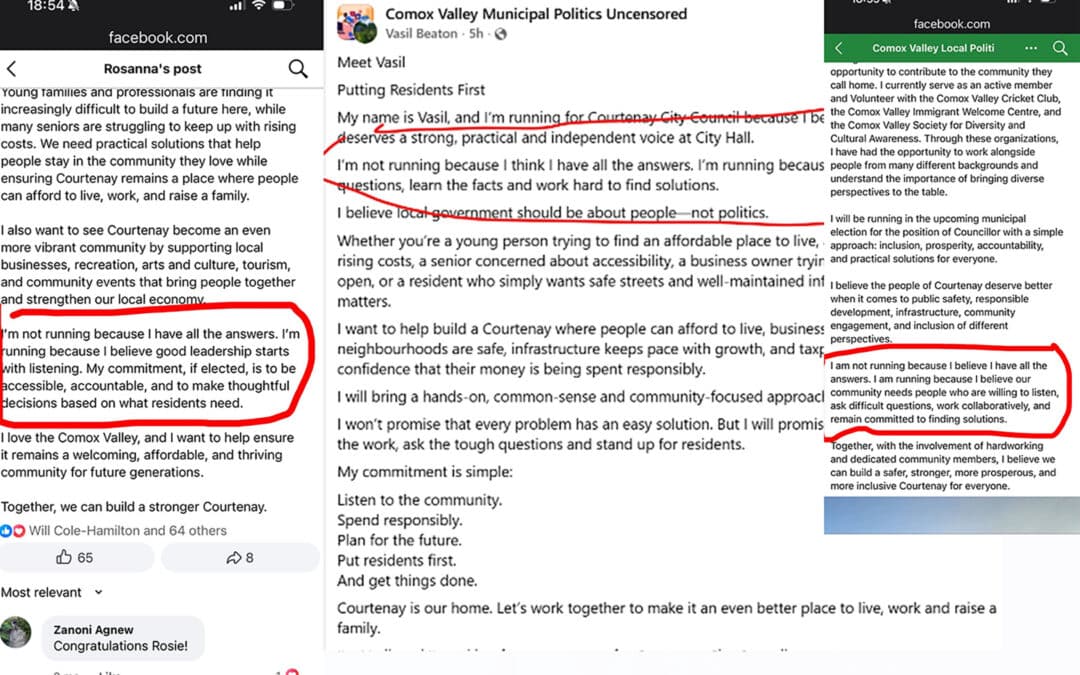
Many candidate’s social media posts appear suspiciously similar. A sample, from left, Rosanna Chamberlin, Vasil Beaton and Kam Singhania

Will Manno Theos win Courtenay in vote split? And are these candidates using AI?

By

M ost candidates running in the 2026 local government election had filed days before the nomination deadline passed at 4 pm Friday. Other candidates, who everyone knew would run but had not filed, popped their last-minute “Surprise! I’m running!” charade to no one’s surprise.

For the 30 percent of Comox Valley residents who vote in municipal elections, it was an exciting moment. The other 70 percent, who won’t vote, released a deep, collective yawn.

Well, it is true, you won’t find many surprises in this year’s candidate line-up. So, let’s have a look at the Good, the Bad and the Nothing’s New.


The Good News

MORE CANDIDATES – Seventy people are running for the 31 Comox Valley elected offices, an increase of 23 percent over the 57 who ran in 2022.

MORE WOMEN – Women account for 41 percent of the candidates (20 of 49) this year, excluding the School District (nine out of 11) ) and the Islands Trust (two out of 10). Comox has the highest percentage of women seeking office (seven out of 12) at 58 percent. That compares to 35 percent in Courtenay (eight out of 23) and 25 percent in Cumberland (two out of eight).

And, a woman is running for the mayor’s chair in Courtenay for the first time in 18 years, since Star Winchester ran for re-election 2008.


The Nothing’s New

DEJA VU – It feels like Groundhog Day all over again in Courtenay’s mayoral race, where the late-filing Trish McPhail will split the center-progressive vote, maybe clearing a path to His Honor’s chair for Manno Theos. Comox Valley’s sitting conservative MLA and MP both won their seats thanks to vote splitting between the NDP and Greens. Will it happen again? Maybe. It is highly unlikely that McPhail will take votes away from Theos supporters. Her share will come from Incumbent Mayor Bob Wells. The question here is: Can Wells and McPhail get enough new voters out to both outpoll Theos?

ACCLAIMED – Several candidates have already won their election races because no one challenged them. Comox Mayor Nicole Minions won her second consecutive election by acclamation. In two mayoral terms she has never been opposed. Cumberland Mayor Vickey Brown and Electoral Area A regional Director Daniel Arbour also were acclaimed.

SAME NAMES – Many familiar names dot the candidate list, again. Ken Grant seeks his seventh term on Comox Council, a total of 21 years. Maureen Swift has warmed her council chair for 15 years. Erik Eriksson … filed again. He won a council chair in 1986 and again in 2014. Then, he ran unsuccessfully for mayor in 2018 and again in 2022. This will be Jin Lin’s third try for Courtenay council. She came close in 2018 and 2022. Phil Adams got less than a 1,000 votes in 2022, but he’s having another go.

Candidates keep trying, because on election day, anything’s possible. Voters are a little like courtroom juries. Unpredictable. Just look at Brennan Day. Courtenay voters rejected him twice. Now he’s the riding’s MLA.


The Bad News

GET OUTTA HERE – We like that candidates have shared their reasons for seeking office on the competing Facebook politics pages. But we don’t like it when their words are almost identical. Check out the social media posts above and below. That’s just a small sampling of what’s being posted by many first-time candidates.
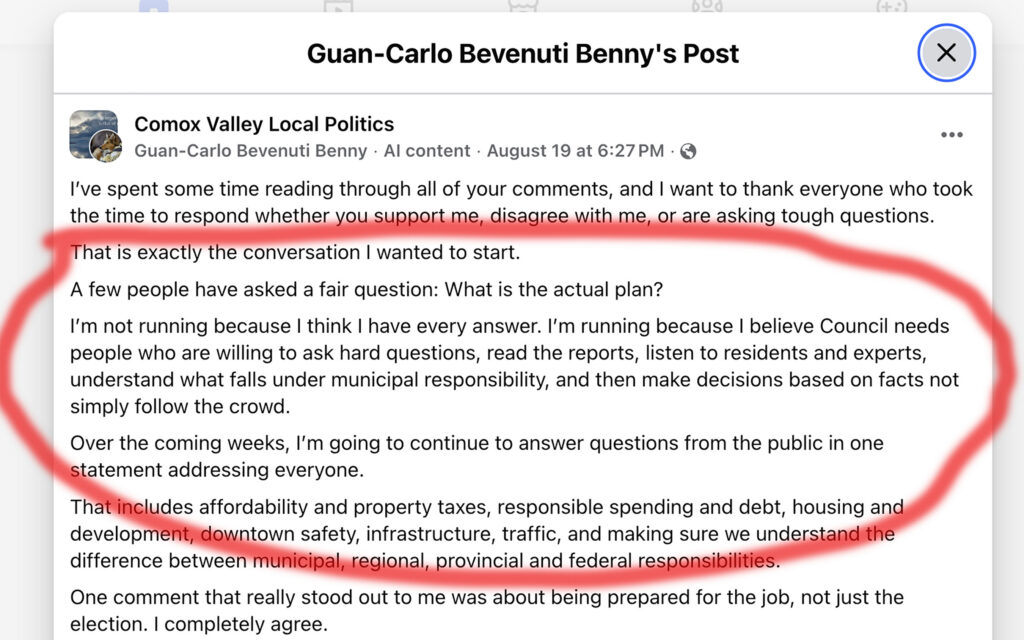
Is this plagiarism? Did some third party group write these posts for multiple candidates? Did these candidates use AI to write their posts? It’s almost certainly not a coincidence. Benvenuti’s post admits that it includes AI content. So what IS going on here? Whatever “it” is, it’s not a good look for these candidates.

BIG MONEY STINKS – We’re gagging on the prolific fake accounts and paid trolls trying to influence our local government elections, primarily for Courtenay City Council and mayor. They post angry and vacuous comments. When you click on their profile, you find nothing. A picture of a human, but no profile. No history of posts or friends. Nada. It’s just garbage littering the Internet.


ELECTION DAY OCT. 17

COMOX VALLEY CHAMBER OF COMMERCE

– Cumberland candidates. 5:30 pm on Monday, Sept. 21 at the Cumberland Cultural Centre location.

– Comox candidates. 5:30 pm on Monday, Sept. 28 at the Comox Legion.

– Courtenay candidates. 5:30 pm on Thursday, Oct. 1 at the North Island College Stan Hagen Theatre.


COMOX VALLEY SOCIAL PLANNING SOCIETY

An all-candidates forum on the social determinants of health at 5:00 pm on Tuesday, Sept. 22 at the Westerly Best Western Hotel in Courtenay.


ADVANCE VOTING INFORMATION

Polls for the Oct. 17 election will open for advance voting on Oct. 7 and Oct. 14.


SUBSCRIBE TO OUR NEWSLETTER

Enter your email address to subscribe to the Decafnation newsletter.

More

Overwhelmed by so many candidates? Just vote for the ones you know and like

For many Valley residents, it’s difficult and time consuming to gather the necessary information to make thoughtful selections in municipal elections. And paid trolls and fake posters on social media pages make it even more difficult. Public candidate forums help, but there is a simple solution for frustrated voters

Post-war attempt to ‘Run cities like a business’ by allowing sprawl failed miserably

Post-war attempt to ‘Run cities like a business’ by allowing sprawl failed miserably

Post-war attempt to ‘Run cities like a business’ by allowing sprawl failed miserably

By

This is the second in a series of articles about the City of Courtenay finances.

I t’s no secret that residents of any municipality have at one time or another accused their local government of waste, inefficiencies, senseless delays and an unfriendly attitude on the part of a public employee. It happens. That such a complex organization affecting such a broad swath of the community occasionally runs afoul of a citizen or a group shouldn’t surprise you.

But it should alarm you when those citizens, out of frustration, suggest, ”They should run our city like a business!”

That’s a battle cry usually heard during municipal elections by newcomer candidates and their supporters trying to diminish the records of the incumbent mayor and council members. And there’s a lot of social media mud-slinging going on right now about Courtenay City Council’s financial management.

But what does “Running it like a business” actually mean?

A business exists primarily to generate profits for its owners, who can grow their revenue by any legal means. Home Hardware, for example, must generate more revenue selling home improvement products than it costs to operate the business. It can add products to increase revenue and drop products that prove unprofitable in order to maximize its net profit.

In a sense, a municipality must also make a profit. Besides paying today’s expenses, a city needs funds to set aside for future known expenses and to have sufficient reserves for emergencies.

But a city’s taxes and fees should only cover the costs of providing services, including all long-term maintenance and replacement expenses. The goal is not to maximize net profits. It’s to deliver municipal services efficiently and effectively.

Maximizing profits would mean overtaxation.

So let’s dig deeper into other ways that “Running it like a business” does and does not make sense for the City of Courtenay.

The reality is that municipalities in British Columbia have no legislated authority to tax anybody, citizens or businesses. They can only do what the province allows. “We are children of the province,”


LIMITED REVENUE STREAM

Private sector businesses can create any means short of illegal activities to earn more revenue. They can increase prices, add new product lines and expand into new territories to attract more customers.

Parks and recreation centers cost more to run than user fees provide. Does running a city like a business mean the city should solicit paid signage, such as billboards on the fields or allow mall-like kiosks in public buildings?

Would you enjoy advertisements interrupting plays and concerts at the Sid Williams Theatre? How about tolls on the Fifth Street Bridge? Charging sky-high entry fees at the museum and Comox Valley Art Gallery to cover all their expenses would quickly close them down.

That’s all silly, of course, because the reality is that municipalities in British Columbia have no legislated authority to tax anybody, citizens or businesses. They can only do what the province allows.

“We are children of the province,” says Councillor Will Cole-Hamilton.

Courtenay Councillor Melanie McCollum, Cole-Hamilton and other municipal leaders across the province have asked the BC Provincial government to provide additional sources of revenue for cities and towns. They have suggested the province share a percentage of the property transfer tax or a portion of the liquor tax, arguing that both correlate to municipal planning and policing costs.

“But at this time, there’s no way for the City Council to increase revenue and lower taxes at the same time – it would be self-contradictory. Property taxes are our primary source of revenue,” says McCollum, a budget analyst at North Island College. “It would require finding a substantial industrial taxpayer for this to change in a meaningful way.”

The only avenue for additional revenue today is to apply for grants for non-operational needs from the federal and provincial governments.

Courtenay’s revenue comprises 65 percent from taxes and 35 percent from grants. Municipalities with a smaller tax base, such as Cumberland, receive about 50 percent of their revenue from grant funding.

However, the current council did increase revenue from one important source this year: Development Cost Charges (DCC).

DCCs represent a developer’s contribution toward the cost of expanding infrastructure due to growth. The process for determining the charges involves complex calculations that have to be approved by the province.

Courtenay’s DCCs hadn’t been reviewed in over a decade, so the overdue review resulted in a substantial increase.

Courtenay, Comox and Cumberland are prime examples of the ticking time bomb of unfunded liabilities for infrastructure maintenance and replacement hovering over almost every Canadian municipality


EXPAND THE TAX BASE

Those who believe a municipality should be “Run like a business” should be happy campers. For decades after the end of WWII, municipalities across Canada and the United States, tried a trick out of the private sector’s playbook to gather more revenue.

Blame it on the automobile, maybe, but municipalities embraced suburban sprawl to expand their tax base. Generating growth was needed, they thought, to accommodate the needs of the Boomer Generation and create jobs.

Municipalities enlarged their boundaries so developers could open up large tracts of single-family housing. And the cities took in a bounty of revenue from building permits, developer cost charges, other fees and, of course, property taxes.

It seemed like the perfect answer: more growth equals more municipal revenue without increasing an individual’s taxes.

But, it turns out, suburban sprawl was really a Ponzi scheme, according to Strong Towns founder Charles Marohn, the author of “Escaping the Housing Trap: The Strong Towns Response to the Housing Crisis.”

“Cities also assumed the long-term liability for servicing and maintaining all the new infrastructure … This exchange – a near-term cash advantage for a long-term financial obligation – is one element of a Ponzi scheme,” Marohn says.

“Over the life cycle, a city frequently receives just a dime or two of revenue for each dollar of liability, a ridiculously low level of financial productivity.”

Courtenay, Comox and Cumberland are prime examples of the ticking time bomb of unfunded liabilities for infrastructure maintenance and replacement hovering over almost every Canadian municipality.

But Courtenay took the first steps to defuse the crisis in BC by implementing its Asset Management Plan in 2019, immediately after the 2018 election. And then it took another bold step – any council that purposely increases taxes does so at great political risk – three years ago adding compounding tax increases over 10 years to save funds to cover all of its infrastructure liabilities.

Comox and Cumberland followed suit with their own infrastructure savings plans.

Comox Valley residents have also benefited from the Regional Growth Strategy, a shared vision to curtail urban sprawl – to avoid future infrastructure liabilities – and direct new growth to the right places to sustain the diverse economic, cultural and environmental assets of our multiple communities.

So, a post-war attempt to run a municipality like business failed miserably and current political leaders are only now providing the remedy.

The federal Liberal government has budgeted a significant increase in defense spending that includes a $3 billion upgrade at CFB Comox. Early estimates predict 700 new employees at the base (about 1,800 new residents).


POPULATION TRENDS MATTER

Today’s general economic inflationary pressures – especially from the pandemic years and recently jacked by U.S. tariffs – no doubt influence the City of Courtenay’s operational expenses. But the biggest driver of tax increases is our population growthl, according to Councillor McCollum.

“Adding population means a demand for more services, such as policing and recreation, two of the largest operational budget categories,” she said.

The City of Courtenay grew by 10.8 percent from 2016 to 2021, according to the latest census data. Comox grew by 5.5 percent and Cumberland grew by a whopping 18.5 per cent.

The three electoral areas grew, too. Area A added 9.9 percent more population, Area B added 4.2 percent and Area C added 6.8 percent.

Overall, the Comox Valley grew by 8.9 percent over the last census period. New census data, expected soon, will likely show similar or higher trends.

From 2021 through 2025, the city added an annual average of 372 new housing units, mostly apartments. Addressing the shortage of rental vacancies, developers created 491 new apartments in 2025 – nearly 80 percent of all new housing units that year – and 438 in 2022 and 443 in 2021.

The city issued 1,713 new building permits over the last five years, and approved 214 new subdivisions.

But that trend is slowing. Council received applications for only six subdivisions last year – all were approved – compared with 95 in 2021, a pattern that is consistent with a July report from the Chartered Professional Accountants of BC (CPABC).

The group’s quarterly economic report says Vancouver Island’s population growth slowed to its weakest pace in more than a decade.

“The region continued to attract new residents from elsewhere in British Columbia. That migration has been the primary source of population growth in recent years,” according to the report.

But a slowing trend isn’t likely for the Comox Valley, according to Councillor Cole-Hamilton, whose work on the executive team of the Federation of Canadian Municipalities (FCM), will help the city cope with an expected boom at CFB Comox.

The federal Liberal government has budgeted a significant increase in defense spending that includes a $3 billion upgrade at CFB Comox. Early estimates predict 700 new employees at the base (about 1,800 new residents).

CFB Comox is already urging the city and the regional district to provide more active transportation lanes (bicycling and pedestrian) and transit improvements on Ryan Road to move Canadian Forces personnel to and from the base gates.

In the past, municipalities have shouldered the burden of costly changes to accommodate DND expansion and other activities. Traditionally, those costs resulted in tax increases.

But Cole-Hamilton, who chairs the seven-member BC Caucus of the FCM, helped create the organization’s first policy on Department of Defense issues. It includes the formation of a national Defense Task Force to lobby DND to dedicate a substantial portion of its infrastructure spending to “dual use” projects – those that support the needs of both the Canadian Armed Forces and the communities that host them.

As co-chair of the national Task Force, Cole-Hamilton says he wants to ensure that municipalities like Courtenay “get a fair deal with DND.”

“Some people may think that we are not doing the math, or planning for the future,” Cole-Hamilton said. “But the facts are that we’re doing the politically hard stuff previous councils should have been doing. And we’re making important connections with other levels of government, such as my work with the FCM, that benefit the entire Comox Valley.”


ELECTION DAY OCT. 17


COMOX VALLEY CHAMBER OF COMMERCE

– Cumberland candidates. 5:30 pm on Monday, Sept. 21 at the Cumberland Cultural Centre location.

– Comox candidates. 5:30 pm on Monday, Sept. 28 at the Comox Legion.

– Courtenay candidates. 5:30 pm on Thursday, Oct. 1 at the North Island College Stan Hagen Theatre.


COMOX VALLEY SOCIAL PLANNING SOCIETY

An all-candidates forum on the social determinants of health at 5:00 pm on Tuesday, Sept. 22 at the Westerly Best Western Hotel in Courtenay.


ADVANCE VOTING INFORMATION

Polls for the Oct. 17 election will open for advance voting on Oct. 7 and Oct. 14.

SUBSCRIBE TO OUR NEWSLETTER

Enter your email address to subscribe to the Decafnation newsletter.

More

Overwhelmed by so many candidates? Just vote for the ones you know and like

For many Valley residents, it’s difficult and time consuming to gather the necessary information to make thoughtful selections in municipal elections. And paid trolls and fake posters on social media pages make it even more difficult. Public candidate forums help, but there is a simple solution for frustrated voters

Fact: Courtenay property tax burden equal or lower than most same-sized BC cities

Fact: Courtenay property tax burden equal or lower than most same-sized BC cities

Photo Caption

Fact: Courtenay property tax burden equal or lower than most same-sized BC cities

By

The first in a series of articles about City of Courtenay finances

T he dominant issues in local elections usually revolve around money. It makes sense, because municipalities rely almost exclusively on their share of the property tax to keep the community’s water taps flowing and its toilets flushing.

Property taxes are the price homeowners pay for the services the municipal government provides. And just like the cost of eggs and gas, property taxes go up every year.

Not all voters complain about their taxes – many recognize the value they receive in services like recreation, policing, garbage collection and water and sewer infrastructure – but most pay at least casual attention to the annual increase of this household expense.

However, when municipal elections roll around every four years, the property tax burden, and generally how the local government spends your money, takes a front row seat.

This is particularly true in the absence of any overriding issues. In well-run municipalities, new candidates seeking to upset the incumbent mayor and council members historically point fingers at “unnecessary spending” and make promises to “lower your taxes.”

It’s an age-old tactic. What voter doesn’t want lower taxes? But what voter also wants the downside of lowering taxes, such as park closures, reduced hours at recreation centers and pot holes going unfilled in front of their homes?

Every mayor and council member struggles with this problem: how best to balance maintaining services and making improvements with the least necessary tax increase.

It’s difficult because a community has diverse wants and needs. And also because, according to the Federation of Canadian Municipalities, local governments are responsible for 60 percent of all infrastructure in Canada but receive only $0.09 out of every dollar of taxes paid in Canada.

Nevertheless, the city finances have enveloped this year’s races for public office.

New candidates for council aligned with former councillor and mayoral candidate Manno Theos are following the “spending is out of control” and “taxes are too high” playbook to build momentum for the Oct. 17 elections.

Theos and his supporters have attacked a handful of projects undertaken over the last four years – such as the Sixth Street pedestrian and cycling bridge, a Back Road traffic circle, bicycle lanes and more – as unnecessary spending on things they believe the community doesn’t want. They also propose to cut taxes and seem to suggest that the city has too many employees who are paid too much money.

“The facts are that this council is doing the politically hard stuff that previous councils were afraid to do,” says incumbent Councillor Will Cole-Hamilton. “Even though they knew these things needed to be done”

These are valid points of view, even though their social media platforms overflow with rage-baiting posts and insulting personal comments that undermine their own credibility.

The public must accept and election challengers should respect that when voters give a mayor and council members the responsibility of deciding how to spend their taxes, they should expect that each group will do it slightly differently.

One mixture of council members might prioritize building a bridge while a different group of councillors would build a convention center. Yet another bunch might choose to spend no money on anything at all.

And it may also be true that each group could have equal amounts of support from separate parts of the community.

The real question for voters, then, is not whether money was spent on this or that, but whether the city’s finances have been managed competently.

So let’s look at some facts.

PROPERTY TAXES

To assess whether a municipality’s property taxes are high or low, the province applies its tax rate to a representative house, a median-value property sometimes called “a typical home.” This standardization makes it easy to compare the tax burden between municipalities.

It’s important to note that about one-third of the property tax total goes to schools, the regional district and hospitals. The municipality is required to collect the total tax and redistribute it.

The total 2025 residential taxes and charges on a representative house in Courtenay was $5,717. That’s lower than both Comox ($5,743) and Cumberland ($5,776).

The accompanying chart shows that Courtenay’s 2025 tax burden was slightly below the middle of similar-sized cities, and near the bottom of Island municipalities.

City of Courtenay staff chart

In the 2026 taxation data released last month, Courtenay’s taxed $6,115 on a typical house. That’s still lower than Comox ($6,121) but slightly higher than Cumberland ($6,049). Here are a few other comparisons from the provincial data, which you can see in total here.

– Langley:: $7,274
– Penticton: $6,190
– Squamish: $8,130
– White Rock: $10,015

The 2026 provincial data shows that the tax burden on Courtenay homeowners is about the same as on residents of similar communities. It’s higher than some and lower than others. It raised taxes by about the same amount as Comox and by less than Parksville.

We have not yet seen any social media rage of “unnecessary spending” in Comox or heard of any candidates there selling the “I’ll lower taxes” promise. Although it did build two controversial traffic circles this year.

If, as the data shows, the tax burden on Courtenay homeowners is not significantly different from similar communities – and it is lower than most – then the claims by some of the new candidates that the city’s taxes are unreasonably high cannot be accurate.

Perhaps Manno and the other candidates simply believe that taxes in general are too high. It’s a valid point of view, but not a fair or meaningful way to assess the city’s financial competency.


MANAGING CITY ASSETS

Municipal governments have a limited role and responsibilities. They primarily operate and maintain local infrastructure like roads, water, sewer, public works and garbage collection. They maintain and operate parks and recreation centres. They license businesses, create Official Community Plans to dictate land use and zoning. And they provide fire, police and emergency services.

Connected to those operations, the City of Courtenay has $896 million in assets, which includes water and sewer pipes, roads and parks. Much of it was created 50-plus years ago.

The city estimates that about 10 percent of these assets have been overdue for replacement.

That’s because councils prior to the 2018 election, on which Theos served, had taken a Do Nothing approach. They put off improvements and fixed things only when they broke. Emergency repairs typically cost four times more than planned maintenance.

And when they did repair or replace assets, they funded it with debt.

The Do Nothing strategy was effective in keeping tax increases temporarily and unrealistically low. But in reality those previous councils were just pushing the tax burden of unfunded liabilities onto future councils and taxpayers.

The need did not disappear. The cost just escalated.

“The facts are that this council is doing the politically hard stuff that previous councils were afraid to do,” says incumbent Councillor Will Cole-Hamilton. “Even though they knew these things needed to be done”

For example, when council first recognized that the Fifth St bridge required some repairs, federal and provincial grants would have covered two-thirds of the cost, leaving only a third for local taxpayers. But then-mayor Larry Jangula and former councillor Theos did not prioritize the project.

When the bridge repair could no longer be delayed for public safety concerns, the current council had to ask for an extension to the grant. But the cost had now doubled.

As a result, grant funding only covered one-third of the cost. Local taxpayers paid more.

The planned 2027 water metering project is another example. When it was first discussed, some 14 years ago, the cost estimate was $16 million. But then-mayor Larry Jangula again chose not to push it forward.

Now, as drier climates make water conservation necessary, the price to install meters in Courtenay has jumped to $32 million.

The ideology behind previous councils’ Do Nothing philosophy trickled down to the staff and created a corporate culture of avoiding new projects. In reality, previous councils had also kept staffing levels too low to do anything but the bare minimum.

“The days of two percent tax increases are not coming back anytime soon,” says retiring two-term Councillor Melanie McCollum. “Because to achieve that would require going back to doing nothing, stopping improvements, reducing services and cutting staff.”

The current council, most of whom were first elected in 2018, including Cole-Hamilton and McCollum, has adopted a more structured two-prong approach to financial planning over the last eight years.

They passed a comprehensive Asset Management Bylaw in 2019 and later created a Strategic Infrastructure Investment Program (SIIP).


ASSET MANAGEMENT BYLAW

Courtenay was the first city in British Columbia and the second in all of Canada to enact an Asset Management Bylaw. Councillor Cole-Hamilton introduced the motion immediately after taking office.

The bylaw, which only impacts new projects, directs council and city staff to explicitly consider full life-cycle costs — including planning, procurement, creation, operation, maintenance, renewal and decommissioning — when making decisions regarding the acquisition, upgrade or replacement of Tangible Capital Assets.

And it mandates the evaluation and consideration of natural assets (for example, wetlands, urban forests, natural drainage pathways) alongside or as alternatives to traditional engineered and constructed infrastructure wherever feasible.

“The goal of asset management is achieving sustainable service delivery: ensuring that current community services are delivered in a socially, economically, and environmentally responsible manner that does not compromise the ability of future generations to meet their own needs,” said former Chief Administrative Officer David Allen in 2019.

Since then, Courtenay has based its capital budget on up-to-date detailed information about what assets have failed and which are projected to fail within two years. It’s complicated work using a computerized system the city developed to help operate all the existing assets for the longest possible time and the lowest possible cost over their lifespan.

“Managing our assets involves identifying all the renewal needs, planning the work to avoid disruption of service and having a long-term financial strategy to pay for it,” Cole-Hamilton said.

“This means tax increases sometimes but it heads off bigger financial problems and potentially huge tax increases down the line.”


STRATEGIC INFRASTRUCTURE INVESTMENT PROGRAM

In addition to the Asset Management Bylaw, the city created a Strategic Infrastructure Investment Program (SIIP) three years ago to address its annual asset renewal shortfall of nearly $9 million.

The program’s goal is to set aside funds to maintain the $896 million of assets that already exist. So that when roads, water lines and other assets need repair or replacement the city can avoid massive borrowing that creates debt.

The general rule for municipal infrastructure expenses is 80/20. The initial cost is 20 per cent and the operation, maintenance and replacement is 80 percent over the assets’ lifetime.

To save this money, the city began adding a 1.5 per cent tax increase three years ago that will grow incrementally and compound – 1.5 percent the first year, 3.0 in the second, 4.5 in the third and so on – each year for 10 years. Then the fund will be large enough to maintain its existing infrastructure without borrowing.

“The goal is to not borrow from the future to pay for fixes today,” said McCollum. “People who are using an asset should pay the cost of eventually repairing or replacing that asset when it wears out.”

With these two key initiatives, this council has created a structured work plan, for the first time in decades. McCollum says it took political courage to do, because nobody wants to pay more taxes, “but everybody wants a well-run and maintained city.”

Councillor Doug Hillian, a 17-year council veteran, says any candidate promising to lower taxes must identify what services and which staff they are planning to cut, “because the cost of running a city goes up with the cost of living” higher taxes are necessary each year to maintain the existing level of services.

“People are moving to the Comox Valley to escape wildfire smoke or extreme weather in other places, so the taxes here don’t seem to be an issue,” Hillian says. “In fact, taxes here are the same or lower than where they came from and our taxes are comparable to similar sized communities around the province.”


NEXT: Can municipalities be run like a business? And, later, a look at Courtenay’s Capital Plan and its debt.


KEY ELECTION DATES

Candidate filings end this Friday, Sept. 11. Click our Candidate post for the updated list.

Sept. 11 — candidate filing deadline

Sept. 19 — campaigns can officially begin

Oct. 7 — advance voting begins.

Oct. 14 — a second advance voting opportunity

Oct. 17 — Election Day


SUBSCRIBE TO OUR NEWSLETTER

Enter your email address to subscribe to the Decafnation newsletter.

More

Overwhelmed by so many candidates? Just vote for the ones you know and like

For many Valley residents, it’s difficult and time consuming to gather the necessary information to make thoughtful selections in municipal elections. And paid trolls and fake posters on social media pages make it even more difficult. Public candidate forums help, but there is a simple solution for frustrated voters

The FINAL candidates for the 2026 local elections

The FINAL candidates for the 2026 local elections

Photo Caption

The FINAL candidates for the 2026 local elections

By

H ere is the final list of candidates who have filed local government positions this year. Nominations are now closed.


Key: ♻️ Re-running | 🆕 New candidate
Facebook followers listed where available


🏙️ CITY OF COURTENAY

Mayor — 3 candidates:

♻️ 👤 Bob Wells
https://mayorbobwells.ca/ | https://www.facebook.com/MayorBobWells (1,429)

🆕 👤 Trish McPhail
https://www.facebook.com/profile.php?id=61594360798780 (99)

🆕 👤 Manno Theos
https://www.facebook.com/manno.theos (Personal)

Council — 20 candidates (6 seats):

♻️ 👤 Will Cole-Hamilton
https://www.willcolehamilton.ca/ | https://www.facebook.com/WillForCourtenayCouncil (600)

♻️ 👤 David Frisch
https://www.facebook.com/ElectDavidFrisch (439)

♻️ 👤 Evan Jolicoeur
https://evanjolicoeur.com/ | https://www.facebook.com/evanjolicoeur2026 (956)

♻️ 👤 Wendy Morin
https://www.wendymorin.ca/ | https://www.facebook.com/profile.php?id=100067508774609 (828)

🆕 👤 Phil Adams
https://www.facebook.com/profile.php?id=61573324320206 (498)

🆕 👤 Vasil Beaton
No campaign links

🆕 👤 Guancarlo “Benny” Benvenuti
https://www.facebook.com/guancarlo.benvenuti/ (Personal)

🆕 👤 Rosanna Chamberlin
https://www.facebook.com/rosanna.chamberlin/ (Personal)

🆕 👤 Dick Clancy
https://www.facebook.com/dick.clancy.2025 (Personal)

🆕 👤 John Dacombe
https://johndacombe.ca/ | https://www.facebook.com/profile.php?id=61593266858598 (12)

🆕 👤 Erik Eriksson
https://erikeriksson.ca/ | https://www.facebook.com/ErikErikssonForCouncil (62)

🆕 👤 Jessie Lightburn
https://www.facebook.com/profile.php?id=61593097444849 (32)

🆕 👤 Jin Lin
https://www.facebook.com/jinlinforcouncil (165)

🆕 👤 Kelly Matthews
https://kellyscottmatthews.nationbuilder.com/

🆕 👤 Thomas McDevitt
No campaign links

🆕 👤 Dave Mellin
https://www.linkedin.com/in/dave-mellin-0b477843/

🆕 👤 Kitty Pitt
https://www.facebook.com/profile.php?id=61579177443015 (Personal)

🆕 👤 Davina Singh
https://www.facebook.com/profile.php?id=61593965494237 (94)

🆕 👤 Kam Singhania
https://www.facebook.com/p/Kam-Singhania-for-Courtenay-Council-61594269334218/ (4)

🆕 👤 Darin Tufts
https://www.facebook.com/darin.tufts (Personal)

School Trustee Area 1 — 3 candidates (2 seats):

♻️ 👤 Shannon Aldinger
https://www.facebook.com/shannon.aldinger.2025 (Personal)

🆕 👤 Kendall Packham
No campaign links

🆕 👤 Maria Sanchez
No campaign links


🌲 VILLAGE OF CUMBERLAND

Mayor — Uncontested:

♻️ 👤 Vickey Brown
https://www.facebook.com/VickeyforCumberland/ (593)

Council — 7 candidates (4 seats):

♻️ 👤 Neil Borecky
https://www.facebook.com/profile.php?id=100085326682059 (110)

♻️ 👤 Sean Sullivan
https://www.facebook.com/electseansullivan/ (577)

♻️ 👤 Troy Therrien
https://www.votetroy.ca/ | https://www.facebook.com/votetroytherrien (151)

♻️ 👤 Nick Ward
https://nickforcumberland.ca/ | https://www.facebook.com/nickforcumberland (176)

🆕 👤 Zanoni Agnew
https://www.facebook.com/people/Zanoni-Agnew-for-Cumberland-Council/61591297644757/ (46)

🆕 👤 Ellian Bell
https://ellianbell.com/ | https://www.facebook.com/profile.php?id=61594113788357 (250)

🆕 👤 Kevin Snaden
http://www.snaden.ca/

School Trustee — Uncontested:

🆕 👤 Laurel Rankin
Pending


🌊 TOWN OF COMOX

Mayor — Uncontested:

♻️ 👤 Nicole Minions
https://www.facebook.com/comoxforgenerations/ (1,158)

Council — 11 candidates (6 seats):

♻️ 👤 Steve Blacklock
https://steve4comox.ca/ | https://www.facebook.com/Steve4Comox (364)

♻️ 👤 Ken Grant
https://www.facebook.com/ken.grant.54/ (Personal)

♻️ 👤 Chris Haslett
https://www.facebook.com/chris.haslett1

♻️ 👤 Dr. Jonathan Kerr
https://www.facebook.com/HealthyComoxBC (382)

♻️ 👤 Jenn Meilleur
https://www.jennmeilleur.com/ | https://www.facebook.com/civicjenn (57)

♻️ 👤 Maureen Swift
https://www.facebook.com/maureen.swift.16/ (Personal)

🆕 👤 Lisa Bourgeois
https://lisaforcomox.ca/ | https://www.facebook.com/profile.php?id=61593636885380 (74)

🆕 👤 Vivian Chislett
https://www.linkedin.com/in/vivian-chislett-65859359/

🆕 👤 Neil Ladell
https://neil4comox.ca/ | https://www.facebook.com/profile.php?id=61594386715622

🆕 👤 Ruby Sidhu
No campaign links

🆕 👤 Jessica Wegg
Pending

School Trustee — 2 candidates (1 seat):

🆕 👤 Bruce Curtis
No campaign links

🆕 👤 Jennifer Fisher
https://www.facebook.com/jennifer.fisher.1227 (Personal)


🗺️ CVRD ELECTORAL AREA A — Baynes Sound / Denman & Hornby Islands

Director — Uncontested:

♻️ 👤 Daniel Arbour
https://danielarbour.ca/ | https://www.facebook.com/danielarbour.ca (1,035)

School Trustee (Area 4) — Uncontested:

♻️ 👤 Chelsea McCannel-Keene
No campaign links


🗺️ CVRD ELECTORAL AREA B — Lazo North

Director — 2 candidates (1 seat):

♻️ 👤 Richard Hardy
https://www.facebook.com/profile.php?id=100085505266263

🆕 👤 Arzeena Hamir
https://www.arzeena.ca/ | https://www.facebook.com/arzeena.hamir (1,342)

School Trustee (Area 5) — Uncontested:

♻️ 👤 Michelle Waite
https://www.facebook.com/MichelleWaiteTrusteeforAreaB (224)


🗺️ CVRD ELECTORAL AREA C — Puntledge / Black Creek

Director — 3 candidates (1 seat):

🆕 👤 Gillian Anderson
https://www.facebook.com/gillian.anderson.96155

🆕 👤 Ariel Becherer
https://www.facebook.com/profile.php?id=61592000729860 (46)

🆕 👤 Norm McPhail
https://www.facebook.com/NormMcPhailCandidateforAreaC2026ComoxValley (104)

School Trustee (Area 6) — 2 candidates (1 seat):

🆕 👤 Nicole Bergot
https://www.facebook.com/nicolebergot

🆕 👤 Nat Raedwulf Pogue
(No social media found)


🏝️ ISLANDS TRUST — DENMAN ISLAND

Trustee — 4 candidates (2 seats):

♻️ 👤 Sam Borthwick
(No social media found)

🆕 👤 Perri Gorrara
https://www.facebook.com/perri.gorrara

🆕 👤 Steve Hawkins
https://www.facebook.com/stephen.hawkins.545

🆕 👤 Noah Ross
https://www.facebook.com/noah.rass.777


🏝️ ISLANDS TRUST — HORNBY ISLAND

Trustee — 6 candidates (2 seats):

♻️ 👤 Alex Allen
(No social media found)

🆕 👤 George Buvyer
https://www.facebook.com/profile.php?id=61594452624220

🆕 👤 Ronaldo Cruz
https://www.facebook.com/cruzronaldo

🆕 👤 April Lewis
https://www.facebook.com/april.lewis.7902

🆕 👤 Pat Mullan
https://www.facebook.com/pat.mullan.3

🆕 👤 Jeffrey Rabena
https://www.facebook.com/jeffrey.rabena


Advance polls open on Oct. 7

Come here for advance voting times and locations for each jurisdiction

SUBSCRIBE TO OUR NEWSLETTER

Enter your email address to subscribe to the Decafnation newsletter.

Overwhelmed by so many candidates? Just vote for the ones you know and like

Overwhelmed by so many candidates? Just vote for the ones you know and like

Photo Caption

Overwhelmed by so many candidates? Just vote for the ones you know and like

By

B y the end of next week, Comox Valley residents will know who is officially running for local government offices in our three municipalities, the three regional electoral areas, School District 71 and the Islands Trust.

In the last municipal elections of 2022, there were a total of 57 candidates seeking the 31 local elected offices – seven in Courtenay and Comox, five in Cumberland, seven on the school board, three regional district area representatives and two for the Denman/Hornby Island trust area.

That’s a lot of candidates for voters in each voting jurisdiction to assess. In 2022, there were 14 candidates seeking the seven School District 71 positions alone, and another 18 for Courtenay City Council.

For many Valley residents, it’s just too much work and too confusing to gather the necessary information to make thoughtful selections. It could partly explain why only 30 percent of eligible voters turn out for local government elections.

With no single source of information about each individual candidate – such as comprehensive news media coverage – some eligible voters don’t bother casting a ballot. Others rely on conversations with their friends and neighbors.

Perhaps the best advice for voters is the simplest: You do not have to vote for candidates to fill all the vacant seats.

In response to last week’s pre-election article in Decafnation, subscriber Dede Fitton expressed this wide-spread frustration.

“To be serious, I live in Courtenay and I don’t know how any voter can sort through the “debates” on local (social media) forums. I’d like to make casting an informed vote easier but damned if I can figure out how.

“I think I should keep an open mind about new candidates. And a critical look at present council members. Now, how do I do that? I don’t follow council meetings.
I also know that most of a council member’s job is performed on committees and in the community, not at the public meeting.

“I wish there were criteria for candidates. Even more, I wish there were criteria for voters! (Tongue firmly in cheek).”

Ms. Fitton has identified the main obstacle facing Valley residents seeking factual information about individual candidates: Absent robust election coverage in the Comox Valley Record or the local radio stations’ news websites, people often resort to the Facebook pages devoted to local municipal politics.

But that almost never helps because although some people try to post factual information, they are usually overrun by paid trolls, bots and people hiding behind fake names. The pages are dominated by people who really just want to rant about one thing or another without adding anything useful to the conversation.

For example, when incumbent Courtenay Councilor Wendy Morin recently announced she is running again, her post was greeted with vile comments. Mark Jackson wrote, “No fing way. 18% tax increase a few years back cause (sic) of her. Sooner vote for a dog.” Jonny Valentine wrote, “We need to clean all these usless (sic) politicians out of city hall. Not voting for this chick for sure.”

Both Jackson and Valentine appear to be fake names on empty FB accounts. They might be bots or trolls paid by organizations determined to defeat forward-thinking council candidates.

There are only two elector organizations registered for the Comox Valley with Elections BC. One is the Conservative Electors Association run by David Denhoff, of North Vancouver, and the other is ParentsVoice BC, run by Marc Vella, of Langley.

ParentsVoice BC is a new BC party pushing school board candidates with anti-vaxx and conspiratorial views, per CBC news. Their slogan “Take Back Our Schools” translates to opposing education programs on health, racism, gender and sexuality.

For these reasons, sitting council members, school trustees and mayors generally avoid engaging in social media frenzies. It’s unfortunate, because without these online harassments and personal attacks, people could be getting factual information directly from their local government representatives.

So, how should voters assess this year’s candidates?

Perhaps the best advice for voters is the simplest: You do not have to vote for candidates to fill all the vacant seats.

If you have found a few candidates that you believe will represent you well, just vote for them. Period. You already have all the information you need to cast a thoughtful ballot.

It’s not necessary to fill the ballot with six council members plus the mayor. Just show up and cast a vote for the two or three or four who seem capable. Voting for only three or four candidates makes a perfectly valid ballot.

For many, the overwhelming part is getting a grasp on every candidate instead of just identifying a few worthy of support.

To help people do that, the Comox Valley Chamber of Commerce has scheduled three distinct candidate forums in late September.

– A forum for Cumberland candidates at 5:30 pm on Monday, Sept. 21 at the Cumberland Cultural Centre location.

– A forum for Comox candidates at 5:30 pm on Monday, Sept. 28 at the Comox Legion.

– A final forum for Courtenay candidates at 5:30 pm on Thursday, Oct. 1 at the North Island College Stan Hagen Theatre.

The Comox Valley Social Planning Society will also host an all-candidates forum specifically on substance abuse strategies at 5:00 pm on Tuesday, Sept. 22 at the Westerly Best Western Hotel in Courtenay. Candidates are being invited to meet the public starting at 4:00 pm.

There are rumours that Project Watershed and the NIC student union may hold candidate forums. In the past, there have been election events at Gladstones Brewing Co. in Courtenay and at some of the senior assisted living facilities.

That’s not much, but maybe the Record newspaper will engage more deeply during this election cycle. And Decafnation readers can read our upcoming Candidate Survey to compare individual responses.


WHO HAS OFFICIALLY FILED FOR OFFICE

Here’s a current list of who has filed or declared to run for local government positions this year. Nominations will close Sept. 11. For an updated list, see our separate post, which is updated several times every day.

COURTENAY
Bob Wells — Mayor, incumbent
Will Cole-Hamilton — Council, incumbent
Wendy Morin — Council, incumbent
David Frisch — Council, incumbent
Evan Jolicoeur — Council, incumbent
Manno Theos — Mayor
Dick Clancy — Council
Phil Adams — Council
Guancarlo “Benny” Benvenuti — Council
Rosanna Chamberlin — Council
Erik Eriksson — Council


CUMBERLAND
Troy Therrien — Council, incumbent
Vicky Brown — Mayor, incumbent
Nick Ward –Counmcil, incumbent

TOWN OF COMOX
Nicole Minions — Mayor, incumbent

CVRD ELECTORAL AREAS
Daniel Arbour — Electoral Area A, incumbent
Rich Hardy, Electoral Area B, incumbent
Arzeena Hamir — Electoral Area B
Ariel Becherer — Electoral Area C
Norman McPhail – Electoral Area C

ISLANDS TRUST
Sam Borthwick — Denman, incumbent
Perri Gorrara — Denman


SUBSCRIBE TO OUR NEWSLETTER

Enter your email address to subscribe to the Decafnation newsletter.

More

Will Manno Theos win Courtenay in vote split? And are these candidates using AI?

What’s going on in this year’s local government elections? More candidates. More women candidates. Another possible vote split in Courtenay to favor the underdog. Many long-time veterans still hanging on. Fake social media posters and other trolls. And suspicions surfacing of plagiarism or AI use in candidate statements. Looks like a wild four-week ride. Buckle up!

Overwhelmed by so many candidates? Just vote for the ones you know and like

For many Valley residents, it’s difficult and time consuming to gather the necessary information to make thoughtful selections in municipal elections. And paid trolls and fake posters on social media pages make it even more difficult. Public candidate forums help, but there is a simple solution for frustrated voters

“Liberal Rush” tricked voters in NDP ridings and exposed an electoral system flaw

Despite the positive big picture outcome, this election exposed a glaring vulnerability within our electoral system. And that vulnerability caused otherwise smart people to forget how our Canadian parliamentary system actually works. Namely: We do not have a proportional representation form of government. But there is a simple solution.