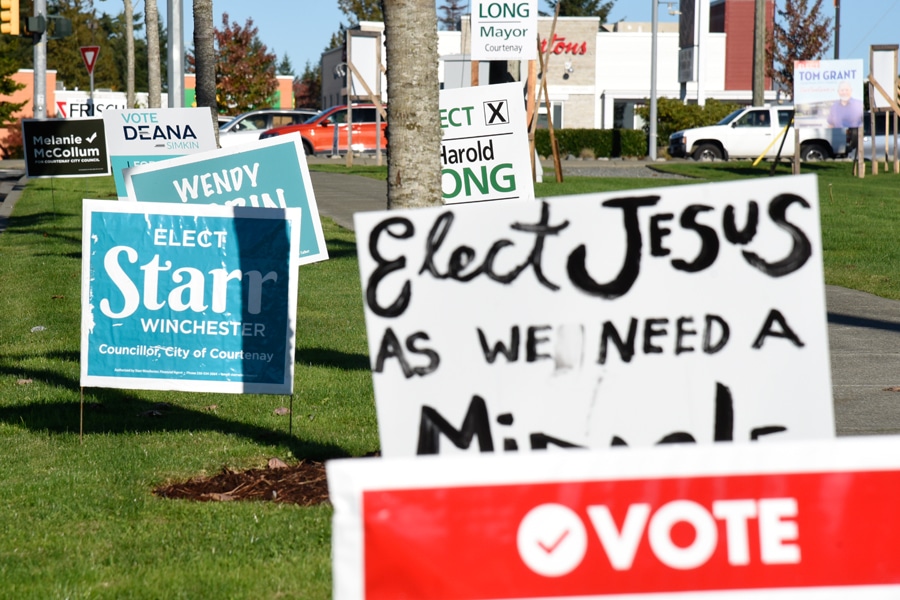
There’s a youth movement in Comox Valley politics and Decafnation supports it. Former council members have had their chance. It’s those who must live with the impact of decisions tomorrow who should have the opportunity to make them today
Unlike the federal and provincial political scene where parties and candidates start positioning themselves months, even years, before Election Day, candidates for local government often don’t announce until the filing deadline.
That gives most candidates only six weeks to make their appeals. And because all-candidate forums tend to occur in the final days of the campaign, voters have to make up their minds quickly.
Decafnation has tried to complement the Comox Valley’s private news media this year. We’ve published profiles of most candidates based on in-person interviews. We have not merely published their press releases.
And most of the candidates have collaborated with us, sitting for interviews, responding to our questionnaires, taking our follow-up phone calls. Those interactions have played a crucial role in determining which candidates Decafnation recommends today, the first day of advance voting.
We have generally supported qualified younger candidates because the future belongs to them. They are the ones who will have to live with the decisions our local governments make today.
We were surprised by the number of former Courtenay City Council members from the 1980s, 1990s and 2000s who have tried to make a come-back. Decafnation appreciates their former service, but respectfully suggests they had their turn. It’s time to let go.
We’re encouraged by the number of youthful candidates seeking office this year. Even the Town of Comox has four under-40 candidates. This level of civic engagement bodes well for the whole Comox Valley.
Decafnation realizes that some readers won’t agree with all of our choices. So we’ll say it again: persuasion is not our objective. We only hope to stimulate thought and civil debate.
We admire and congratulate everyone who’s stood for election. It takes courage and a love of community.
Decafnation will offer its recommendations for mayors, council members and regional district rural directors tomorrow, on the first day of advance voting in the 2018 municipal elections. But persuasion is not the objective
A gradual decline in daytime temperatures, the return of drizzling skies and a knock on your door by strangers handing you brightly colored brochures can only mean one thing: the fall election season is baaaaack.
Decafnation has met with most candidates running in this year’s elections for council and mayor positions, and tomorrow — the first day of voting at advance polls — we will offer our recommendations.
There is some debate within the journalism profession about the value of political endorsements. Research on the topic is almost non-existent, but some years ago the Annenberg Public Policy Center found that a measly 11 percent said media endorsements played “somewhat” of a role in their voting decision.
But of that 11 percent, about a quarter were mistaken about which candidate their newspaper had actually endorsed.
So, why endorse candidates?
Decafnation has no delusion that people will change their opinion of the candidates after they read our recommendations. Persuasion is not the objective.
Decafnation thinks of itself as a good citizen. We engage in civic affairs. We care. Nearly every week of the year, we offer commentary on topics ranging from how to fix our sewerage and traffic problems to why Justin Trudeau should keep his shirt on.
Wouldn’t it seem odd to suddenly have no opinion whatsoever about the most important event of all: electing our local governments?
But first, let’s be clear about something. Most of the time, Decafnation is me, one person, although Decafnation does have an informal advisory board and a few infrequent contributors.
These endorsements are based on my private meetings with the candidates, one-on-one interviews with them and my own unique vantage point of having covered the issues and the candidates.
I have also reached out for input from leaders of community organizations and other people I respect, including many whose views often run contrary to my own. In that sense, the endorsements are a collective effort.
Decafnation’s recommendations are meant to stimulate interest and debate, and perhaps to help you crystallize your own thoughts, whether you agree or disagree with our choices.
Most importantly, we’re cheerleading for the democratic process and what local elections are really all about: good governance.
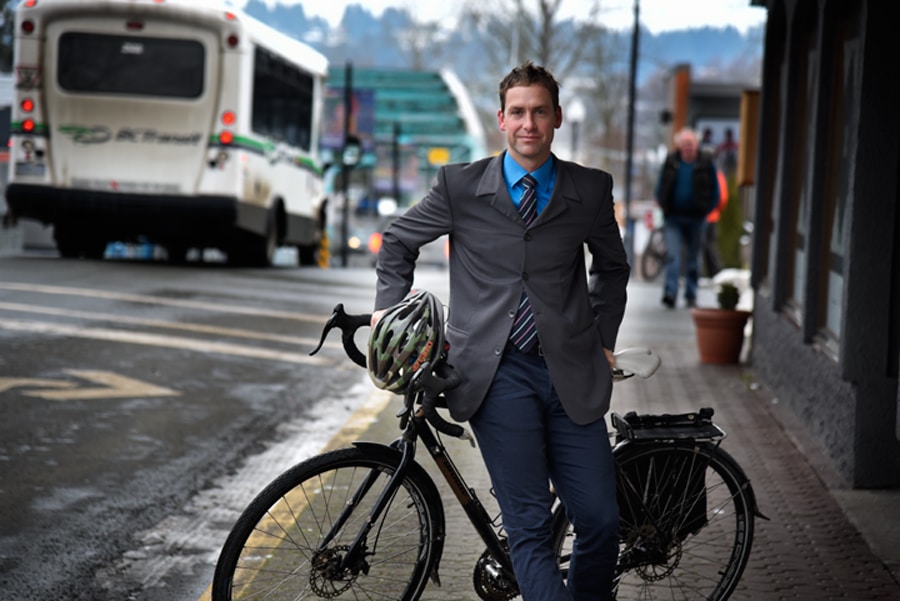
PHOTO: Courtenay Councilor David Frisch will seek a second term to finish work on transportation, zoning and the city’s downtown core (See story below)
With just 257 days before Comox Valley voters choose the 29 elected officials who will run local governments and school district through 2022, only a few people have declared their candidacy.
That’s not unusual for this community, where candidates historically wait until summer to announce they are running. But it’s not the norm in other communities.
In the Capital Regional District, for example, most of the 13 incumbent mayors have announced their plans to stand for re-election.In a Decafnation survey of the Valley’s three municipalities, only four incumbents say they definitely plan to seek office again: Courtenay’s Erik Eriksson and David Frisch, Comox Valley Regional District Area B Director Rod Nicol and School District 71 Board Chair Janice Caton.
Courtenay Mayor Larry Jangula said his decision whether to run again weighed on several factors.
“It is far too early to make any decisions now,” he said. “I will make my mind up in the summer.”
In reference to City Council member Eriksson, who announced in October that he would seek Jangula’s mayoralty seat, the incumbent said, “It is very distracting when people indicate they are running a year away from an election. It takes everyone’s mind away from what they are doing and it politicizes every decision made at Council.”
Jangula said his decision will be based on a number of factors including his wife’s health, his health and “an examination of who might be running.”
Eriksson said, “I just had to get my campaign started. It takes time to put together a successful support team for the mayor’s office.”
Courtenay councilor Rebecca Lennox said she’s undecided.
“The opportunity to serve on council has been life-changing and I am so honoured to have had this experience,” she said. “Being diagnosed with cancer half-way through this term has definitely changed many things for me.
“At this point I am undecided whether I will run for a second term, and will see how I feel and how my results are looking nearer the time.” she said.
Cumberland’s Roger Kishi says he’s leaning toward running, but will decide in the spring.
Jesse Kelter, also a Cumberland councillor, said she has not decided “one way or the other about running in the next election.”
“As you can imagine, as a parent of young children and a professional it is a very tricky balance to give so much time to Council and all the committees that go along with it,” she said. “I have a lot of things to weigh ….”
School District 71 Trustee Cliff Boldt said he and his wife, Maureen, were mulling over a re-election bid, but that there were “lots of considerations.” He hasn’t decided yet.
Former NDP hopeful for the provincial Comox Valley riding, Kiyoshi Kosky said he’s also considering a run at municipal office.
David Frisch hopes to finish zoning, transportation work
First-term Courtenay Council Member David Frisch didn’t originally intend to seek a second term.
“I thought I would do a shift,” he said. “But I discovered it takes so long to do things; I’d feel like I was quitting now. There’s a lot of work to do.”
In his first term, Frisch has focused on two primary issues: zoning and transportation.
“That’s the core of what we do,” he said. “The roots of what we have today go so far back, to the Joseph McPhee layout of the city in the late 1800s, that it’s a big weight to move now.”
But Frisch believes the current council has made dramatic and positive shifts in the city’s direction. He points to the fact that council now approves all development applications and questions the value of each application to the city’s future and the Regional Growth Strategy.
He sees his role in supporting that shift in direction as one of the accomplishments of his first term.
“We’ve steered developers toward multi-unit projects and opened the door to secondary suites,” Frisch said. “There’s no easier or better mechanism to get affordable housing.”
Frisch has championed the creation of multi-use lanes. Three years ago, he pushed for protected bike lanes on Willemar Avenue, which is a corridor for three public schools. But he couldn’t move council at the time, “It was too progressive for them.”
But three years later, those bike lanes are in the transportation plan.
Frisch sits on the Comox Valley Regional District Integrated Resource Transportation Select Committee whose two main goals are: one, to create a multi-use path for bicycles, scooters and walkers along the Dyke Road; and, two, to establish a single point of contact for future transportation initiatives between municipalities.
If he’s re-elected next fall, Frisch says he will pursue more transportation and zoning solutions. He’s particularly excited about creating a scooter/cycling plan to help people move through all of west Courtenay. He envisions a grid of pathways connecting Willermar, Fitzgerald and Cliffe avenues.
And he’s not limiting his transportation vision to traditional infrastructure. Frisch believes the city can have important transportation corridors that aren’t on existing roadways. He points to the Rotary Trail alongside the E&N rail tracks and the Courtenay River Trail as examples of alternate ways for people to move around their community.
After becoming engrossed in these issues and seeing how long it takes to make progress, Frisch admits the work “might take a lifetime to do.”
But for now, he’s simply committing himself to serve a second term.
Photo: A view of Allen Lake, in the Perseverance Creek watershed. Courtesy of the Village of Cumberland.
While Courtenay and Comox residents suffer through another boil-water advisory this week, clear and drinkable water flows freely in the Village of Cumberland.
For Cumberland Mayor Leslie Baird that fact alone justifies her council’s decision to not join the Courtenay-Comox water system. But she also likes to point out that the village will save millions of dollars for its taxpayers.
Because while those other Comox Valley elected officials search for the financing to build a $110 million water filtration plant, Cumberland has already received a $4.9 million grant to fund the $6 million first stage of its long-term water quality and supply system improvement plan.
Joining the Courtenay-Comox system would have cost Cumberland taxpayers $26.7 million upfront and annual operating costs of $600,000.
Bringing their own system up to current provincial standards will cost $6 million now (80 percent funded by the provincial Clean Water, Wastewater fund), another $6.5 million for further improvements through 2066, and annual operating costs of $255,000.
It was a clear-cut financial decision, Mayor Baird said, and it provides the village with water security for the next 50 years.
How the water system works
Cumberland Manager of Operations Rob Crisfield said the village’s water supply comes from five lakes in two separate watersheds — Allen Lake in the Perseverance Creek watershed, and Hamilton, Stevens and Henderson lakes and Pond. No. 2 in the Cumberland Creek watershed.
The five lakes in two watersheds that comprise the Cumberland water supply. The village has a license for future use of Vanwest Lakes.
A deep well drilled in Coal Creek Historic Park opened in 2013. It adds a groundwater supply to the watersheds’ surface water sources.
The system operates on nine water licenses, some issued as early as 1897, and serves Cumberland and everyone in the Royston water service area. The village owns all of the land around the lakes, but not all of the land in the watersheds.
That means the system is less susceptible to harmful logging practices in terms of the turbidity issue that plagues the Courtenay-Comox system. Cumberland has not issued any boil-water advisories.
However, some of the infrastructure in the hills above the village is more than 100 years old. While it’s been maintained well, many upgrades are necessary and underway.
Henderson Lake has the lowest elevation of the four lakes in the Cumberland Creek watershed, so its outflow makes the connection to the village’s water supply. It merges with a line from Allen Lake.
Where water lines from the two watersheds come together, the water is treated with chlorine. It then descends down to Cumberland via a single, one kilometer long 300 mm diameter pipe, before splitting again into two main trunk lines servicing different parts of the village.
What’s happening now
The village is installing a second “twinned” 300 mm pipe so it can regulate the flow from each watershed based on the amount of water stored in the lakes. That work should finish in mid-December.
Future work will include adding a new facility that will provides both UV and chlorine treatment. It will also switch from chlorine gas to sodium hypochlorite, which poses fewer risks for operators.
The village will also construct two new reservoirs to increase water storage capacity. One will go out to tender in the spring, along with the new UV treatment facility. The second reservoir will be built by the year 2040.
Sediment washing into Comox Lake through Perseverance Creek after a major rain event in 2014
Crisfield said the village will repair and replace some of its dams, most importantly the Pond No. 2 dam, which failed in December of 1972, causing a washout of the Henderson Lake dam. Both the Henderson dam and No. 2 dam were rebuilt in 1973, with a spillway out of Cumberland Creek watershed and into Perseverance Creek.
It was this spillway that undercut a kilometer-long 50-foot high bank during a major rain event in 2014. The ensuing slide washed sentiment, including clay particles, into Perseverance Creek and ultimately into Comox Lake, the source of drinking water for Courtenay and Comox. Following the slide, a the Comox Valley Regional District issued a boil-water advisory for Courtenay-Comox residents that lasted 49 days.
Crisfield said other dams will get either seismic stabilization, such as Stevens Lake did in 2014, or be completely rebuilt over time to meet the Canadian Dam Safety Guidelines in future years.
How residents benefit
When all the projects are completed, Cumberland and Royston will have a secure supply of water through 2066 that meets B.C. Drinking Water Guidelines. The more reliable and controllable system will reduce risks to human life, the water supply and the environment from a major earthquake.
The village was able to lift its moratorium on development in 2014 after opening the Coal Creek deep groundwater well.
It will surprise some that Cumberland is the fastest growing community in the Comox Valley. According to the 2016 Census statistics, the village grew by 5.6 percent to 3,600 residents. That beats Courtenay, Comox and all three regional districts, which each grew by 4.7 percent.
It’s even more surprising that during that same period of growth, Cumberland has reduced its demand for water by 41 percent, according to the June 2016 study by Koers & Associates Engineering Ltd. Cumberland residents used 49 percent less water and Royston residents used 17 percent less.
The lower water usage resulted from a new rate structure and the installation of water meters at all residential and commercial connections. People just naturally used less water. And the meters revealed many service leaks, which have been repaired.
Crisfield said once all these surface supply improvements are in place, Cumberland will have improved redundancy and reliability on water delivery, improved water quality and greater flexibility in how they can operate the supply system.
What’s next
The biggest challenge confronting Cumberland is how to rebuild the Pond No. 2 dam; specifically where to direct its spillway. If it goes toward Cumberland Creek, it could affect water quality in the village’s system. If it goes into Perseverance Creek, it could erode more sediment into Comox Lake. Crisfield hopes that a study underway by Tetra Tech consulting engineers, of Nanaimo, will find a solution to that problem.
Meanwhile, Crisfield is interested in the possibility of generating hydroelectricity by adding turbines into the system’s water lines. Due to the large elevation drop, there may be sufficient pressure to power the water treatment operations.
For nearly three years, a group of rural Comox Valley citizens has warned the Courtenay-Comox Sewage Commission about the environmental and financial risks of building a sewage pump station on a small Croteau Beach lot.
They’ve spent their own money on independent hydrology and financial experts to support their concerns, and have pointed commissioners toward less expensive and more effective alternatives.
But the commission — primarily the Town of Comox delegates — has consistently turned a deaf ear.
However, all the commissioners heard the message contained in five separate reports on Oct. 24 that collectively validated most of the citizens’ concerns about the project. The message was clear: Beech Street is too expensive and poses too many risks.
So they quickly and unanimously supported a staff recommendation to shelve the Comox No. 2 pump station in favor of three new alternative solutions.
That left several Comox commissioners scrambling to explain why they’ve spent so many taxpayers dollars and staff time on a project they never thoroughly vetted before purchasing real estate, and how they neglected to undertake the studies recommended by their 2011 Sewage Master Plan.
Those studies have now been completed, including a lengthy report from Opus International Consultants that evaluates the 12-year-old plan to decommission the section of sewer pipe on Balmoral Beach, below the Willemar Bluffs. It was feared that wave action and other forces might cause it to fail and create an environmental crisis.
So, with less urgency to remove the Balmoral Beach pipe, Opus has recommended the commission take another 12 months starting in January 2018 to analyze and investigate three better solutions than the ill-considered plan to build a new pump station on Beech Street.
Comox Valley Regional District staff will report back to the commission in January 2019 and make recommendations to restart the project.
The citizens left the Oct. 24 meeting feeling vindicated, but still frustrated by regional district policies that can deny residents affected by infrastructure projects the right to be represented at the decision-making table.
Four new options
Opus consultants have recommended removing the main Courtenay-Comox sewer pipe from intertidal zones due to multiple and significant environmental risks, and relocating it to an overland route — the inland side of Dyke Road — from the Courtenay No. 1 pump station through Comox enroute to the wastewater treatment plant on Brent Road.
They proposed four overland options.
Option 1 would utilize stronger pumps at the Courtenay No. 1 and Comox Jane Place pump stations to move sanitary flows up the Glacier View and Lazo Road hills before gravity takes over and draws sewage down to the Brent Road plant.
Option 2 is the sewage commission’s original plan to build a new pump station at Beech Street. But Opus says this option creates a single point of failure for the entire system, among multiple other concerns, including the highest ongoing operating costs.
The serious disadvantages with Option 2 are the reason Opus has recommended three less expensive and less problematic solutions. So it’s curious why this option was left on the table, other than for comparison purposes and, perhaps, for purely political reasons.
Option 3 also includes a new pump station in Comox, but at a lower elevation, such as the town’s Marina Park. But it also creates a single point of system failure.
Option 4 mirrors the first option, using stronger pumps to move sewage over Glacier View Hill, but would tunnel under Lazo Road Hill, rather than pump sewage over it to the Brent Road treatment plant.
However, the report doesn’t consider how the tunnel option might impact aquifers along the route, and the wells that tap into them, or how the tunneled pipe would be monitored for leaks and accessed for emergency repairs and maintenance.
Why not Beech Street?
Kris La Rose, the CVRD’s manager of sewerage and water operations, summarized the key findings of the five reports for sewage commissioners.
Estimated costs for the Beech Street pump station had jumped by about 50 percent to nearly $20 million. And it was already more expensive than the top options recommended by the CVRD’s Advisory Committee three years ago.
The Opus report included operating costs in its analysis, which citizens have maintained the commission should have considered all along, and that puts Beech Street costs far above all other options.
A complicated tie-in between the main sewer pipe in the foreshore and the new pipe to a Beech Street pump station could only be done by a few specialized and expensive technicians around the world. And short working times due to tidal action made the tie-in fraught with environmental risk.
The small size of the Beech Street property put restrictions on pump station design and construction, and made the CVRD’s guarantees about no odour, noise or vibration beyond the property lines seem questionable.
Opus also pointed a new concern that hadn’t been raised before. The new pump station would have been connected in series, rather than parallel configuration, so a pump failure at any site could shut down the entire system.
The hydrology report indicated significant risks to neighborhood wells.
And, finally, a nearby active eagle’s nest would have required some mitigation.
How sewage commissioners reacted
Comox Councillor Ken Grant tried to deflect blame away from the sewage commission, which he claimed was saddled with a piece of property and bad original information.
He also appeared skepticall of staff’s recommendation to take 12 months to analyze other alternatives to the Beech Street pump station.
“My experience with how government works, is that whatever you say, we can times two,” he said.
Grant also proposed asking a utilities commission to review the consultants reports because he said they were so technical that he couldn’t understand them.
“We’re managing by crisis,” he said. “And when you do things by crisis, you make bad decisions.”
Courtenay councillor Erik Eriksson suggested staff take this one-year opportunity to consider a bigger sewer project that serves more residents. He specifically suggested a new treatment plant south of Courtenay to serve Union Bay, Royston and possibly Cumberland. He said it would take more pressure off the existing Courtenay-Comox sewerage system.
Comox Councillor Maureen Swift lamented the time and money spent over the several years on the Comox No. 2 pump station project, but she added that the goal was to make the right decision.
Courtenay Councillor Bob Wells reminded the Comox delegates that their municipality has dragged its feet on sewer projects. He mentioned delays in getting the Hudson and Greenwood sewer lines operational.
Area B director Rod Nicol, who was just recently granted a non-voting seat at the sewage commission, said there are too many red flags about the Beech Street project to seriously consider it any longer. But, he added, since it hasn’t been definitively taken off the list of possible options, he should retain his seat on the commission through the January 2019 meeting.
The only response to his request came from Commission Chair Barbara Price, of Comox, who said, “We can talk about that later.”
No Comox Valley-wide solution
The Opus report represents good progress in CVRD sewerage planning. It presents the sewage commission with an opportunity to study three better options than its Beech Street proposal, all of which move the main sewer pipe out of the K’omoks Estuary and Comox Bay and onto an overland route.
The scope of the report does not extend beyond removing pipes from Balmoral Beach and the estuary foreshore, and moving sewage over a longer term to the Brent Road treatment plant, which are all good and necessary goals.
But that still leaves the Royston-Union Bay area to the south of Courtenay and the Saratoga-Miracle Beach area to the north, and the Village of Cumberland, without any long-term strategy for wastewater management.
It’s a better patchwork solution, but it’s still a patch.
To address the broader community’s long-term needs, a Comox Valley-wide solution should at least be envisioned as part of the review of the three Opus options. At the least, any changes in realignment to the Courtenay-Comox sewerage system today must be compatible with requirements for the entire Valley tomorrow.
Almost all of the problems with the Beech Street pump station proposal that were identified in the five reports to the Courtenay-Comox Sewage Commission this week had already been raised by citizens from the affected Croteau Beach neighborhood years ago.
Had the commission listened to the citizens and took their concerns seriously, they could have saved two years and a lot of taxpayer money.