That the Courtenay-Comox Sewage Commission shelved its multi-million dollar sewerage project this summer comes as no surprise.
For nearly two years, Comox Valley citizens have implored the commission and regional district engineers to consider less expensive and more effective solutions for moving raw sewage from Courtenay and Comox to a treatment plant on Brent Road, on the Comox peninsula.
And to do it on a site or sites that present no risk to people’s drinking water.
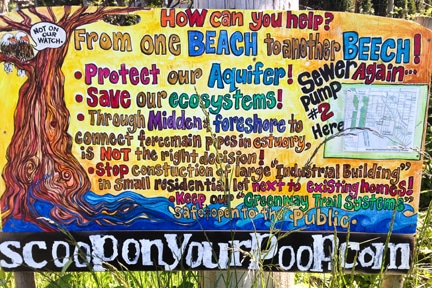
But the commission, strong-armed by the representatives from Comox Council and aided by a misinformed CFB Comox delegate, pressed ahead anyway to build a new pump station in Area B, which has no representation on the commission.
Like so many of the commission’s sewer plans in the past, this one seemed destined for another lawsuit costly to Courtenay and Comox taxpayers.
But faced with a cost estimate nearly double the original budget — $12 million to $22 million — and the spectre of adverse impacts to private wells in the neighborhood of the proposed site, the regional district’s engineers saw red flags and took the summer to reconsider.
Courtenay Councillor Erik Eriksson
For more reasonable thinkers, like Erik Eriksson, a Courtenay representative on the commission, this pause in a misguided project provides an opportunity for the regional district to go back to the drawing board and come up with a new overall plan that encompasses the whole Comox Valley, and that takes citizen and environmental concerns seriously.
Let’s review the facts:
The commission proposed building a Comox No. 2 pump station — at a cost of $12 million — to redirect its raw sewage from a deteriorating pipe that runs along the base of the Willemar Bluffs. The current pumps at existing Courtenay and Comox pump stations are inadequate to move the sewage up and over the Comox peninsula to the Brent Road treatment plant.
But the commission’s own Advisory Committee said building a new pump station was the least desirable option of several it considered. The committee recommended rebuilding the existing pump station in Courtenay as the most preferred solution.
The regional district’s own initial financial analysis showed upgrading the Courtenay No. 1 pump station was the best and most cost-effective option in the long run. Email documentation shows the Town of Comox disliked this report.
But an independent analysis confirmed that the CVRD could save taxpayers between $7 million and $12 million in the long-term if it upgraded the pumps at Courtenay immediately.
The commission’s long-term plan is to upgrade the pumps at Courtenay No. 1 in just a few years anyway. So why spend millions unnecessarily now?
In the alternative, the Advisory Committee noted, upgrading the existing pump station at Jane Place in Comox, would also cost less in the long run.
Either of those options would eliminate the need for a second pump station and eliminate the vulnerable section under the Willemar Bluffs. Plus, in both of these options, raw sewage would not threaten any drinking water supplies. Courtenay and Comox residents enjoy piped water, not vulnerable private wells.
And Eriksson, a potential candidate for mayor of Courtenay, has a third option that could also resolve issues created by the failed South Sewer referendum earlier this year.
Eriksson proposes building a new state-of-the-art treatment plant in the south Courtenay area that would handle all wastewater from west of the Courtenay River. That would take enough pressure off the existing Courtenay and Comox pump stations to render the proposed Comox No. 2 pump unnecessary.
And it would also solve the problem of failing septic systems in the Royston and Union Bay areas and provide the infrastructure for new development.
It would also provide a solution for the Village of Cumberland, which shamefully continues to pollute the Trent River watershed and estuary.
The new treatment plant could treat the water to such a high standard to use its effluent for agriculture and other reclamation purposes, including reinjection into groundwater. In an increasing number of communities around the world, wastewater is cleaned to potable standards and even flowed back into drinking water systems.
There are probably other farsighted options, too, rather than spend $22 million — at least! — on a pump station inherent with risks to humans and potentially expensive lawsuits that serves only a narrow purpose.
If there’s any justice and common sense left in this world, next month the engineers for the Courtenay-Comox Sewage Commission will recommend a more visionary, comprehensive sewerage strategy for the entire Comox Valley.
Given yet another opportunity to follow its own Master Plan this week, the Courtenay/Comox Sewer Commission chose to ignore it. Again.
A letter from two residents of the Area B neighborhood most affected by the proposed construction of a multi-million dollar pump station requested a minor restructuring of the commission’s membership.
But the residents were really questioning the commission’s governance of matters outside of its existing mandate. A matter that the commission’s 2011 Sewer Master Plan said should have been addressed six years ago, but which they have disregarded.
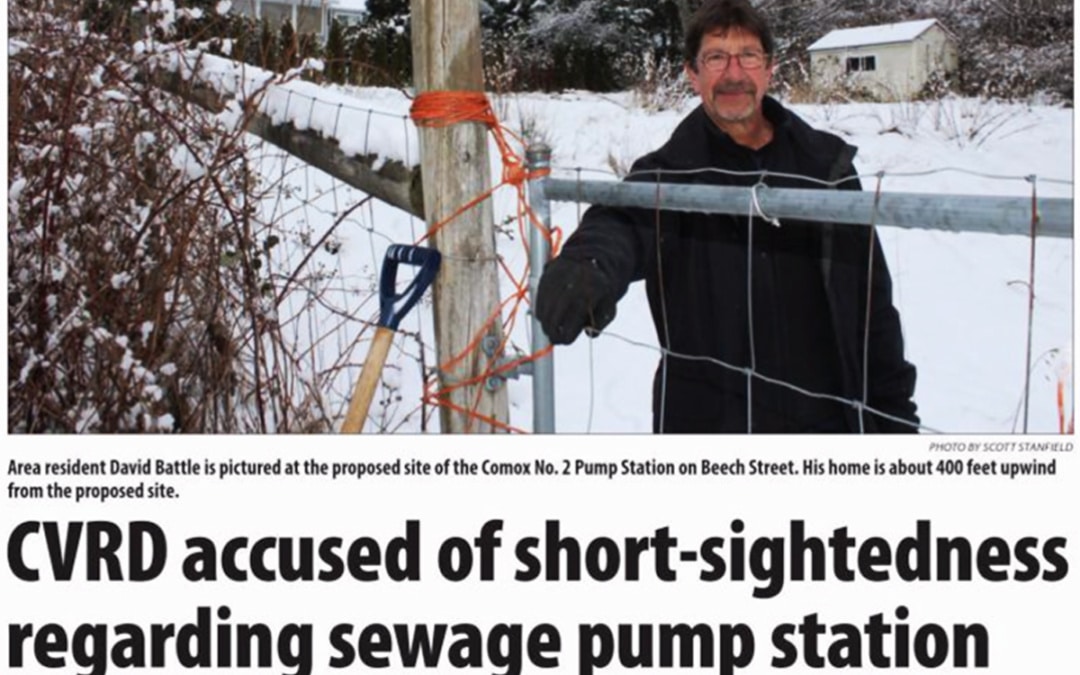
In their letter, David Battle and Lorraine Aitken asked that the Area B director be added to the commission on a limited basis. He or she would participate and vote only “on issues relating to any existing or proposed infrastructure in Area B.”
It’s a reasonable request. If the elected officials of Courtenay and Comox propose to build infrastructure outside of their municipal boundaries, then the elected representative of those in the affected area should have a voice and a vote.
Democracy is based on the idea that all citizens will have a voice in government — their own or their elected representative’s — on matters that concern them. But residents of Area B have been denied representation.
The Courtenay/Comox Sewer Commission comprises members only from Courtenay, Comox and CFB Comox. But where it places sewer pipes, pump stations and treatment facilities affect people outside of those jurisdictions.
The commission’s 2011 Sewer Master Plan anticipated this problem, and is absolutely clear about the appropriate resolution.
The Master Plan says that before the commission embarks on any of the plan’s identified projects, it should create a governance structure for areas outside of the City of Courtenay and the Town of Comox.
Presumably that would entail giving fair representation — voice and vote — to people in areas affected by the commission’s actions.
It’s no surprise that commission members haven’t undertaken even a simple review of governance structure in the six years since the Master Plan was adopted. The commission has consistently neglected those parts of the plan that seemed troublesome, expensive or that might have prevented them for doing whatever they want.
For example, the Master Plan calls for the commission to review and revise the plan every three years. It wasn’t done in 2014, as it should have been, and still hasn’t been done. Other plan initiatives have also been ignored.
The commission and Comox Valley Regional District engineering staff have a long history of ignoring the advice and concerns of the community on sewerage issues. The regional district has been successfully sued twice over engineering mistakes that citizens warned against.
And history is repeating itself. The Sewer Commission has bungled the proposed Comox #2 pump station project from the beginning. It planned the project and purchased the property in secret. It intentionally withheld announcement of its plan and property purchase until after the 2014 municipal elections.
And the commission continues to treat legitimate citizen concerns with disdain, adopting a confrontational posture, rather than trying to find a win-win solution.
The letter from Aitken and Battle presented the commission with an opportunity to change course, and resolve the Comox #2 pump station outrage before the situation devolves into new lawsuits.
The commission should have treated the residents’ letter with respect, and fulfilled its obligations under the Sewer Master Plan, by undertaking a review of its governance structure and decision-making framework that would address Aitken’s and Battle’s concerns.
Instead, they deferred the matter to their June strategic planning workshop. That could be seen as a positive step.
But without advance work to develop possible options and process requirements, legal opinions and geopolitical analysis, nothing definitive can come from the June session. At best, the commissioners will ask that this same work be done and they’ll discuss it again. Later.
To those already suspect of the Courtenay/Comox Sewer Commission’s intentions, this looks like an insincere stalling tactic, perhaps to avoid immediate legal action.
It would be lovely if it were not, and the commission finally recognized the legitimacy of the neighborhood’s concerns and the better and less expensive options available to them.
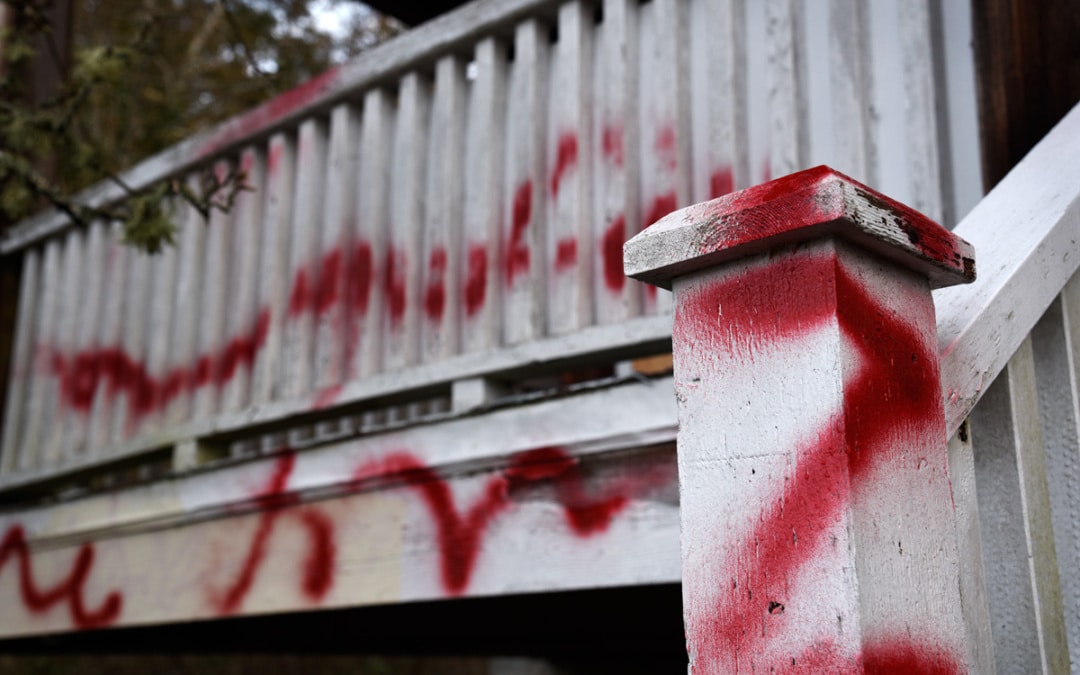
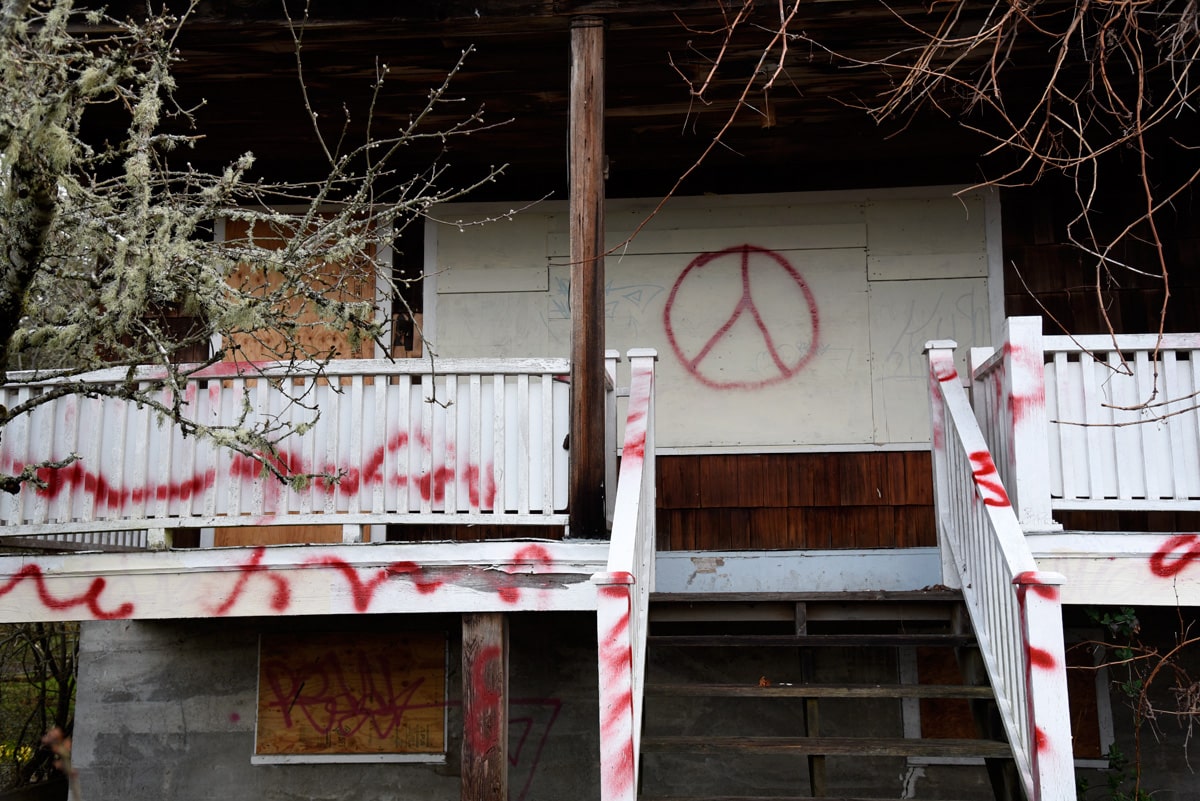
Vandals spray-painted the historical home of Hamilton Mack Laing, known as Shakesides, this week with what appears to be a lame version of tagging.
Squiggles of red paint were carelessly sprayed on three sides of the building, and a circle with an upside down ’Y’ was painted on plywood covering the building’s front window.
This doesn’t look like the work of any young graffiti artist. Not a serious one, anyway. They would not spray meaningless scribbles at a fast walk around a building and then produce a 50-year-old peace sign.
No, this seems like the work of somebody without spray-painting skills attempting to inflict maximum damage in the shortest amount of time.
Who would do such a thing? I don’t know, maybe someone angry about something? A jerk?
The front stairway into Shakesides
But it is interesting that no other sign, bridge, post or even tree was spray-painted. That creates the impression this was about something else, possibly the political and legal battle over preservation of Laing’s home.
Maybe it was an attempt to show that a building in a secluded location is vulnerable to defacing by graffiti. But that logic doesn’t hold. It doesn’t explain the worldwide tagging of downtown buildings, railway cars, subway walls, etc.
The whole point of graffiti is to be publicly viewed.
Mayor Paul Ives told me the town will remove the scrawls. They pretty much have to after last year ordering parks staff to remove good-looking murals painted on the window boards by turning the plywood panels around.
Unwanted graffiti is a nuisance and the bane of every property owner. Except that, in this case, the murals made the building look better.
But the town hasn’t always been so keen. Someone painted the word FUCK on the front of Shakesides two years ago and the town just ignored it. A citizen eventually painted over the obscenity.
And the town has ignored other graffiti previously sprayed on parts of the Mack Laing Nature Park.
When a person or organization wants to tear down a heritage building, they employ a variety of tricks to gain public support.
The type of graffiti a young graffiti artist might do, from a building in Olympia, WA.
The most commonly used trick is to let the building fall into disrepair. Spend as little as possible to repair rot or leaks, don’t make improvements and board up the windows quickly. Make it look as bad as possible.
The Town of Comox has used this strategy on Shakesides for 35 years.
Maybe the person or persons who committed this recent act of vandalism wanted to help the town along in its plan to demolish the house. Who knows? Sometimes, people just do dumb stuff.
Fresh out of college in 1982 at the age of 23, Richard Mackie came face-to-face on Newcastle Island with “Torchy” Smith, a B.C. government employee who roamed the province in search of abandoned buildings in provincial parks.
It was his job that when he found one, he burned it down.
Mackie had just taken on his first job: writing a historical report on the Newcastle Island Dance Pavilion. It was the last remaining pavilion of the 10 built by the Canadian Pacific Railway (CPR) in the early part of the 20th Century.
The pavilions were featured attractions of the CPR’s coastal resorts, whose guests arrived on the company’s Princess Ships of the British Columbia Coast Steamship Service.
The Newcastle Island Pavilion after it’s 19834 restoration. It’s a popular and busy site for weddings and other social gatherings.
Mackie’s 1983 report noted the historical, recreational and aesthetic values of the last pavilion, and it sent Torchy back to the mainland to start some other fire. The pavilion was restored in 1984 and today is a sought-after location for weddings and other events.
Flush with his initial success, Mackie began a noted career of teaching and writing about history, with an emphasis on heritage buildings. He’s authored half-a-dozen books.
“I got the idea from my Newcastle experience,” Mackie told an audience at North Island College on Saturday, “that if I wrote a report, people would always care. They don’t.”
That’s particularly true in the Town of Comox, which Mackie accused of perpetrating “wanton cultural vandalism.”
He referred to the Comox Council’s decision last year to demolish famous naturalist Hamilton Mack Laing’s original Comox Bay home, named Baybrook, and its plan to demolish Laing’s second home, Shakesides.. The nation’s top heritage experts have criticized Comox for demolishing Baybrook and are fighting the town to save Shakesides.
“In the Comox, you can write all the reports you want, but they’ll tear them down,” he said.
Mackie titled his lecture, the last in an NIC Elder College series featuring authors, “Dead Dog or Land of Plenty? Creating and Effacing History in the Comox Valley.”
He discussed many of the region’s “dead dogs,” which have either been torn down or burned down before they could be restored. It’s a long list that includes the Lorne Hotel, the Elk Hotel, the Courtenay Hotel, the Riverside Hotel and the EW Bickle Palace Theatre.
He lamented the loss of these historical buildings because they serve as anchors for a community’s collective memories, like rooms and artifacts in a person’s childhood home.
He noted the contrast between Cumberland, which has preserved many of its historical buildings, and Comox, which has no apparent regard or respect for its history.
He did have praise for the preservation of Courtenay’s Native Sons Hall and the Filberg Lodge.
Mackie said saving heritage buildings can benefit a community in many ways, including financially.
Campbell River boosted its public awareness when it preserved the home of Roderick Haig-Brown, a more well-known figure but less important to the scientific world than Mack Laing.
And that city also supported the restoration of artist Sybil Andrews’ home, which has since become a popular tourist and event location similar to the Newcastle Island Pavilion.
Referring to the area’s moniker as the “land of plenty,” Mackie asked “plenty of what?” The Comox Valley is destroying its ghosts, he said, with a frontier mentality that doesn’t value these buildings.
———————————————-
Richard Mackie is a former Comox Valley resident. He is the author of Mountain Timber: The Comox Logging Company in the Vancouver Island Mountains (Sono Nis Press, 2009), Island Timber: A Social History of the Comox Logging Company, Vancouver Island (Sono Nis Press, 2000), Trading Beyond the Mountains: The British Fur Trade on the Pacific, 1793-1843 (UBC Press, 1997), The Wilderness Profound: Victorian Life on the Gulf of Georgia (Sono Nis Press, 2009) and Hamilton Mack Laing: Hunter-Naturalist (Sono Nis Press, 1985). Mackie lives in Vancouver where he is Reviews Editor of the Ormsby Review.
Comox Councillor Barbara Price has offered up misleading statements to defend changes to an antiquated sewerage system that serves only Comox and Courtenay residents.
Price chairs the Comox Valley Sewage Commission, which is itself a misnomer. The Sewage Commission does not serve or represent the Comox Valley. It represents the sole interests of the Town of Comox, the City of Courtenay and CFB Comox.
A nearly equal amount of the Comox Valley’s population resides outside these two municipalities and relies on septic systems and wells for their water and sewage treatment. The Village of Cumberland manages its own wastewater.
So Price stretches the truth when she writes that the Comox Valley Regional District is “… planning and managing sewage operations for the region.” That’s a true statement only if you narrowly define ‘region’ as Courtenay and Comox. But Price attempts to give the impression of a broader interest.
The irony of Price’s fake fact is that a Valley-wide sewerage system is exactly what the CVRD should be doing. Instead of furthering the patchwork delivery of wastewater services, which creates inter-jurisdictional fights, the Comox Valley should have a 21st Century model for comprehensive and fair delivery of wastewater collection and treatment.
The issue of the moment is the Courtenay-Comox Sewage Commission’s plan to build a large pump station on Beech Street, which resides in Area B, not within the municipal boundaries of either the Town of Comox or the City of Courtenay.
On that point, Price also misleads readers when she suggests that the commission followed “proper processes” in selecting the Beech Street site, which she also calls the “preferred location.”
A proper process to site such an important public facility would have been transparent. As is required in the Town of Comox, several possible locations would have been identified and the public would have had input before the commission authorized purchase of any property. A fair process would have given a vote to the Area B director who represents people most directly affected by the facility.
But the sewage commission did all of this work in secret. By shutting out the public, and delaying announcement of the property purchase until after the 2014 municipal elections, the commission showed a callous disregard for public sentiment and open governance.
The Beech Street location was not the preferred location of the commission’s own Advisory Committee — formed after the property purchase was announced and comprising elected officials, staff and Beech Street neighbors. The committee gave its top recommendation to upgrading the existing pump station in Courtenay, and for good reason.
Two separate financial analyses — one by the regional district itself and another by a qualified citizen — showed that upgrading the Courtenay No. 1 pump station was less expensive. The independent report predicted savings of $7 million to $12 million in the long-term.
In her op-ed column Price writes that the Comox No. 2 pump station will only be built if it “can be built safely, without harm to neighbours and their necessities (such as well-water access.” CVRD Engineer Kris La Rose made a similar promise in a meeting with Beech Street neighbors last summer. He promised the new pump station would not create any odour or noise discernible beyond the facility’s property line.
Those are bold promises. But can the public have any faith in their veracity? The Courtenay/Comox Sewage Commission made similar promises to residents of the Willemar Bluffs about property erosion and to the Curtis/Brent road residents about odours.
Both sets of residents successfully sued the regional district because the commission’s promises were proved untrue. More than 30 years later, odours from the treatment plant still drift through the neighborhood, which remains skeptical of yet another plan in 2017 to fix the problem.
The Comox Valley faces a watershed moment. Elected officials can choose to invest in patchwork infrastructure that shackles us for decades to deteriorating and outdated technology, or they can create a 21st Century model: a Valley-wide shared service that addresses population growth, new technology and climate change and takes in more service areas and more ratepayers so the burden — and benefits — can be shared more widely.
If not now, then when?
Does the Comox Valley have visionary leaders who see the big picture and consider the long-term? Do we have leaders willing to debate the merits of building a world-class Valley-wide sewerage system with tertiary treatment and resource recovery?
Or, do we have leaders stuck in the past, afraid to think of the greater good because it would be a long, hard sell to voters?
Other North American cities already clean their wastewater to point of reinjecting it into groundwater supplies and, in some cases, directly back into public drinking water systems. They use the byproducts of treatment to fuel their plants, and provide suitable water for agriculture irrigation.
Why can’t the Comox Valley take such a forward-thinking approach?