
Many Courtenay, Comox and electoral area candidates with similar ideologies have usurped the democratic process this year by declining to attend organized public forums, a huge disservice to voters
Directors challenge legitimacy of advanced recycling technologies
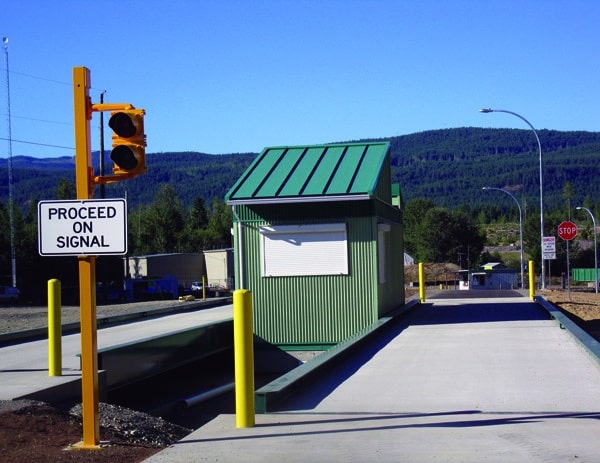
Entrance to the Comox Valley landfill, where tipping fees are calculated / George Le Masurier photo
Directors challenge legitimacy of advanced recycling technologies
By
New directors of the Comox-Strathcona Solid Waste Management Board have called into question the legitimacy of a special committee exploring new waste-to-energy (WTE) technologies.
And new Area B Director Arzeena Hamir has suggested some at least one of the WTE committee members met privately and inappropriately with one of the technology proponents.

Director Hamir
The committee, which originally named itself the WTE select committee but later changed its name to the Solid Waste Advanced Technologies (SWAT) committee, had explored methods of extending the life of north Island landfills at the Pigeon Lake dump.
Landfills are expensive to construct, and just as expensive to close when they are full.
The provincial Ministry of the Environment has ordered the closure of all existing landfills on the north Island at an estimated cost to taxpayers of just over $38 million. This includes landfills in Campbell River, Gold River, Tahsis and Zeballos.
All residential and commercial garbage that cannot be recycled or reused will be dumped into new high-tech landfills, also at Pigeon Lake, that minimize methane gas emissions and the leaking of toxic liquids into the ground. But each of these new landfills cost $10 million to construct and almost as much to close.
So new technologies that claim to reduce the amount of garbage dumped into landfills by 90 percent was obvious. Landfills would last longer, and the expense to taxpayers would decline.
But nothing is ever that simple.
The former SWAT committee members had leaned toward Sustane Technologies, a company that says it can recycle all forms of plastic and transform it into biodiesel pellets. They sell these pellets to other companies who burn it for energy.
Sustane does not yet have any functioning facilities using their technology, although Nova Scotia will pilot a project.
But Hamir and new Comox Director Alex Bissinger question whether that process — proven or not — constitutes any environmental benefit.
“What is the carbon footprint of these new technologies,” she said at the most recent solid waste management board meeting. “And shouldn’t we incorporate this (the net carbon footprint) into our analysis of them.”
Hamir wants the technologies re-evaluated to include climate change, carbon footprints and any impact on the entire solid waste management system, which includes recycling and a new organics composting facility.
Area A director Daniel Arbour said he supported a staff recommendation that ultimately passed to update the SWAT committee’s terms of reference to include emissions from burning the end product of the new technologies.
“If it really reduces the carbon footprint, then it should help reduce costs and increase diversion,” he said. “I wouldn’t expect the committee to recommend anything counter to the board’s mission.”
Hamir said the committee’s name change hides the fact that burning the product of any technology “is still waste-to-energy.”
Bissinger agreed and wanted clarification of whether such a technology actually achieved diversion under the Ministry of Environment’s definition and regulations.
Ministry officials told the solid waste management board in October that it must divert a minimum of 350 kg per capita of solid waste before the province would approve the use of any new technologies. And further, that the use of new technologies would require an amendment to the CSWM Solid Waste Management Plan. And that could trigger expensive studies and new regulations before implementation.
The previous SWAT committee, chaired by former Area B Director Rod Nichol, had operated on the assumption that the ministry’s diversion requirement was just a guideline, not a rigid number. But the October presentation and follow-up letter made it clear that was not the case.
Hamir also suggested that at least one member of the SWAT had met privately with Sustane Technologies, and did not declare the meeting or the substance of the meeting to the whole committee. She did not name the director.
Also, a budget issue
Area C Director Edwin Grieve supported the recommendation to update the SWAT committee’s terms of reference, and added a concern that Comox Valley taxpayers will pay an unfair share of the $38 million to close historic north Island landfills.
He raised the issue because some north Island directors oppose the use of a tax requisition to pay for the closure of historic landfills. They propose paying for the closures solely out of tipping fees (the charge individuals and commercial enterprises pay to dump garbage at the landfill).
The cost will be spread evenly among the 66,537 Comox Valley taxpayers and 43,000 north Island taxpayers. But the cost to close historic Comox Valley landfills totals just shy of $15 million, while north Island lands will cost more than $23 million to close.
“In terms of fairness, it appears that residents of the Comox Valley are paying the majority of the closure costs with the majority of the benefits going north of the Oyster river,” Grieve said in a personal letter to the CSWM board.
Grieve favors a tax requisition to pay for the closure of the historic landfills.
“The big cost facing us is the closure of the landfills and for that we must use taxation,” he said.
SUBSCRIBE TO OUR NEWSLETTER
More
Local candidates clam up rather than speak to Comox Valley voters in public
Decafnation candidate voting sheet
A list of candidates endorsed by Decafnation
Councillor Melanie McCollum’s mother dies in bicycle-truck accident in Courtenay
Anything a city can do to make our roads safer for drivers, pedestrians, cyclists, children and the mobility impaired should be praised, not criticized. The rest is just nonsense from desperate candidates who run negative campaigns
Decafnation recommends these candidates as District 71 trustees
Decafnation’s panel of education insiders unanimously recommends these candidates for the School District 71 Board of Education
School District 71 candidates respond to our questions
Candidates for the School District 71 Board of Education answer three questions about sexual health education, the role of trustees in relation to climate change and how to address overcapacity
Our recommendations in the 2022 Comox Valley local government elections
Decafnation announces its list of preferred candidates in this year’s local government elections and for the first time we identify candidates that we think show promise and provide our reasons for not endorsing the other candidates. Our endorsements fall on the first day of voting at advance polls
This list of candidates is anything but ‘mainstream;’ why running ‘out of town’ feels icky
The announcement nobody was waiting for arrived over the weekend when CV Mainstream trotted out their list of endorsed candidates without any justification for these particular candidates, and we notice somebody was conspicuously missing
COMOX: Candidates (most of them) respond to our questions
Only half of the candidates for the town of Comox council responded to Decafnation’s three questions on public health orders, the Regional Growth Strategy and the role of local governments in regard to climate change
“Sexual deviancy in our schools!” says local disciple of right-wing Christian group
The Week: A Comox Valley school trustee candidate hands out leaflets that spread misinformation about a sexual health curriculum; Strategic voting; and, Is Ken Grant for or against the town’s tree retention bylaw?
Join the discussion Oct. 3 about food system security in the Comox Valley
The Watershed Sentinel magazine is hosting a zoom webinar Oct. 3 on food system security in the Comox Valley