

The Courtenay River rises almost to the Fifth Street Bridge this week as rains and high tides lifted water levels everywhere — Kevin Snaden photo
THE WEEK: Flooding everywhere, big snow on Mt. Washington and crime in Comox
Heavy rains, warmer ocean temperatures and seasonal high tides this week have combined for serious flooding and emergency evacuation orders across the Comox Valley. Lewis Park turned into Lewis Lake. Roads flooded, preventing people on Stephens Road from reaching their homes. The Coal Creek Historic Park in Cumberland flooded. The Courtenay River nearly reached the bottom of the Fifth Street bridge.
And, of course, storm watchers donned waterproof gear for trips to Goose Spit Park, the Airpark trails and other places just for the thrill of getting wet and staring down Mother Nature in the eye of her storm.
But it’s not all entertainment.
The Comox Valley Regional Emergency Operations Centre activated a dedicated Flood Response Call Centre to support the coordinated emergency response and provide a centralized point of contact for affected residents.
The Call Centre is operational and can be reached at 250-334-6000.
The CVRD said yesterday that a State of Local Emergency remained in effect for the City of Courtenay, Comox Valley Regional District and K’ómoks First Nation.
“Due to water flows and resulting flood levels in the Puntledge, Tsolum, and Courtenay rivers posing a danger to life and health, the City of Courtenay, through the Regional Emergency Operations Centre, has issued an Evacuation Order for Maple Pool Campground and a designated section of Headquarters Road, effective 8 am on Thursday, Nov. 26,” says the CVRD website.
Members of the Comox Valley RCMP, Courtenay Fire, Ground Search and Rescue (GSAR), and other applicable agencies assisted with evacuations in the Maple Pool/Headquarters Road area.
Kevin Snaden, a Cumberland resident who writes about the village on the Facebook Page, Cumberland Matters, has been tracking water levels from BC Hydro data. And creating charts (see sidebar).
His last report showed that “Comox Lake has risen another 47.3 cm and is now just 38.3 cm below its free spill elevation. Total precipitation recorded at Comox Dam since Monday has reached 178 mm.
“Although Puntledge River discharge has decreased significantly from approximately 481 m³/s overnight to 136 m³/s this morning, water levels at the 5th Street Bridge have continued to rise.
“At 7:50 a.m., the river reached 4.244 m, exceeding the 10-year return level of 4.185 m. This morning’s high tide is predicted to reach 5.26 m at 8:44 a.m.”

Courtenay’s Lewis Park turned into a lake — Kevin Snaden photo
LET IT SNOW ON THE SKI HILL
While the Comox Valley has flooded around many of its waterways, Mount Washington Alpine Resort has recorded heavy snowfalls. At one point during the storm, the mountain reported more than 115 inches of snow base. This morning it was reporting just 19 inches, or 50 cm. The resort plans to open on Dec. 11.
If the unusually warm temperatures stay down in the Valley, Mt. Washington could be headed for one of its best snow years.
The all-time biggest snowfall season was 2010–2011 with 1,840 cm (over 60 feet) of cumulative snow, while its lowest recorded modern snow season was 2014–2015, when warm temperatures forced the resort to suspend winter operations after just 51 days.
Although the mountain has operated since 1979, reliable snow depth tracking websites only began archiving data around 2012. But Decafnation sources with personal experience on the mountain also remember the 1988–1989 winter as one of the leanest in the resort’s early decade, with bare grass visible near the top.
For more information, see this page’s sidebar.
IS THIS OUR FUTURE?
Reflecting on the November storms, I realized that over my half-century in the Comox Valley, we’ve seen flooding before. Lewis Park has turned into Lewis Lake before. People have claimed to have caught salmon there. The Courtenay flats have, at times, become almost one giant, if shallow, pond. The Puntledge business area has often flooded.
There is a reason that locals know Comox Road as Dyke Road. It was built by people in the late 1800s or early 1900s who farmed the Courtenay Flats but kept losing crops and soil during the winter high tides and storms.
But how much worse would this year’s flooding have been if the Field’s Sawmill steel wall had not been taken down and the property transformed into a widening of the river, called Kus-Kus-Sum?
Maybe this is the cosmos giving us a dress rehearsal for Novembers of the future, where warmer oceans create higher volumes of water and a changing climate brings us warmer temperatures and wetter winters? And let’s not mention summer droughts.
And if so, what are we learning from what’s happening right now that we could use to adapt to our future?
COMOX CRIME: SOME UPS AND DOWNS
To the casual reader, it might seem like crime in the Town of Comox is on the rise, according to a year-over-year report presented to the Town Council by Inspector Scott Mercer of the local RCMP detachment. But a closer look at the reasons for a 12 percent increase in RCMP calls for service tell a slightly different story.
Traffic incidents were the most common reason officers were called to the town from July to the end of September, a 16 percent increase or 14 more calls over last year.
“Comox is getting busier,” he told the council.
He said the detachment is working on an effective strategy to deal with young people using electric bikes and scooters, which can reach unsafe speeds and account for an increasing amount of officers’ time.
There were 31 calls regarding fraud, 17 more than last year and the largest increase of all crimes at 121 percent over last year. Most are internationally-based and conducted online by organized crime organizations. Mercer said the strategy to combat these is by creating awareness among citizens.
There were 67 calls for officers to check on people’s wellbeing, a 40 percent increase, and probably related to the 117 percent or 21 calls for assistance from police, fire or ambulances.
However, violent crimes were up 31 percent during the fiscal year’s second quarter. Harassment was the most prevalent crime, followed by utter threats, up 46 and 88 percent respectively.
The good news is that property crimes were down 12 percent, even though the frauds increased substantially. Break and enters and shoplifting were both down.
Thefts of bikes and auto were both up, but the numbers are small. Mercer said these seem to be one-offs, not serial in nature.
THE MANNO WORKAROUND
Courtenay Mayor Manno Theos’s voting bloc with Councillors Dick Clancy and Rosanna Chamberlin took their revenge on Councillor Evan Jolicoeur two weeks ago, but this week Jolicoeur got the last laugh
The Theos bloc declined to even consider Jolicoeur’s request for Courtenay to support his nomination for one of the vacant BC seats on the Federation of Canadian Municipalities board of directors. It may have been payback for Jolicoeur leading the council to reject Theos’s aspirations to sit on the regional district board.
So, whatever. But this week, Jolicoeur took his request to the Comox Valley Regional Board and got its full support for the nomination.
“I’m grateful for the Board’s support and the opportunity to represent the Comox Valley at the national level, Jolicoeur told Decafnation. “As the only non-FCM board member from British Columbia appointed to any of FCM’s standing committees, I take that responsibility seriously.”
Jolicoeur said he was honoured to have received the unanimous support of the CVRD board.
“Having a strong voice at the national table is critical to ensuring the priorities and unique challenges of our region, Vancouver Island and communities across British Columbia are reflected in federal policy, advocacy and funding decisions,” he said.
IN OTHER NEWS …
IT’S BAAAACK! — Did anyone else notice that the word “Climate” has disappeared from the titles of the new BC Conservative cabinet minister’s titles? And that the Ministry of Energy and Climate Solutions has reverted back to the pre-2020 title of Energy, Mines and Petroleum Resources. We sense an unfortunate change in direction brewing.
DID YOU KNOW – Saskatchewan notched a record-high $3.2 billion in uranium sales in 2025. “The province produces about a quarter of the world’s uranium — only Kazakhstan mines more. Saskatchewan wants that number to go up — and to expand its own use of uranium for nuclear power, too,” according to The Narwhal.
SO-SO NEWS – If you’re crazy enough to stroll around Goose Spit and go near the official Department of Defence lands, you should be worried about more than getting wet. The Department of National Defence, (DND) is undertaking a surface and subsurface scanning program to locate any ammunition left from WWII. DND says it hasn’t confirmed “the historical use of dud-producing ammunition on Goose Spit; however, records from the Second World War era and the years immediately following are incomplete.” The scanning continues through Dec. 15.
IT’S NOT THAT BAD – When I first read this item about how long it took to get somewhere, I thought they were talking about the 17th St. bridge on a Friday afternoon. Turns out, it was just NASA’s Voyager 1 spacecraft that after 49 years of zooming through space reached a light-day away this week. Just another 40,000 light-years and the spacecraft — loaded with music and images of Earth — will be within a couple light-years away from its destination, a star called Gliese 445. NASA is hoping for a response from other life in the universe – not likely, if they loaded any Miilli Vanilli in there.
A BETTER DISCOVERY – Proving you don’t have to travel very far to discover amazing treasures, an employee of Harpf, an Italian beverage company, found a barrel of beer buried in a receding glacier in the Italian Alps for nearly 50 years. It had fallen from a helicopter in 1978 — probably a another good story. Apparently the flavor, amber color and even the carbonation level in the barrel were still spot on. – The Week.
TAKE A LOOK IN THE MIRROR AND MAKE SOME CHANGE – Folks, do you spend time looking at yourself in the mirror because, heck, you’re just so damn attractive? Well, then this new startup in Hollywood called ‘License Your Face’ is calling your name. Shortical says people can “submit their social media handles to the company, which will then decide whether to offer them ‘a contract setting out the terms’ of using their persona in the company’s AI-generated content.” – Nieman Lab
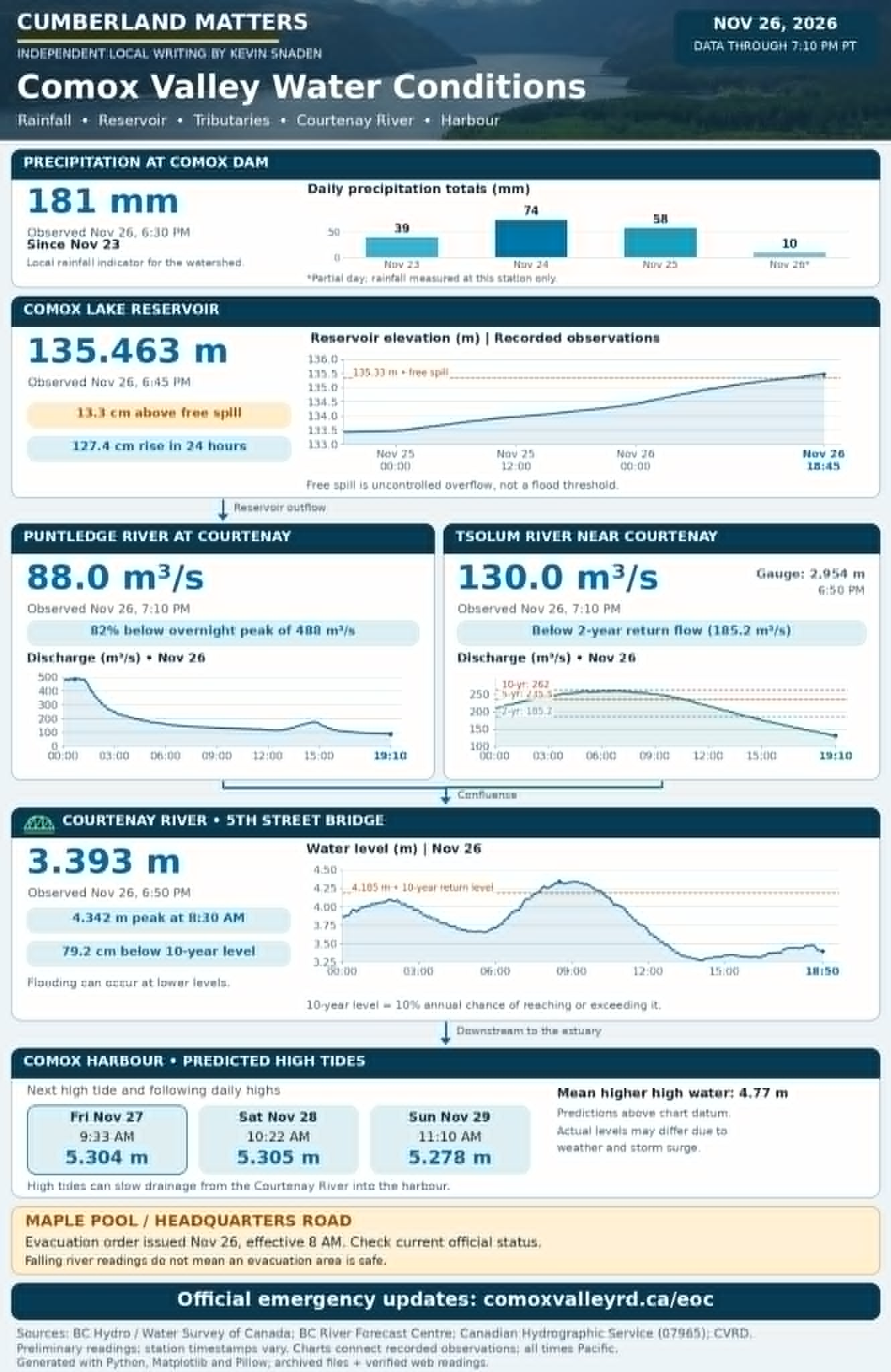
Cumberland writer Kevin Snaden created this chart from BC Hydro data to track water levels across the Comox Valley. Double-click to enlarge.
MT WASHINGTON
SNOW RECORDS
Biggest Snowfall Years & Maximum Base Depth
2010–2011 (All-Time Record): The resort recorded 1,840 cm of cumulative snowfall by mid-April 2011. During an intense late-December storm cycle in 2010, over 250 cm fell in four days (including 150 cm in 24 hours), pushing the mid-mountain base to 480–520 cm before peaking at an all-time record alpine base depth of 663 cm (21.75 feet) in April 2011.
2011–2012: Following the record-breaking winter, the mountain saw another massive year with roughly 1,890 cm (62 feet) reported in historical ski museum archives.
1998–1999 (Previous Record): Driven by a strong La Niña pattern, the mountain received 1,835 cm of total snowfall. (Note: Environment Canada’s separate, standardized alpine weather station at the resort recorded 779 cm of settled/measured accumulation for that winter, which set a Canadian seasonal snowfall record at the time.)
Lowest Snowfall Years
2014–2015 (Worst Modern Snow Year): Affected by the warm Pacific “Blob” ocean anomaly, the mountain saw virtually no sustained snowpack, with automated ski trackers logging just 76 inches (193 cm) of cumulative snowfall across 17 snowfall days and a maximum base depth of 56 inches (142 cm).
2013–2014: Another severe snow drought hit the previous winter. By the end of January 2014, the mountain had received only 140–150 cm of total snow (compared to 500 cm by New Year’s Day the year prior), with automated trackers logging 136 inches (345 cm) for the entire winter and a max base of 83 inches (211 cm).
Longest Ski Season
Longest Ski Season (2010–2011): Thanks to the 663 cm snowpack, Mount Washington extended its regular operations by two weekends through April 25, 2011, and then reopened lifts for special bonus summer ski weekends in June (“Snowmer”) and on Canada Day, July 1, 2011.
Shortest Ski Season
2014–2015: Opened on December 20, 2014, and suspended operations early due to heavy rain and warm temperatures on February 9, 2015—lasting just 51 days.
For the 2013–2014 season, the opening was delayed until January 12, 2014. After just 14 days of operation, the resort closed indefinitely on January 29 due to lack of snow, though a February storm allowed it to reopen on February 13 and run intermittently until April 18. In 2019–2020, operations were also cut short at 79 days on March 18, 2020, but due to the COVID-19 pandemic rather than snow conditions.
SUBSCRIBE TO OUR NEWSLETTER
Town Council clears way for six-storey building on Comox Avenue, “had no choice”
Comox Town Council cleared the way for a six-storey condo building at 1890 Comox Avenue, having no legal means to reduce its size. Council postponed a decision on another proposal to erect three six-storey buildings on the “cabins” property that fronts on both Comox Avenue and Buena Vista Avenue.
Cumberland plans to raise 2027 utility fees to pay for expensive wastewater upgrade
As the Village of Cumberland nears the end of a two-phase upgrading of its wastewater treatment plant, it must now start repaying the cost of borrowing $6.9 million. To do that, the village plans to increase utility rates by more than 20 percent in 2027. Also, with the rise in electric vehicles, is it time to review the provincial gas tax?
THE WEEK: Hamir to chair CVRD – Confusion at City Council – City crime down
Violent crime dropped 18 percent over last year in Courtenay, according to the RCMP’s second quarterly report. This week’s City Council meeting got bogged down with procedural missteps and a verbal attack in the gallery. CVRD directors elect Arzeena Hamir as chair of the board and there’s good news and bad news.
The “Seven-Day Building Permit Rule” in Comox, a flurry of motions in Courtenay
A Comox Valley developer has reportedly met the Seven-Day Rule for a building permit in Comox, most likely changing the Town Council’s consideration of downzoning the site. In Courtenay, notices of motion include a review of city operations, a deputy mayor position and freezing of council salaries for two years.
The Week: We’ve got the data! A look ahead at busy councils, and Good/Bad news
Any human with a computer has access to all the local government financial data they could ever want … and more. Unless you’re a financial statement nerd and need the real thing, check out our spreadsheets today that play your government’s greatest hits. Plus, tension-packed council meetings expected in Comox and Courtenay.
To frame the current zoning conflict in Comox about one property minimizes the democratic process
The whole timeline and background story about how the Town of Comox got into conflict with the owner of 1890 Comox Avenue is long and complicated, but the essence of the dispute is much simpler: the community at large does not want what this developer is offering and they couldn’t have made that point more clear than the Oct. 17 election results
The Week: The sun still rises every morning, just a lot later than usual, and other stuff
The Week looks at the time change chaos created by former BC Premier John Horgan’s sketchy poll and asks, “Why?” And then we turn to a candidate who this week announced her candidacy for the 2029 federal election and ask, “Why?” Finally we take a deeper dive into hospital boards with Doug Hillian and throw out some data about data centers
Inaugural meeting: Comox Council considers a six-storey project, Mayor Minions’s address
The Town of Comox held its inaugural council meeting Wednesday night so new councillors could take the oath of office and Mayor Nicole Minions could deliver her State of the Town address. But unlike traditional inaugural meetings, this one required the new council to address a development project approved by the previous council that conflicts with the election mandate opposed to six-storey buildings in the downtown core.
Courtenay City Council majority overrules new Mayor Theos’s appointments
Manno Theos may have won the Courtenay mayor’s office but he lost the first battle with the City Council this week, as four councillors objected to his proposed appointments to the regional district board and other assignments. Instead, the council majority passed their own list of appointments, leaving Theos off the CVRD board.
Mayor Brown gets emotional, says the village inspires her even on the hardest days
Mayor Vickey Brown and four Village Council members were sworn into office Monday night and accepted appointment to various boards and committees. In her inaugural address Brown acknowledged the importance of provincial funding and asked the community to leave the campaign behind and now focus on collaboration and team-building.