No Results Found
The page you requested could not be found. Try refining your search, or use the navigation above to locate the post.


Photo Caption
W hen a local government election comes around, candidates roll out the usual suspects, the issues they think will get them elected, or re-elected. So the political chatter tends toward property taxes, housing shortages, public safety and, with increasing urgency, climate preparedness.
Those are all important election topics. But after speaking with a sampling of incumbents and challengers in the Town of Comox, the key topics in this year’s campaign should focus on managing growth and shaping community identity.
As in, What is Comox? A quaint little village on the water, or the next White Rock? Does Comox even have a shared community identity? How will population growth and mandating housing targets affect that identity?
The town, like other municipalities, must meet provincially mandated housing starts and the target of 801 new housing units that came with a Canadian Mortgage Housing Corporation grant. And, it must work within the Regional Growth Strategy to increase density rather than create sprawl.
These questions are rising as election issues now, in part, because last year Comox updated its Official Community Plan, which initially increased the allowable height of buildings in the downtown core and in some residential areas to six storeys.
Having six-storey buildings popping up everywhere got some people excited during the OCP process, and not often in a good way.
In theory, the OCP represents a common vision, one in which all residents feel they have an equal voice in shaping. But not everyone in Comox does.
The OCP’s pumped up building heights and developers’ proposals for even taller structures have become hot topics among councillors and in some neighborhoods. That’s particularly true in the Pritchard Road area, along Buena Vista Avenue and the Beaufort Avenue area.
But on Election Day Oct. 17, voters get to have the biggest voice of all: Choosing who they want on the Town Council to make the decisions to manage that growth and form or maintain the town’s identity?
Let’s take a closer look.
Comox started the process to update its Official Community Plan in 2024, with a public survey on community vision, land-use scenarios and growth priorities. That was followed a few months later in 2025 by an open house.
A town summary of the survey results showed that the majority of respondents wanted a small-town Comox feel.
After that, the town held three separate invitation-only focus group meetings. One of them for property developers, one for businesses and one for representatives from the school district, other organizations and provincially-connected individuals.
“The town focuses on information sharing. Residents want engagement. People want a voice before it’s too late to make a difference.”
The town then held an open house on the OCP on June 24, 2025. The town’s presentation, however, did not mention that a developer had applied for a 10-storey building at the Mariner Apartments site or that another developer had applied for a 12-storey building near the marinas.
After the open house and before the town held its first public hearing, the maximum height limits in the draft OCP were changed from four to six storeys.
The first public hearing was held on Nov. 26, 2025 at the d’Esterre Seniors Centre. More than 300 people showed up (exceeding the fire limit 115 capacity). People sat on floors, while public speakers focused on height limits, setbacks and downtown density.
Council then held the second Public Hearing on Feb. 4, 2026. Citizens provided feedback on a final draft of the plan.
That culminated what the town says was more than 50 hours of public engagement sessions over an 18-month period.
Four days later, the Town Council adopted the plan, but not unanimously. The voting split 4-3 on the same ongoing ideological lines as most votes have split the Town Council over the last four years.
Councillors Ken Grant, Maureen Swift, Steve Blacklock and Chris Haslett voted to approve the plan. Mayor Nicole Minions, Jonathan Kerr and Jenn Meilleur voted against it.
One of the crucial dividing issues among councillors concerned raising maximum building heights from four storeys to six, and where these taller buildings should be allowed. And how they can be designed to better fit into existing neighborhoods. The final OCP plan also includes pre-zoning, which allows developers to build to the zone rules right away, without going through a rezoning process.
Early drafts of the OCP showed a 10-storey building on the Mariner apartments site, at the top of Comox Hill and later a 12-storey building showed up on the OCP’s maps as a future project in the marina area.
Citizens showed up at council meetings to oppose both projects and Town Council voted them down. But allowable maximum building heights were still going up to six storeys.
Do six-story buildings lining the south side of Comox Avenue fit with that vision? Do three-storey multi-family units fit with Buena Vista and Beaufort?
Early versions of the OCP planned for six-storey buildings on both sides of Comox Avenue from Ellis Street to the Filberg Lodge. It also planned six-storey buildings on both sides of Beaufort and Buena Vista avenues.
But council made changes after citizens vocally opposed those plans at the public hearing.
The Town Council changed the building heights to six storeys on the north side of Comox Avenue from Comox Hill to Pritchard. Six storeys are also allowed on the south (water facing) side, except from Rodello to Ellis streets. Buena Vista and Beaufort went down to three and three.
The maximum building height was left at six storeys for the “cabins” property on the north side of Comox Avenue near the Anderston Road intersection. The developer and town staff had apparently progressed too far into the permitting process to shift direction.
Those building heights lasted through the second public hearing and are now enshrined in the OCP. But it does not include options for building designs, such as step backs on the upper floors.
In between the two public hearings on the updated OCP, Cameron Contracting applied to build a five storey 100-unit apartment building on a property at 1533 Cedar Avenue that backs onto Brooklyn Creek.
But the quickly formed Pritchard Neighborhood Association and the Brooklyn Creek Watershed Society joined forces to successfully oppose the project. They had help from the OCP itself, which had not designated the west side of Pritchard Road as one of the town’s six growth areas.
That might have been the end of the issue.
However, two weeks after adopting the OCP, the Town Council agreed on the usual 4-3 vote to consider two amendments to the brand new document.
In the first, Cameron Contracting re-applied to build the five-storey apartment building at 1533 Cedar. But at its April 22 meeting, council killed the project based on its non-compliance with the OCP growth designated areas and neighborhood character.
In the second, Arpeg Holdings, of Victoria, applied to build a 10-storey rental building at the Mariner Apartments site at 2181 Comox Avenue. Council also rejected the developer of the Mariner site. Under the new OCP, a six storey building remains possible.
Comox Mayor Nicole Minions — acclaimed for another term — told Decafnation that she voted not to approve and adopt this OCP for two main reasons: first, because the council majority would not consider step backs for the top 1-2 floors of buildings; and, second, because the plan includes pre-zoning.
“The above two points I felt we heard strongly from the community and did not incorporate, I was compelled to vote against, ” Minions said. “It was good we revisited the Buena Vista area and reduced the height there. It’s a living document and so it will evolve in future years.”
Councillor Jenn Meilleur says the debate became polarized around height and project viability, but that she doesn’t believe growth and (community) character have to be mutually exclusive.
“I voted against … because it didn’t include the guidelines or safeguards to reflect the values around ‘human scale’ that hundreds of people in our community said mattered most to them,” she told Decafnation. “My motion to create a short, focused process to develop (building) design guidelines didn’t pass this time, but the conversation it sparked is exactly the one we need to keep having.”
Councillor Jonathan Kerr said he voted against the OCP as written for several reasons, which “all come down to this: the other four (councillors) weren’t listening to the community.”
Kerr said 77 percent of the speakers at the two OCP public hearings opposed six-storey buildings, and that 32 of the 33 letters sent to council were also opposed.
“For many issues like that, embedded in the OCP, the community voice wasn’t heard by the four (councillors) who voted for it,” he told Decafnation. “This isn’t an Official Council Plan or an Official Developers Plan, this is an Official Community Plan.”
Throughout the OCP process, public feedback consistently favored retaining a small-town ambience. The town kept pushing toward taller building heights, pre-zoning and would not consider step-backs for the top floors.
The town must try to create more housing for new residents. Comox population continues to increase. It grew by 5.5 percent from 2021 to 2025, according to census data. And it’s not expected to slow down in the near future.
Are those new residents moving to Comox because it has a small town ambience?
Do six-story buildings lining the south side of Comox Avenue fit with that vision? Do three-storey multi-family units fit with Buena Vista and Beaufort?
On Election Day, Comox voters have the ultimate voice on blending taller buildings with their vision of community identity. They will do that by electing the candidates they think will best manage these growth issues over the next four years.
This article was updated at 6 pm Sept. 24 to correct the heights of buildings along Comox Avenue.
Advance voting begins on Oct. 7, to find locations and times for your jurisdictions, click these links:
The page you requested could not be found. Try refining your search, or use the navigation above to locate the post.

Photo Caption
This is the third in a series of articles about City of Courtenay finances
A complete examination of any municipality’s financial competency has to include their capital planning process and its debt management practices. It’s an important and significant portion of local government spending.
When you hear comments about the financial management of the City of Courtenay, or any other municipality, it’s usually not about their phone bill or other common operational expenses. Most often, it’s about spending on the big stuff in the city’s Capital Improvement Plan – sometimes called the Capital Budget or Capital Plan.
And it’s natural that people will reasonably disagree about which projects the City Council included in the capital budget. Pickleball players want more courts. Performing arts groups want improvements to theatres.
There will be as many pros and cons for every project as there are passionate and active special interests in the community.
So how does the City Council decide what goes into its Capital Budget, how are the items financed and what effect does that have on individual homeowners?
And the most important question: How well has the City Council managed its debt and borrowing?
The short answer to that question – spoiler alert – is that Courtenay has reduced its total borrowing by more than half from 2012 to 2025, according to the most recent data. And the city has reduced its Real Debt Per Capita by 65 percent in 2026 adjusted dollars during the same time period.
So let’s take a closer look at debt and Capital Budgets.
At the beginning of every new term, the new council creates a Capital Improvement Plan, which some citizens misunderstand as complete discretionary spending. Far from it.
There are four types of projects that comprise a Capital Plan.
1) At the top of the list is infrastructure facing imminent failure. Council has no choice here but to repair or replace. Past Courtenay Councils skimped on infrastructure repairs and maintenance to keep taxes artificially low. But the new councils since 2018 have created the province’s first Asset Management Plan to plan maintenance technically and financially going forward.
Here’s an example: In 2007 the province mandated Courtenay and the other users of the Comox Valley Water System to build a water treatment facility. The work was estimated at $30 million in 2007, but not done.
When an extreme weather event in 2014 broke a Cumberland dam causing turbidity in Comox Lake, and boil water advisories made building the water treatment plant a necessity, the cost had escalated to $129 million.
“What people don’t realize is that 90 percent of what the city does is under provincial and federal regulations,” Incumbent Mayor Bob Wells told Decafnation. “In this case, a history of doing nothing to keep taxes low ended up costing the taxpayers even more.”
2) Next are unfunded provincial mandates. The province may set new regulations for infrastructure and the council has to find the money to meet them. No choice.
3) Projects scheduled in the city’s various master plans. Council has some leeway to choose among the projects specified in these master plans for a current year’s work. But “have to dos” can push “like to dos” out to future years. And some of these projects may already be underway, not giving a new council much leeway.
Sometimes, councils will put projects envisioned in a master plan into the budget in order to explore the possibility of grant funding, which may green light or kill the project. But the city cannot apply for grants unless the project is in the budget.
And when projects are put in the Capital Plan, council always uses the maximum estimated cost of the work. They budgeted the East Courtenay Fire Hall at $18-$23 million, but now appears to be tracking toward $14 million.
4) Projects that are not mandatory. Although it’s a small percentage of the Capital Budget, these projects usually originate with requests from citizen groups.
For example, a delegation to council in 2018 calling themselves the Arden School Ambassadors asked for a multi-use pathway between Lake Trail School and Arden. Council agreed and it went into the capital plan. But “have tos” pushed the pathway forward several years until it was completed.
“The kids just wanted a safe way to get to school,” incumbent Councillor Will Cole-Hamilton told Decafnation. “But it is a reality that the expenditures some people see as discretionary, others see as necessary.”
The City of Courtenay wraps some small projects into existing taxation, but larger ones may also require using some reserves and surpluses. And for the largest community improvement projects — to build new Fire Halls or bridges or renovate recreation centers — they must borrow money.
And in BC, a municipality like Courtenay can only borrow money from the provincial Municipal Finance Authority (MFA), an independent financial institution created by the BC Municipal Finance Authority Act. Its sole purpose is to provide low-cost lending to local governments across the province.
That is one way the province controls municipal debt. But there are others.
First of all, legislation prohibits municipalities from running an operating deficit and they cannot borrow to pay operating expenses.
Secondly, a municipality’s debt-servicing costs (interest and principal payments) cannot exceed more than 25 percent of its “controllable sustainable revenues;” that is, property taxes, charges and fees. Grants do not count in the revenue number for debt limit calculations.
And lastly, a municipality cannot borrow more than this authorized debt.
The province looks at the percentage of authorized debt a municipality has used, And they monitor another data point, known as the Real Debt Per Capita. Both are considered as indicators of how well a municipality has managed its debt.
Decafnation did a comparison of the city’s debt from the 2012 council (when Larry Jangula was mayor) to the 2026 council.
Which one would you guess incurred more debt and used more taxes to make its principal and interest payments?
We found that the current councils elected in 2018 and again in 2022 incurred less than half the total debt of the Jangula council in 2012. As a result, the newer councils used much less of its provincially authorized debt capacity and paid less to service that debt.
In 2012, the city’s total debt was $28.754 million (adjusted to 2026 dollars), or 26.9 percent of its debt capacity.
By 2026, the new councils had reduced the total debt to $12.384 million, a 56.7 percent reduction. And they had used only 12.4 percent of their debt capacity, a 64.7 percent drop.
The other key provincial indicator of debt management is what’s called the Real Debt Per Capita. The amount of debt the city owes per population figures.
Looking at Courtenay’s Real Debt Per Capita figures shows a similar story.
The high degree of borrowing by the 2012 council meant $1,188 of debt per Courtenay resident. The new councils reduced that number to just $420 of debt per capita through better financial management to pay down the debt and more strategic borrowing. These are CPI adjusted 2026 dollars.
Here’s a comparison of Island municipalities, listed by the 2026 percentage of the total borrowing ceiling they have used.
Comox used 0.7 percent of its ceiling because the town relies almost entirely on cash reserves and Development Cost Charges. It has virtually zero debt.
Campbell River used 6.9 percent. The city has a substantial revenue base and it has retired debt on older capital assets.
Powell River used 27.2 percent. It recently built a wastewater treatment plant and has a constrained industrial tax base.
Cumberland used 55.7 percent. An example of a small tax base and upgrading a multi-million-dollar wastewater treatment plant.
In 2019, the new council created an Asset Management Bylaw that inventories the city’s infrastructure, projects timelines for repair or replacement and projects those future costs. And the City Council also created the Strategic Infrastructure Investment Program, a 10-year plan to generate savings through annual tax increases to cover future previously unfunded infrastructure expenses.
Since 2019, Courtenay has based its capital budget on up-to-date detailed information about what assets have failed and which are projected to fail within two years.
“Managing our assets involves planning the work to avoid disruption of service and having a long-term financial strategy to pay for it,” Councillor Cole-Hamilton said. “This means tax increases sometimes, but it heads off bigger financial problems and potentially huge tax increases down the line.”
With those two initiatives and continued good financial management, the future borrowing for known infrastructure maintenance and debt repayment costs should continue to decrease over time.
Advance voting begins on Oct. 7, to find locations and times for your jurisdictions, click these links:
The page you requested could not be found. Try refining your search, or use the navigation above to locate the post.
H ave you not had enough politics in your life lately? Has the municipal election campaign underway right now and heading toward Election Day on Oct. 17 not satisfied your appetite for debate and listening to campaign speeches.
Well, you’re in for a treat when Premier David Eby drops the writ sometime this week triggering a provincial election.
Sources are telling Decafnation that the election machinery will be in place for an election call by the end of this week or early next week, possibly overlapping the local government campaign already in progress.
The Green Party leader, Emily Lowen, has hinted about an imminent election in her social media posts, as have some MLAs.
Courtenay-Comox MLA Brennan Day says he will make an announcement in the next few days about whether he runs as an independent or some other option.
There’s another sign that something is afoot. Courtenay Councillor Will Cole-Hamilton withdrew from his previously announced municipal re-election bid last Friday.
By calling an election now, the NDP will have an advantage over a Conservative Party that has ruptured over its controversial far-right leader.
There have been rumours that conservatives who fled the party to sit as independents – such as Courtenay-Comox MLA Brennan Day – may form a new, right-of-center third party. But it’s doubtful they will have time to organize for an early fall campaign.
Depending on when Eby asks the Lt. Governor to dissolve the Legislature, the provincial campaign will run about 28 days, with general voting always taking place on a Saturday. But special circumstances outlined in the BC Elections Act could extend that period to a maximum of 38 days.
Because the BC campaign might overlap the municipal races, that may affect the timing of provincial nominations and the final Election Day.
But Decafnation’s sources say the premier is not waiting for the local government campaigns to complete on Oct. 17.
“Dropping the writ” is a reference to official documents the Lt. Governor signs, called “Writs of Election.” They certify that an election is underway, and set the date for the final voting day.
In the last BC general elections on Oct. 19, 2024, more than 2.1 million valid ballots were cast. More people voted in advance polls by a slim margin over the final voting day.
The NDP won 47 seats with 44.9 percent of the vote, a narrow win over the Conservative Party’s 44 seats with 44.3 percent of the vote.
Despite the positive big picture outcome, this election exposed a glaring vulnerability within our electoral system. And that vulnerability caused otherwise smart people to forget how our Canadian parliamentary system actually works. Namely: We do not have a proportional representation form of government. But there is a simple solution.
Progressives have found something new to squabble about: which poll of the North Island-Powell River (NIPR) riding is the accurate one? Some polls show the Liberals ahead of the NDP. Others show the NDP with an edge. But does it really matter if neither party can win?
Photo Caption omox Valley voters will have several opportunities to watch and listen to the candidates for the Oct. 17 local government election SUBSCRIBE TO OUR NEWSLETTER
Photo Caption growing coalition of over 140 Vancouver Island residents has called for strategic voting in the North Island-Powell River and Courtenay-Alberni ridings to block the Conservatives and reject Aaron Gunn's...
If you want to help the Mark Carney Liberals form the next federal government, then DO NOT vote for them in the North Island-Powell River riding. That sounds counter-intuitive, but only a vote for the NDP can save this riding from swinging to the Conservatives in 2025. Why? Read on for the full article.
Regional district staff recommend approving an amended application for groundwater extraction in Merville as a “home occupation,” but rural area directors want more clarity on its legal definition
The Comox Valley Electoral Areas Service Commission will consider on Monday an amended application for water bottling operations in Merville and draw attention to larger water policy issues in British Columbia
Decafnation starts a new tradition this year by asking selected Comox Valley people to share their acquired knowledge that didn’t come from book-learning or academic studies. We begin today with the collective wisdom of five notable Vancouver Islanders rooted in the Comox Valley.
Faith-based volunteers can contribute positively to the educational experience in our public schools but everyone must be perfectly clear about who they are, what they can and cannot do and school administrators must monitor their activity closely and consistently
A Comox Valley developer is suing the Town of Comox because his permits to cut down trees and build more single-family homes haven’t been issued as fast as he’s wanted and because the town wants a wider walking trail through the property

Like almost every other British Columbia municipality, before the city even starts work on next year’s financial plan, most of the budget has already been spent or dictated by the province.
Things like water and sewer services, police and fire services, recreational and cultural services and financial items like amortization and debt interest will have already consumed about 65 percent of the revenue. When it comes to general operations, your elected officials have limited discretionary choices.
This may be why some candidates in this year’s municipal election have zeroed in on the incumbent’s capital expenditures. It’s a common misconception that council has complete discretion over its Capital Improvement Plan. But, in reality, only a small portion of each Capital Budget has not been mandated by the province or failing infrastructure.
It is true, however, that each new mayor and council prioritizes a few projects for their multi-year Capital Improvement Plan (CIP).
For better or worse, the current City Council included the recently opened Sixth Street Bridge in its last capital plan. The pedestrian and cycling bridge became an instant lightning rod for critics and candidates in the Oct. 17 municipal elections.
One of those disparaging the bridge this year is mayoral candidate Manno Theos, a former Courtenay Councillor, who championed the bridge decision in 2019. Seven years later, he’s calling it “The bridge to nowhere,” while his supporters call it “unnecessary spending.”
Let’s take a closer look at how the Sixth Street bridge bounced around and came to life.
The bridge has a storied history involving many people and many design variations. It had more starts and stops than a vehicle trying to cross the 17th St. bridge on a Friday afternoon.
The original idea for a Courtenay foot bridge at Sixth Street arose during the 1980s, when it was mentioned in the Official Community Plan. It popped up again, during the planning for Simms Park in the 1990s. A sketch of the park design shows the bridge.
IT’S A GO – But the bridge started to get real legs in 2005 when the Sunrise Rotary Club supported the concept and made plans to construct it using community donations and volunteer labor. They envisioned a Timber frame structure.
NO GO – The city abandoned the Rotary Club plan after engineers ruled out the wood construction for various reasons, including maintenance and public safety.
IT’S A GO – Then, in 2016, business and property owners in the downtown district held a charrette in conjunction with the city to gather ideas for a downtown revitalization. The Downtown Playbook document that emerged from those planning sessions included a bridge for foot and bicycle traffic.
NO GO – But then-mayor Larry Jangula did not make the bridge a priority, so the city never followed up on that item from the Downtown Playbook.
IT’S ANOTHER GO – When a new mayor and council were elected in 2018, they engaged staff to focus on the Downtown Playbook and an update to the city’s Official Community Plan. The bridge became a piece in council’s movement toward more active transportation corridors and the further development of Simms Park.
NOPE, STILL A NO GO – The Sixth Street bridge stalled again, however, because the city discovered that for public safety reasons, a restoration of the Fifth Street bridge had to take priority.
Before the Fifth Street project started, city staff floated an option to add four-foot wide cantilevers for cyclists on both sides of the bridge. This would have cost $1 million (less than the Sixth Street bridge option), but it would have added an extra six weeks to the partial bridge closure for construction.
A GO? – Council leaned toward approving the cantilevers plan, although staff later cooled on the idea in favor of returning to the Sixth Street bridge plan. Cantilevers would be less expensive. They could be constructed quicker than an entire new bridge.
NOT SO FAST — At the Sept. 3, 2019 council meeting, Jenny Deters, a business owner and president of the Downtown Business Association, led a delegation on behalf of 200 business owners and the Chamber of Commerce to oppose the cantilevering option and to urge council to build the Sixth Street bridge.
You can watch the video of her presentation and council members’s response starting at 20:23 in the video below.
Deters said a majority of business owners supported the Fifth Street bridge restoration and also supported “alternate modes of transportation and more cycling to get around the Valley.”
She told council that Downtown businesses would suffer lost revenue during to the six month Fifth Street bridge closure. And that they feared another six weeks to add cantilevers could be catastrophic. Deters praised Sixth Street as a better investment. She predicted that a foot and cycle bridge at Sixth Street would become a tourist attraction and a beautification of the downtown area.
Deters went so far as to call the bridge a long-time vision of past councils and citizens and that the bridge was “strategic to the revitalization” of downtown Courtenay. She pleaded with council to “do the bridge sooner than later,” and drop the plan for cantilevers.
MANNO TO THE RESCUE – Councillor Manno Theos praised Deters’s presentation at the 2019 meeting and endorsed her plea to build the Sixth Street bridge instead of adding cantilevers. And he also made a prediction, “This (decision for cantilevers versus Sixth Street) will be an issue that is going to end up defining this council.” See his comments starting at 30:55 in the video.
If the council voted to proceed with cantilevers, Theos said, they would pay a heavy political price. He warned that voters might toss them out of office.
“It’s going to be a hurricane for many of the councillors sitting at this table. We claimed the downtown core was one of our biggest issues … if we fail you (Downtown) now, we are going to be judged three years from now (2022 elections), certainly.”
In his effusive support for building the Sixth Street bridge, Theos went on to say that adding cantilevers would eliminate the possibility of a future bridge at Sixth Street bridge because doing both was not possible, “Especially now with significant tax increases coming forward at us.”
Theos said he supported a bridge at Sixth Street for safety reasons and also “moving it into nature … a more nature setting.”
Finally, in 2020, about 40 years after the idea originated, council approved the Sixth Street bridge and included it in the city’s capital budget. Council didn’t know if or when they would build the bridge, but it was a requirement to include the project in their capital plan in order to apply for grants.
IT’S A GO, AGAIN – When the federal government awarded Courtenay a $2.5 million grant, the project suddenly became a go. It was the largest federal grant for an active transportation project in Canadian history.
MAYBE NOT – But, in the years following the Covid pandemic, prices had escalated for everything across North America. The original cost estimate of $4 million to $6 million leaped to nearly $11 million (the exact cost will be known this fall when the accounting is completed).
Faced with such an increase, at its March 12, 2025 meeting, the council again considered dropping the project. They had three options to consider:
1) approve the bridge at the higher cost;
2) refer the matter back to the engineering department to examine previous design options to see if there was a less expensive solution;
or 3) cancel the project entirely.
Councillors were divided on what to do. Will Cole-Hamilton urged council to choose the second option to have engineering staff review other viable bridge designs. However, a council majority voted to go ahead with the bridge.
YES, YES – In the end, the council decided to proceed because the cost would only keep escalating and the city would lose the federal grant.
Courtenay Mayor Bob Wells told Decafnation that he supported the bridge when the cost was $6.9 million. But he hesitated at the cost escalation.
“But with the grants of $5.55 million, our final cost would be less than the original $6.9 million,” Wells said. “As the project finished ahead of schedule and under budget, it will cost our taxpayers even less.”
The city obtained $5.55 million in grants for the bridge, including $2.5 million from the Active Transportation Fund, $2.555 million from the Growing Communities Fund and $500,000 from the Canada Community Building Fund. The city is expected to use $3.75 million in long-term borrowing and $1.8 million from surplus and reserves.
The final cost of the bridge is unknown, though it is expected to come in under $11 million. The final accounting of bridge costs will complete this fall.
Advance voting begins on Oct. 7, to find locations and times for your jurisdictions, click these links:
Comox Valley Regional District
The page you requested could not be found. Try refining your search, or use the navigation above to locate the post.
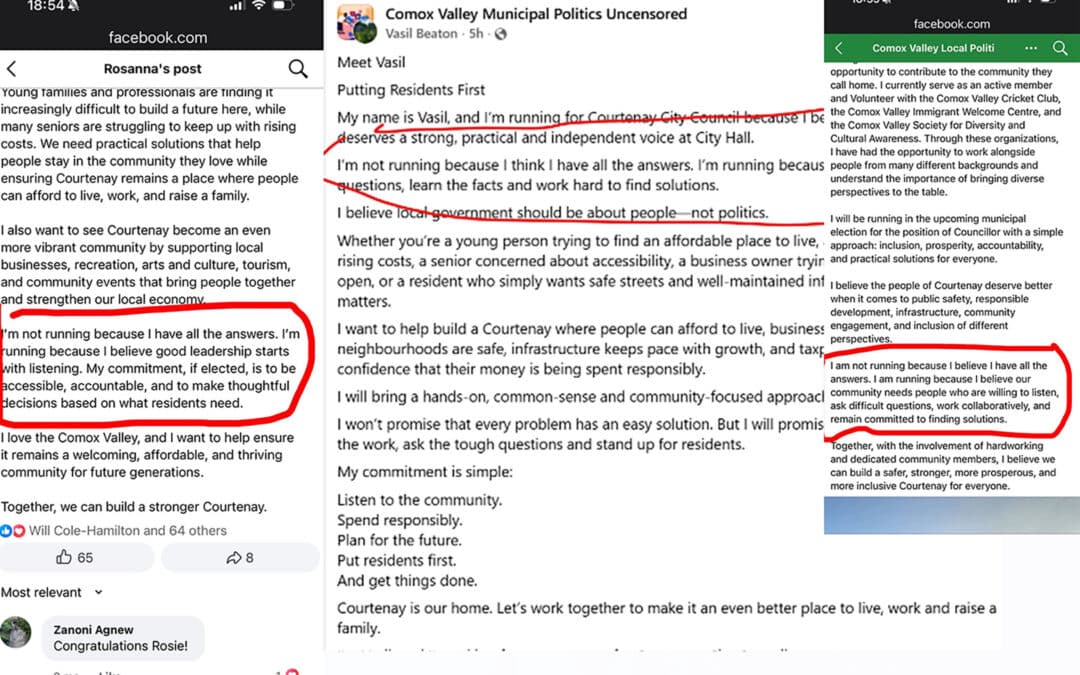
Many candidate’s social media posts appear suspiciously similar. A sample, from left, Rosanna Chamberlin, Vasil Beaton and Kam Singhania
M ost candidates running in the 2026 local government election had filed days before the nomination deadline passed at 4 pm Friday. Other candidates, who everyone knew would run but had not filed, popped their last-minute “Surprise! I’m running!” charade to no one’s surprise.
For the 30 percent of Comox Valley residents who vote in municipal elections, it was an exciting moment. The other 70 percent, who won’t vote, released a deep, collective yawn.
Well, it is true, you won’t find many surprises in this year’s candidate line-up. So, let’s have a look at the Good, the Bad and the Nothing’s New.
MORE CANDIDATES – Seventy people are running for the 31 Comox Valley elected offices, an increase of 23 percent over the 57 who ran in 2022.
MORE WOMEN – Women account for 41 percent of the candidates (20 of 49) this year, excluding the School District (nine out of 11) ) and the Islands Trust (two out of 10). Comox has the highest percentage of women seeking office (seven out of 12) at 58 percent. That compares to 35 percent in Courtenay (eight out of 23) and 25 percent in Cumberland (two out of eight).
And, a woman is running for the mayor’s chair in Courtenay for the first time in 18 years, since Star Winchester ran for re-election 2008.
DEJA VU – It feels like Groundhog Day all over again in Courtenay’s mayoral race, where the late-filing Trish McPhail will split the center-progressive vote, maybe clearing a path to His Honor’s chair for Manno Theos. Comox Valley’s sitting conservative MLA and MP both won their seats thanks to vote splitting between the NDP and Greens. Will it happen again? Maybe. It is highly unlikely that McPhail will take votes away from Theos supporters. Her share will come from Incumbent Mayor Bob Wells. The question here is: Can Wells and McPhail get enough new voters out to both outpoll Theos?
ACCLAIMED – Several candidates have already won their election races because no one challenged them. Comox Mayor Nicole Minions won her second consecutive election by acclamation. In two mayoral terms she has never been opposed. Cumberland Mayor Vickey Brown and Electoral Area A regional Director Daniel Arbour also were acclaimed.
SAME NAMES – Many familiar names dot the candidate list, again. Ken Grant seeks his seventh term on Comox Council, a total of 21 years. Maureen Swift has warmed her council chair for 15 years. Erik Eriksson … filed again. He won a council chair in 1986 and again in 2014. Then, he ran unsuccessfully for mayor in 2018 and again in 2022. This will be Jin Lin’s third try for Courtenay council. She came close in 2018 and 2022. Phil Adams got less than a 1,000 votes in 2022, but he’s having another go.
Candidates keep trying, because on election day, anything’s possible. Voters are a little like courtroom juries. Unpredictable. Just look at Brennan Day. Courtenay voters rejected him twice. Now he’s the riding’s MLA.
GET OUTTA HERE – We like that candidates have shared their reasons for seeking office on the competing Facebook politics pages. But we don’t like it when their words are almost identical. Check out the social media posts above and below. That’s just a small sampling of what’s being posted by many first-time candidates.
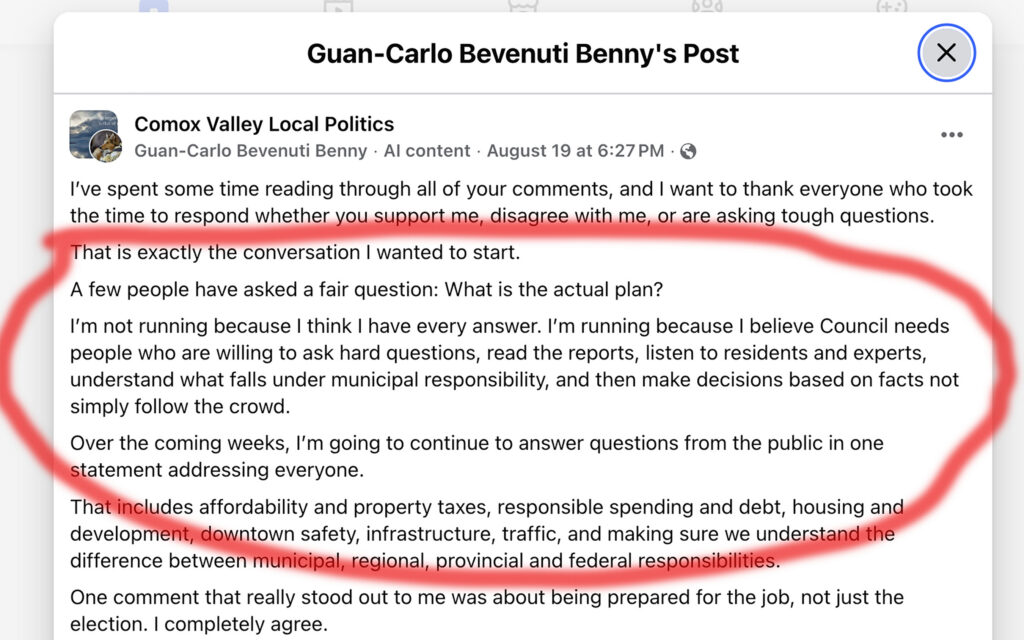
Is this plagiarism? Did some third party group write these posts for multiple candidates? Did these candidates use AI to write their posts? It’s almost certainly not a coincidence. Benvenuti’s post admits that it includes AI content. So what IS going on here? Whatever “it” is, it’s not a good look for these candidates.
BIG MONEY STINKS – We’re gagging on the prolific fake accounts and paid trolls trying to influence our local government elections, primarily for Courtenay City Council and mayor. They post angry and vacuous comments. When you click on their profile, you find nothing. A picture of a human, but no profile. No history of posts or friends. Nada. It’s just garbage littering the Internet.
COMOX VALLEY CHAMBER OF COMMERCE
– Cumberland candidates. 5:30 pm on Monday, Sept. 21 at the Cumberland Cultural Centre location.
– Comox candidates. 5:30 pm on Monday, Sept. 28 at the Comox Legion.
– Courtenay candidates. 5:30 pm on Thursday, Oct. 1 at the North Island College Stan Hagen Theatre.
COMOX VALLEY SOCIAL PLANNING SOCIETY
An all-candidates forum on the social determinants of health at 5:00 pm on Tuesday, Sept. 22 at the Westerly Best Western Hotel in Courtenay.
ADVANCE VOTING INFORMATION
Polls for the Oct. 17 election will open for advance voting on Oct. 7 and Oct. 14.
The page you requested could not be found. Try refining your search, or use the navigation above to locate the post.

Photo by Raphaël Biscaldi on Unsplash
This is the second in a series of articles about the City of Courtenay finances.
I t’s no secret that residents of any municipality have at one time or another accused their local government of waste, inefficiencies, senseless delays and an unfriendly attitude on the part of a public employee. It happens. That such a complex organization affecting such a broad swath of the community occasionally runs afoul of a citizen or a group shouldn’t surprise you.
But it should alarm you when those citizens, out of frustration, suggest, ”They should run our city like a business!”
That’s a battle cry usually heard during municipal elections by newcomer candidates and their supporters trying to diminish the records of the incumbent mayor and council members. And there’s a lot of social media mud-slinging going on right now about Courtenay City Council’s financial management.
But what does “Running it like a business” actually mean?
A business exists primarily to generate profits for its owners, who can grow their revenue by any legal means. Home Hardware, for example, must generate more revenue selling home improvement products than it costs to operate the business. It can add products to increase revenue and drop products that prove unprofitable in order to maximize its net profit.
In a sense, a municipality must also make a profit. Besides paying today’s expenses, a city needs funds to set aside for future known expenses and to have sufficient reserves for emergencies.
But a city’s taxes and fees should only cover the costs of providing services, including all long-term maintenance and replacement expenses. The goal is not to maximize net profits. It’s to deliver municipal services efficiently and effectively.
Maximizing profits would mean overtaxation.
So let’s dig deeper into other ways that “Running it like a business” does and does not make sense for the City of Courtenay.
The reality is that municipalities in British Columbia have no legislated authority to tax anybody, citizens or businesses. They can only do what the province allows. “We are children of the province,”
Private sector businesses can create any means short of illegal activities to earn more revenue. They can increase prices, add new product lines and expand into new territories to attract more customers.
Parks and recreation centers cost more to run than user fees provide. Does running a city like a business mean the city should solicit paid signage, such as billboards on the fields or allow mall-like kiosks in public buildings?
Would you enjoy advertisements interrupting plays and concerts at the Sid Williams Theatre? How about tolls on the Fifth Street Bridge? Charging sky-high entry fees at the museum and Comox Valley Art Gallery to cover all their expenses would quickly close them down.
That’s all silly, of course, because the reality is that municipalities in British Columbia have no legislated authority to tax anybody, citizens or businesses. They can only do what the province allows.
“We are children of the province,” says Councillor Will Cole-Hamilton.
Courtenay Councillor Melanie McCollum, Cole-Hamilton and other municipal leaders across the province have asked the BC Provincial government to provide additional sources of revenue for cities and towns. They have suggested the province share a percentage of the property transfer tax or a portion of the liquor tax, arguing that both correlate to municipal planning and policing costs.
“But at this time, there’s no way for the City Council to increase revenue and lower taxes at the same time – it would be self-contradictory. Property taxes are our primary source of revenue,” says McCollum, a budget analyst at North Island College. “It would require finding a substantial industrial taxpayer for this to change in a meaningful way.”
The only avenue for additional revenue today is to apply for grants for non-operational needs from the federal and provincial governments.
Courtenay’s revenue comprises 65 percent from taxes and 35 percent from grants. Municipalities with a smaller tax base, such as Cumberland, receive about 50 percent of their revenue from grant funding.
However, the current council did increase revenue from one important source this year: Development Cost Charges (DCC).
DCCs represent a developer’s contribution toward the cost of expanding infrastructure due to growth. The process for determining the charges involves complex calculations that have to be approved by the province.
Courtenay’s DCCs hadn’t been reviewed in over a decade, so the overdue review resulted in a substantial increase.
Courtenay, Comox and Cumberland are prime examples of the ticking time bomb of unfunded liabilities for infrastructure maintenance and replacement hovering over almost every Canadian municipality
Those who believe a municipality should be “Run like a business” should be happy campers. For decades after the end of WWII, municipalities across Canada and the United States, tried a trick out of the private sector’s playbook to gather more revenue.
Blame it on the automobile, maybe, but municipalities embraced suburban sprawl to expand their tax base. Generating growth was needed, they thought, to accommodate the needs of the Boomer Generation and create jobs.
Municipalities enlarged their boundaries so developers could open up large tracts of single-family housing. And the cities took in a bounty of revenue from building permits, developer cost charges, other fees and, of course, property taxes.
It seemed like the perfect answer: more growth equals more municipal revenue without increasing an individual’s taxes.
But, it turns out, suburban sprawl was really a Ponzi scheme, according to Strong Towns founder Charles Marohn, the author of “Escaping the Housing Trap: The Strong Towns Response to the Housing Crisis.”
“Cities also assumed the long-term liability for servicing and maintaining all the new infrastructure … This exchange – a near-term cash advantage for a long-term financial obligation – is one element of a Ponzi scheme,” Marohn says.
“Over the life cycle, a city frequently receives just a dime or two of revenue for each dollar of liability, a ridiculously low level of financial productivity.”
Courtenay, Comox and Cumberland are prime examples of the ticking time bomb of unfunded liabilities for infrastructure maintenance and replacement hovering over almost every Canadian municipality.
But Courtenay took the first steps to defuse the crisis in BC by implementing its Asset Management Plan in 2019, immediately after the 2018 election. And then it took another bold step – any council that purposely increases taxes does so at great political risk – three years ago adding compounding tax increases over 10 years to save funds to cover all of its infrastructure liabilities.
Comox and Cumberland followed suit with their own infrastructure savings plans.
Comox Valley residents have also benefited from the Regional Growth Strategy, a shared vision to curtail urban sprawl – to avoid future infrastructure liabilities – and direct new growth to the right places to sustain the diverse economic, cultural and environmental assets of our multiple communities.
So, a post-war attempt to run a municipality like business failed miserably and current political leaders are only now providing the remedy.
The federal Liberal government has budgeted a significant increase in defense spending that includes a $3 billion upgrade at CFB Comox. Early estimates predict 700 new employees at the base (about 1,800 new residents).
Today’s general economic inflationary pressures – especially from the pandemic years and recently jacked by U.S. tariffs – no doubt influence the City of Courtenay’s operational expenses. But the biggest driver of tax increases is our population growthl, according to Councillor McCollum.
“Adding population means a demand for more services, such as policing and recreation, two of the largest operational budget categories,” she said.
The City of Courtenay grew by 10.8 percent from 2016 to 2021, according to the latest census data. Comox grew by 5.5 percent and Cumberland grew by a whopping 18.5 per cent.
The three electoral areas grew, too. Area A added 9.9 percent more population, Area B added 4.2 percent and Area C added 6.8 percent.
Overall, the Comox Valley grew by 8.9 percent over the last census period. New census data, expected soon, will likely show similar or higher trends.
From 2021 through 2025, the city added an annual average of 372 new housing units, mostly apartments. Addressing the shortage of rental vacancies, developers created 491 new apartments in 2025 – nearly 80 percent of all new housing units that year – and 438 in 2022 and 443 in 2021.
The city issued 1,713 new building permits over the last five years, and approved 214 new subdivisions.
But that trend is slowing. Council received applications for only six subdivisions last year – all were approved – compared with 95 in 2021, a pattern that is consistent with a July report from the Chartered Professional Accountants of BC (CPABC).
The group’s quarterly economic report says Vancouver Island’s population growth slowed to its weakest pace in more than a decade.
“The region continued to attract new residents from elsewhere in British Columbia. That migration has been the primary source of population growth in recent years,” according to the report.
But a slowing trend isn’t likely for the Comox Valley, according to Councillor Cole-Hamilton, whose work on the executive team of the Federation of Canadian Municipalities (FCM), will help the city cope with an expected boom at CFB Comox.
The federal Liberal government has budgeted a significant increase in defense spending that includes a $3 billion upgrade at CFB Comox. Early estimates predict 700 new employees at the base (about 1,800 new residents).
CFB Comox is already urging the city and the regional district to provide more active transportation lanes (bicycling and pedestrian) and transit improvements on Ryan Road to move Canadian Forces personnel to and from the base gates.
In the past, municipalities have shouldered the burden of costly changes to accommodate DND expansion and other activities. Traditionally, those costs resulted in tax increases.
But Cole-Hamilton, who chairs the seven-member BC Caucus of the FCM, helped create the organization’s first policy on Department of Defense issues. It includes the formation of a national Defense Task Force to lobby DND to dedicate a substantial portion of its infrastructure spending to “dual use” projects – those that support the needs of both the Canadian Armed Forces and the communities that host them.
As co-chair of the national Task Force, Cole-Hamilton says he wants to ensure that municipalities like Courtenay “get a fair deal with DND.”
“Some people may think that we are not doing the math, or planning for the future,” Cole-Hamilton said. “But the facts are that we’re doing the politically hard stuff previous councils should have been doing. And we’re making important connections with other levels of government, such as my work with the FCM, that benefit the entire Comox Valley.”
COMOX VALLEY CHAMBER OF COMMERCE
– Cumberland candidates. 5:30 pm on Monday, Sept. 21 at the Cumberland Cultural Centre location.
– Comox candidates. 5:30 pm on Monday, Sept. 28 at the Comox Legion.
– Courtenay candidates. 5:30 pm on Thursday, Oct. 1 at the North Island College Stan Hagen Theatre.
COMOX VALLEY SOCIAL PLANNING SOCIETY
An all-candidates forum on the social determinants of health at 5:00 pm on Tuesday, Sept. 22 at the Westerly Best Western Hotel in Courtenay.
ADVANCE VOTING INFORMATION
Polls for the Oct. 17 election will open for advance voting on Oct. 7 and Oct. 14.
The page you requested could not be found. Try refining your search, or use the navigation above to locate the post.