“Liberal Rush” tricked voters in NDP ridings and exposed an electoral system flaw

“Liberal Rush” tricked voters in NDP ridings and exposed an electoral system flaw

George Le Masurier photo

“Liberal Rush” tricked voters in NDP ridings and exposed an electoral system flaw

By

The 2025 federal election turned out pretty much as expected. The Liberals won a strong minority government. The Conservatives swept Alberta and Saskatechen. The NDP lost official status in the “Liberal Rush.” But who could have predicted Pierre Poilievre would be so unpopular in his own riding?

With 168 Liberal seats, seven NDP and one Green, this government looks solid for a whole term. That stability will benefit Canadians as the Mark Carney government deals with Trump and the economic chaos he has caused.

We fortunately escaped the damage to Canada that Poilievre – the “Mini-Me Trump” – would have caused by channeling the US Presidents attacks on education, the CBC and media, clean energy initiatives and more.

Now here comes the “But ….” Despite the positive big picture outcome, this election exposed a glaring vulnerability within our electoral system.

And that vulnerability caused otherwise smart people to forget how our Canadian parliamentary system actually works. Namely: We do not have a proportional representation form of government.

A Canadian majority or strong minority government gives a single party almost dictatorial powers to change and make laws, to decide how to spend our money and to shape our social, environmental and financial futures.

That’s because, like today’s American Congress, our provincial and federal governments vote in a block. If you’re a federal MP or a provincial MLA, you’re expected to vote how your party’s caucus tells you to vote. Exceptions to this rule are rare and usually get you booted out of town.

So it makes sense that when voters go to the polls on election day, they cast their ballots for the party they want to form the government, the party whose values, policies and promises align with their own.

And there’s the problem. What if the party you align with best has no hope of winning your riding? What if there are three parties running candidates in your riding and you like parts of all of them? What if you want to vote for one party in your riding but doing so will result in the election of another party that you detest, that stands for the opposite of everything you value?

Those were the conflicts facing many voters on Vancouver Island this year. And it was the NDP, Liberals and Green parties themselves that squeezed Island voters into this awkward and divisive situation.

When the NDP, Liberals and federal Greens all ran candidates against a single Conservative, the parties forced progressive voters to figure out on their own how the vote would split and where their vote would do the most good.

Sadly, the Liberal party enthusiasm convinced many traditional NDP voters on the Island to buy into the fantasy that a Liberal candidate could win in ridings like North Island-Powell River (NIPR) where they’ve never finished better than third for over half a century.

They sold “The whole country’s going Liberal this year” like snake oil hustlers in the Wild West. It was a hollow promise.

Yes, it’s true that the Liberals got about 12,000 more votes in the North Island-Powell River riding than they did in 2021 – most of those stolen from the NDP.

But they still finished third and accomplished nothing.

The whole push to “Vote Liberal” didn’t help anybody. It didn’t help the Liberal party win the riding. It didn’t help the NDP, which fell about 5,000 votes short. And it won’t help the majority of people living in the riding – especially indigenous people – who will now be represented by somebody they didn’t want and who will be a do-nothing opposition backbencher.

It had, in fact, the opposite effect of what the Liberals intended.

In NIPR, the Liberals, NDP and Greens tallied 47,819 combined votes compared to 30,551 for the Conservative. It should have been a dominant mandate for progressive values: 60.6 percent.

But we still lost. A gift to the Conservatives.

It was the same sad story in Nanaimo and Cowichan. Across the province, this strategy resulted in a gain of four Liberal seats but a loss of 10 NDP seats, for a net loss of six progressive MPs.

Did people get swept by the charm of Mark Carney and think they were voting for him? Canadians don’t elect a prime minister. We elect MPs in ridings and the leader of the party with the most seats becomes our PM.

After this election, the political parties and many individual candidates will take time to reflect on their campaigns and how their strategies correlated with the final results.

Conservatives will try to understand how they lost a 25 point lead in about eight weeks. Pierre Poilievre will reflect on how he lost his seat in Parliament. Political operatives from all parties will try to assess the effect US President Trump had on this election. The NDP will think about its future as a viable federal party.

Voters should take time to reflect, too, on whether their vote choice got the result they wanted. They might also think about which were the informative and trustworthy sources of information they relied on to make those choices, and which were not.

In the election aftermath, there will be a renewed call for electoral reform. Proponents of proportional representation will make another noble attempt, but Ottawa will be wary of such a fundamental change while Trump still has eyes on our natural resources.

The simpler solution is for the three progressive parties on Vancouver Island to embrace the greater good of sustaining and expanding progressive ideals by fielding a single candidate in the next election.

In short, stop fighting among ourselves.


SUBSCRIBE TO OUR NEWSLETTER
Enter your email address to subscribe to the Decafnation newsletter.

Battle of the North Island riding polls, does it really matter? A prediction

Battle of the North Island riding polls, does it really matter? A prediction

Photo Caption

Battle of the North Island riding polls, does it really matter? A prediction

By

Heading into the final week of the 2025 Canadian federal election, national polls predict the Mark Carney Liberals have a slight lead over the Pierre Poilievre Conservatives. That means the two federal ridings that include portions of the Comox Valley could make a difference in which party forms our next government.

The fear among progressive-minded voters has always been that one or both of the Courtenay-Alberni and North Island-Powell River ridings will swing Conservative, which would help Poilievre.

But despite this shared goal of keeping Poilievre and his cadre of right-wing Freedom Convoy MAGA-style candidates out of office, progressives are once again so embroiled in fighting each other over small-picture differences that the Conservative candidates don’t even bother to show up for public forums.

Progressive voters have been dealt a difficult and divisive hand. Should you vote for the NDP again or the Liberals? Who has the best chance of overcoming the odds and defeating the Conservatives in our two ridings? I’ve already made my choice known.

Some progressive voters in our ridings are waiting to see which party, Liberal or NDP, is ahead in the polls before casting their vote. The problem is that polling at the riding level is often unreliable.

So now, progressives have found something new to squabble about: which poll of the North Island-Powell River (NIPR) riding is the accurate one? Some polls show the Liberals ahead of the NDP. Others show the NDP with an edge. Who to believe?

The realist (pessimist?) in me says it doesn’t matter. All of the polls show the Conservatives well ahead in NIPR. So, in reality, unless all of the polls are wrong, the outcome was already written from the start when the Greens, Liberals and NDP all fielded candidates.

Three candidates to split progressive voters and a single candidate to get 100 percent of the Conservative voters. Those are bad odds.

That shared goal, that common purpose of defeating the Conservatives on the North Island immediately turned into Mutually Assured Destruction. Flat out MADness, in my view.


WHEN THE BC LIBERAL and BC Conservative parties merged during last year’s provincial election, I contacted Green Party candidate Arzeena Hamir. I asked if she was concerned about splitting the vote with the NDP now that the small-c conservative vote would no longer be split. She was not concerned, Hamir told me, because the Greens had the dominant campaign. She genuinely believed she would win.

It was magical thinking then and it’s at play again in this federal election. With two strong progressive candidates in NDP Tanille Johnston and Liberal Jennifer Lash, there’s no way on God’s green earth that either one of them will win the riding.

Lash knew this back in 2021 when she wrote a post on the blog “Malcolm Island Post whatever you want” about that year’s federal election. Disclaimer: Mark Worthing reposted a screenshot of Lash’s blog post. It’s a private group, so I have not seen the post first-hand.

In that post, Lash promotes voting for NDP Rachel Blaney for three reasons. First, because the NIPR riding “historically votes NDP or Conservative with the Liberals and other parties not garnering many votes.” Second, Blaney has “done a great job as an MP.” Third, because the NDP “did a good job pushing the Liberals to do more and go further on climate and other important issues.”

Those were good reasons for voting strategically in 2021 and they are still valid today.

So, why did she spin 180 on this issue? One can only conclude that Lash, like Hamir in the provincial election, has succumbed to magical thinking that she can actually win, despite two other progressive candidates and a single Conservative.

I hope I’m totally wrong and that Lash or Johnston wins, but the Conservative vote looks too unified.

All progressive voters, despite their party affiliations, want a Liberal government, majority or minority. But battling each other isn’t a realistic path to achieving it.


MY ELECTION PREDICTION for NIPR is that the Greens, Liberals and NDP together will get more votes than the Conservatives and lose the riding. And, like new Conservative MLA Brennan Day, Aaron Gunn – the podcaster parachuted into the riding – will go to Ottawa knowing that a majority of voters didn’t want him. But he won’t care.

In the Courtenay-Alberni riding, I think it’s a different story. NDP Gord Johns has earned enough respect from voters to squeak by for another term.


SUBSCRIBE TO OUR NEWSLETTER

Enter your email address to subscribe to the Decafnation newsletter.

More from news

Island group urges NDP vote to stop Conservatives

Photo Caption growing coalition of over 140 Vancouver Island residents has called for strategic voting in the North Island-Powell River and Courtenay-Alberni ridings to block the Conservatives and reject Aaron Gunn's...

For a Liberal government, vote for the NDP in the North Island-Powell River riding

For a Liberal government, vote for the NDP in the North Island-Powell River riding

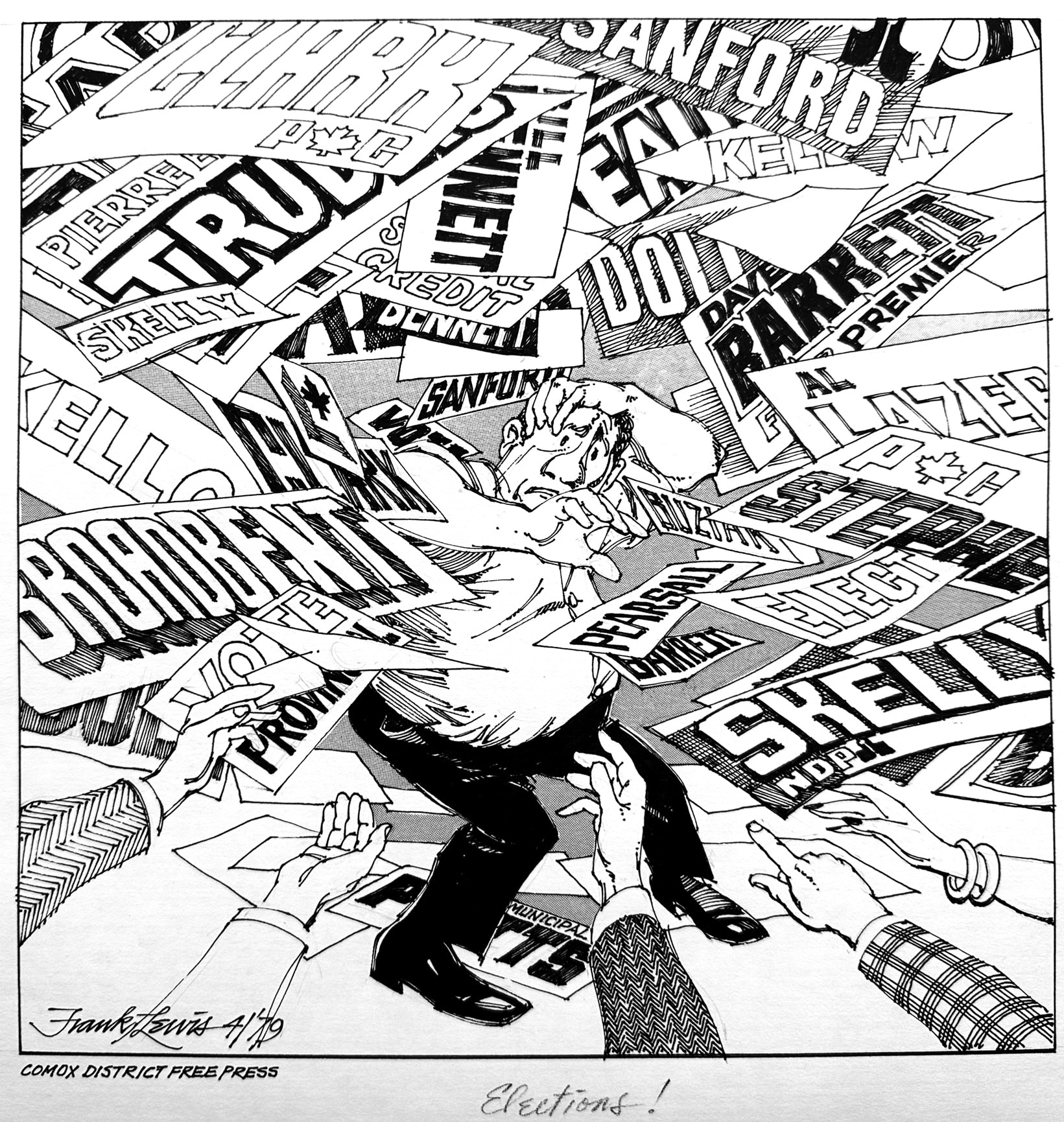
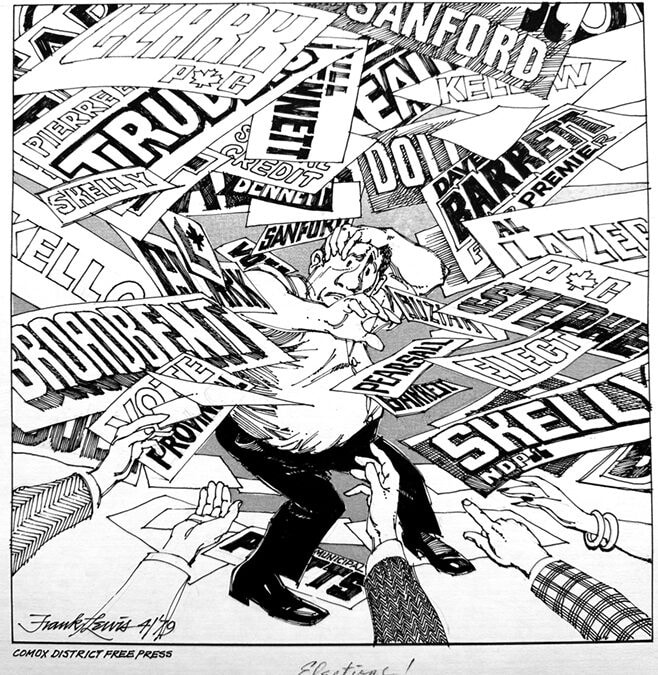
This April 1979 editorial cartoon published in the Comox District Free Press (AKA The Green Sheet), was drawn by the legendary Frank Lewis. He was a remarkable artist whose mural work can be seen all over the Island, including Victoria and Chemainus, and who contributed cartoons for the now defunct newspaper during the late 1970s and early 1980s.

For a Liberal government, vote for the NDP in the North Island-Powell River riding

By

A friend called me the other day to ask how she should vote in the North Island-Powell River riding on April 28th. The caller said she has always voted NDP, but some of her friends and neighbors have been leaning toward the federal Liberal Party this time.

She wondered if she should get on the bandwagon to help the Liberals win enough seats to defeat the Poilievre Conservatives?

I gave her what seems like a confusing answer to this important question.

Here’s what I said in a nutshell: If you want to help the Mark Carney Liberals form the next federal government, then DO NOT vote for them in the North Island-Powell River riding.

That seems counter-intuitive at first, but the Liberals haven’t won this riding since somewhere in the middle of the last century. For more than 50 years, the riding has swung back and forth between the NDP and the Conservative Party of Canada (CPC). 

No Liberal has ever come close to winning it, even when their party enjoyed wide popularity and won a national majority. 

And here’s the most important point: the NDP has only overcome strong Conservative support by the slimmest of margins; roughly 3,000 votes in 2019 and 2,000 in 2021. In both of those elections, the Liberals had weak campaigns in this riding and diminished national popularity.

The CPC vote, however, has been reliably consistent through the years and mostly undiluted by competing conservative parties.

What does all of that mean? It means if too many people who used to vote NDP suddenly switch to voting Liberal, that slim margin of victory disappears. And that guarantees victory for a completely unlikable Conservative candidate.

But why? My caller asked. Couldn’t the Liberal candidate win this riding and be a strong voice for the North Island in Ottawa?

I told her that for three reasons, I believe the Liberal candidate has absolutely no chance of winning this riding. 

First, historical voting trends are crystal clear: Vote totals for NDP and the CPC have consistently relegated the Liberals to a distant third place finish. To win this year, the Liberals would have to more than triple their vote count (from about 8,000 to over 24,000). That’s not just unrealistic. It’s magical thinking.

Second, until recently, this Liberal government hasn’t been widely popular, perhaps unfairly so, but the tarnish still lingers on their brand. While their new leader has injected a strong dose of hope and enthusiasm for party loyalists, not everyone has forgotten why they were so unhappy.

Third, there’s a reason the Conservatives were topping the polls before Justin Trudeau stepped down. Right-wing support has surged around the world. The anger that surfaced in the Freedom Convoy movement still exists. Alberta Premier Danielle Smith keeps stoking federal animosity. These populist signals have drawn out candidates with questionable values. For example, Aaron Gunn in the North Island.

Isn’t it the Number One goal in this election, I asked my friend, to keep those people from gaining power and turning Canada upside down, as the MAGA crowd is doing in the United States? I think it is, because defeating the Conservatives means protecting universal health care, fighting climate change, not becoming the 51st state and everything else that makes Canada great.

Yes, yes, she said, I know all that, but I want to vote FOR something, not just against the Conservatives.

As crazy as it sounds, I said, a vote for the NDP in this riding is a vote FOR a Liberal government. By voting for the NDP in the North Island-Powell River and Courtenay-Alberni ridings, you are supporting the progressive perspective, keeping it alive and giving those ideals the best chance of being solidified and expanded in Ottawa. Not voting strategically for the NDP turns back the clock on social justice.

Because the NDP still has a strong brand on Vancouver Island and the historically proven support to win this riding – actually, the best chance – voting for the NDP’s Tanille Johnston means one less seat for Poilievre and one more MP to support a potential Liberal minority government.

Or think of it the other way around, I concluded: Voting Liberal will subtract from the NDP’s total and put both parties in a dead heat tie for second place.

And, in politics, second place achieves nothing. So, I told my friend to vote for NDP Tanille Johnston.


ELECTION COUNTDOWN

Day(s)

:

Hour(s)

:

Minute(s)

:

Second(s)


ELECTION 2025 INFO

Advance polls will open from 9:00 a.m. to 9:00 p.m., local time 7-10 days before Election Day. Electors must vote at their assigned poll. ID is required to vote.

To find out where and when you can start voting go to this page on the Elections Canada website

The deadline to receive mail-in ballots at Elections Canada headquarters is 6:00 p.m., Eastern time, on Election Day, and the deadline to receive mail-in ballots at local Elections Canada offices is when polls close in the riding where the office is located.

The rules for voting internationally are different than voting in Canada. When you vote in Canada, you must prove your identity and address, click here.

You have three options:

  • Show one original piece of photo identification issued by a Canadian government, whether federal, provincial or local, or an agency of that government, that contains your photo, name and address (for example, a driver’s licence), or
  • Show two pieces of identification from a list authorized by the Chief Electoral Officer of Canada. Both must have your name and one must also have your address (such as a health card and utility bill), or
  • You can still vote if you declare your identity and address in writing and have someone who knows you and who is assigned to your polling station vouch for you. The voucher must be able to prove their identity and address. A person can vouch for only one person (except in long-term care institutions).

SUBSCRIBE TO OUR NEWSLETTER

Enter your email address to subscribe to the Decafnation newsletter.
The Meaning of Life: Five notable Vancouver Islanders reflect on their life’s journey

The Meaning of Life: Five notable Vancouver Islanders reflect on their life’s journey

The Meaning of Life: Five notable Vancouver Islanders reflect on their life’s journey

By

THE LAST WEEK before the start of a new year. It’s a time when people often reflect on their lives and make resolutions for the 12 months ahead. But as we look around at how differently other people have used and are using their lives – for an extreme example, Vladimir Putin versus Terry Fox – we sometimes wonder how best to use our own lives and what lessons we’ve learned as we travel this mysterious journey.

Decafnation starts a new tradition this year by asking selected Vancouver Island people to share their acquired knowledge that didn’t come from book-learning or academic studies. We begin today with the collective wisdom of five notable Vancouver Islanders rooted in the Comox Valley.

Read their interesting and varied stories here.

SUBSCRIBE TO OUR NEWSLETTER

Enter your email address to subscribe to the Decafnation newsletter.
More

The tooth fairy is only human

My daughter lost her first tooth playing outside on a late summer evening. Minutes later, I lost my parental halo after throwing the tooth fairy under the bus.

Lawn mowing, part 1: don’t run over the kids hiding in your lawn

While doing some seriously complicated scientific research on the most ergonomic entry and exit of the common household hammock, I came upon a startling statistic: more men are injured while mowing lawns each year than those who sit around and drink beer. In fact,...

Was Mother Earth Goddess drunk?

Today we celebrate the spring equinox, the beginning of a new astrological year, a time when hope and creativity soar and our hearts beat to the rhythm of the Earth’s renewal. And we just pray to the Mother Earth Goddess that it doesn’t fucking snow again. Because...

I’m really sick

I’m writing today’s column from The Office of Medical Terror, otherwise known as my bedroom. I’m doing this because a monster truck of influenza ran over me, then backed up and ran over me again, and afterwards dumped a load of pneumonia on me. The truck also hit my...

Is the genuine apology a forgotten or endangered species?

When civility in modern public discourse declines, it attempts to drag other forms of decent human interaction into the murky abyss of lost social conventions. The genuine apology, for example, teeters dangerously close to collateral damage. In the Trump world, you...

If we Vote-By-Google this spring, the Green Party would win

When people start suggesting that highly paid writers such as myself – rumored to be in the high single digits! – start writing about British Columbia’s spring provincial election campaign, we do what any other sane person would do: hide under our desks until those...

The Christmas fudge arrived with a resounding thud

It landed on our doorstep with a resounding thud. It measured about the size of a thick hardcover novel. It weighed more than 100 copies of “War and Peace” bound together. But all there was to read was a simple card, which said, predictably, “To my brother. Love, your...

THE WEEK: As Puntledge River goes lower, Colorado drinking recycled wastewater

THE WEEK: As Puntledge River goes lower, Colorado drinking recycled wastewater

Salmon fighting their way up the Puntledge River, a challenge with low water levels

THE WEEK: As Puntledge River goes lower, Colorado drinking recycled wastewater

By

This week, it’s all about water. How much do we have? How much are we going to get? And, should we be wasting potential drinking water by flushing it into the Strait of Georgia?

Record low water levels in the Mississippi River, that nation’s most important transportation waterway, have caused ships to run aground and last month backed up 3,000 barges full of corn, soybeans and other goods for export. Further west, the shrinking Colorado River threatens everything from drinking water supplies to California’s agriculture industry that supplies us with winter vegetables and fruit.

It’s a similar story across Europe where the worst drought in 500 years has rivers running dry.

With the amount of rain that falls annually on Vancouver Island, you might think we have an abundance of water and that we’ll never have to worry about a shortage of drinking water. Think again, if this fall’s precipitation levels are any harbinger of the future.

We wrote about low water levels in Comox Lake recently and the situation has not gotten better. It’s gotten worse. The Puntledge River flow is so low now that the BC Hydro powerhouse is no longer operating.

Hydro spokesperson Stephen Watson says that this fall’s drought has broken the company’s 55-year record of continuously generating electricity on the Punteldge River. But thanks to an integrated provincial hydroelectric system, the Comox Valley will have an adequate supply of power.

That means we can still put up Christmas lights, but our fishy friends aren’t quite so lucky. Hydro has deployed fish salvage crews at key parts of the river. If the river flows go any lower, it will expose salmon eggs in the gravel, which is potentially good news but only for seagulls and eagles.

The company has reduced water flow into the river down to 9 cubic meters per second. It has been at 11.5 m3/s, and the minimum fish habitat flow below the powerhouse and fish hatchery is 15.6 m3/s.

“The one positive about having the river flows so low this fall is that salmon, like chum, which typically spawn after Oct. 1, have spawned in areas near the middle of the river versus the entire riverbed, so without latest river flow reduction, those eggs should remain wetted,” Watson wrote in a report this week.

Still not concerned? Watson says the snowpack in the upper Comox Lake Watershed is less than 25 percent of normal for this time of year. This week’s storms will help, but they aren’t expected to return snowpacks to normal.

Is it too soon for the Comox Valley to consider redirecting wastewater into our drinking water supply?

Sounds yucky, right? But several U.S. cities are already extracting water from their sewage treatment plants and sending it directly to people’s kitchen taps. Recently, Colorado became the first state to adopt direct potable reuse regulations.

The Coors Brewing Company may soon have to drop it’s slogan, “Brewed with Pure Rocky Mountain Spring Water.” According to an Associated Press report, the 105 West Brewing Company in Castle Rock, CO, is already serving beer made with water from recycled sewage and getting no complaints from customers.

Making wastewater potable involves disinfecting it with ozone gas or ultraviolet light and then “filtering it through membranes with microscopic pores.” And it’s an expensive process, especially if new infrastructure is required.

But it looks like the future. The Associated Press reports that Florida, California and Arizona are considering similar regulations and that other states have direct potable reuse projects underway.


SUBSCRIBE TO OUR NEWSLETTER

Enter your email address to subscribe to the Decafnation newsletter.
More

Overwhelmed by so many candidates? Just vote for the ones you know and like

For many Valley residents, it’s difficult and time consuming to gather the necessary information to make thoughtful selections in municipal elections. And paid trolls and fake posters on social media pages make it even more difficult. Public candidate forums help, but there is a simple solution for frustrated voters

“Liberal Rush” tricked voters in NDP ridings and exposed an electoral system flaw

Despite the positive big picture outcome, this election exposed a glaring vulnerability within our electoral system. And that vulnerability caused otherwise smart people to forget how our Canadian parliamentary system actually works. Namely: We do not have a proportional representation form of government. But there is a simple solution.

“Sexual deviancy in our schools!” says local disciple of right-wing Christian group

“Sexual deviancy in our schools!” says local disciple of right-wing Christian group

A portion of the Action4Canada leaflet handed out this week by a school trustee candidate

“Sexual deviancy in our schools!” says local disciple of right-wing Christian group

By

In a crazy election year when a few municipal council candidates are running to avenge personals grudges or spread misinformation about climate change and COVID vaccinations, why shouldn’t a school trustee join in on the fun?

Anita DeVries, a candidate for the School District 71 board of education, took to the streets earlier this week in an unusual campaign strategy to warn people around Courtenay Elementary and Lake Trail that schools are “grooming” our children for “sexual exploitation.”

We had no idea what vile things were happening in our local schools until we saw the brochure DeVries was handing out. It’s shocking!! So shocking that it requires two exclamation points.

DeVries’ brochures claim our schools have been infiltrated by radicals who are using sexually explicit and pornographic books to promote homosexuality and normalize sexual deviancy. Apparently, according to the material Ms. DeVries was handing out, teachers are encouraging our kids to masturbate. They intentionally confuse kids about their gender and then offer surgeries that will permanently mutilate their bodies and sterilize them.

Holy mackerel! And this is going on right under our noses?

Of course not. It’s all bullshit dreamed up by a far-right Christian nationalist organization called Action4Canada. They don’t like the SOGI 123 curriculum used by public school teachers, which is endorsed by the provincial government to educate students about sexual orientation and gender identity. The program is designed in a way to make every student feel like they belong.

And here’s a big surprise: Action4Canada supported and participated in the trucker convoy and anti-vaccination occupations earlier this year. Among the issues they are targeting, according to their website, are 5G technology, abortion, vaccine mandates, cannabis legalization, the United Nations Global Compact on Migration, “political LGBTQ” and “political Islam,” whatever that means.

Canadians used to politely humour people who spewed wacky ideas, but it’s not funny now. Spreading misinformation meant to scare people goes beyond civil discourse and issue-based disagreement.

And the people who promote that misinformation now feel legitimized enough to run for public office. They want to control our local governments and schools. Places they should be banned from getting closer to than, let’s say, a hundred miles.

But they’re real and just like down in the states they want time on the big stage. We should not give it to them.

Based on DeVries’ apparent inability to separate fact from fiction about SOGI 123, she should receive zero votes. But our guess is she’ll get more than that.


SPEAKING ABOUT MISINFORMATION

Incumbent Comox Councillor Ken Grant went all out on an expensive tri-fold campaign brochure this year. But we noticed some misinformation in his section about climate action.

Grant lists a number of items and puts a checkmark next to them, supposedly climate actions he supported. Except he didn’t.

When Grant lists “Tree Bylaw” and puts a checkmark next to it, he’s telling you this is something he had a hand in achieving. But on Feb. 16, 2022, didn’t Grant actually vote against the town’s Tree Retention Bylaw?


ONLY VOTE FOR THE CANDIDATES YOU LIKE

Many voters don’t realize that if there are six council positions up for election, you don’t have to vote for six candidates. Your ballot will be perfectly legal if you only vote for one candidate, or four. There is no requirement to vote for all six positions.

In fact, by only voting for the candidates you really like, you give your favorites a better chance of winning than if you vote for other candidates just to “fill out” your ballot. Your vote for somebody you’re unsure about could put that candidate ahead of those you actually want to elect.

This is especially true for voters who haven’t had the time or opportunity to learn about every candidate and really understand why they’re running for office, which is most of us.

Vote only for those you know and trust. Period. Don’t take a flyer on somebody who might be wrong for you just because you think there must be six Xs on your ballot.


NO ALL-CANDIDATES DEBATES

It’s disappointing that nobody organized an all-issues, all-candidates meeting this year. Without an opportunity to quiz the candidates in person and hear them respond spontaneously to a variety of issues, voters will be going to polling stations armed with less than the usual information.

But there will be an opportunity to see and hear the Courtenay council candidates discuss climate change-related questions at 6.30 pm next Tuesday, Oct. 4 at the NIC theatre. Thank goodness for the college’s nursing students.

And all Comox Valley candidates for municipal office have been invited to discuss the social determinants of health in a cafe-style format on Friday, Oct. 7 at the K’omoks First Nation band hall. Area A, Comox and Cumberland candidates will discuss the topic from 3.00 pm to 4.45 pm. Then, Area B, Area C and Courtenay candidates will take the stage from 6.00 pm to 7.45 pm.

What we’re missing this year is an anything-goes debate where voters can see who really has command of the issues and who’s faking it. Who shines and who fades.

The Comox Valley Chamber has taken on this role in the recent past. But they’re in the middle of a transition to a new CEO, so that might explain their absence this year.

So where are the Comox Valley Record and the two radio stations that like to boast of their news coverage, The Eagle and The Goat, when we need them to fill that gap? In other communities, we know that private media companies regularly fulfill their community service obligations by organizing town hall meetings or all-candidate forums. Maybe next time.


WHERE AND WHEN TO VOTE

General Voting Day is Saturday, Oct. 15 for all local government positions.

Comox Valley Regional District

General Voting Day (Saturday, Oct. 15) and advance voting (Wednesday Oct. 5 and Wednesday Oct. 12) take place at the CVRD building in Courtenay from 8 am to 8 pm.

Go to this link for General Voting Day locations in the three Electoral Areas.

Additional voting takes place on Oct. 6 from 9 am to 12 pm on Denman Island and on Oct. 6 from 2 pm to 5 pm on Hornby Island

Courtenay

Advance Voting begins on Wednesday October 5, 2022, 8 am to 8 pm at the Native Sons Hall, and again on Wednesday October 12, 2022, 8 am to 8 pm at the Florence Filberg Centre.

General Voting Day, Saturday, October 15, 2022, 8 am to 8 pm at the Queneesh Elementary School, and at the Florence Filberg Centre.

Comox

Advance voting begins Wednesday, October 5 from 8 a.m. – 8 p.m. at the Comox Community Centre, and on Saturday, October 8 from 10 a.m. – 2 p.m. at the Genoa Sail Building at Comox Marina, and again on Monday, October 10 from 10 a.m. – 2 p.m. at the Genoa Sail Building at Comox Marina, and on Wednesday, October 12 from 8 a.m. – 8 p.m. at the Comox Community Centre.

General Voting Day runs from 8 am to 8 pm on Oct. 15 at the Comox Community Centre.

Cumberland

All voting in the Village of Cumberland takes place from 8 am to 8 pm at the Cumberland Cultural Centre. Advance voting takes place on Oct. 5 and Oct. 12.

SUBSCRIBE TO OUR NEWSLETTER

Enter your email address to subscribe to the Decafnation newsletter.

More

Here’s the latest Comox Valley local government election results

Mayor Bob Wells and all Courtenay incumbent councillors have been re-elected. Evan Jolicoeur has also been elected. Manno Theos has lost his seat.

Jonathan Kerr, Jenn Meilleur, Steve Blacklock, Chris Haslett, Ken Grant and Maureen Swift have been elected in Comox.

Vickey Brown has been elected mayor in Cumberland, defeating long-time mayor and councillor Leslie Baird.

Voting down -20.6% in Courtenay, -22.3% in Comox and -50.9% in Cumberland.

Full results with Electoral Areas A, B and C, school board and Islands Trust results in the morning.

Daniel Arbour in Area A and Edwin Grieve in Area C won by wide margins. Richard Hardy defeated Arzeena Hamir by 23 votes.

Shannon Aldinger topped the polls in races for SD71 school trustees.

Click the headline on this page for complete results and voter turnout.

Our recommendations in the 2022 Comox Valley local government elections

Decafnation announces its list of preferred candidates in this year’s local government elections and for the first time we identify candidates that we think show promise and provide our reasons for not endorsing the other candidates. Our endorsements fall on the first day of voting at advance polls