Here are the latest preliminary results from Civic Info BC. A * preceding a candidate’s name indicates an incumbent. Decafnation will update results as they become available. The boldface type indicates elected candidates.
VOTING DATA 2022
COURTENAY: 5,854 votes cast; 25.9% turnout of eligible voters
COMOX: 3,412 votes cast; 28.5% turnout
CUMBERLAND: 1,420 votes cast; 41.9% turnout
CVRD: 5,245 votes cast; 26.2% turnout
VOTING DATA 2018
COURTENAY: 7,372 votes cast; 37.1% turnout of eligible voters
COMOX: 4,392 votes cast; 40.4% turnout
CUMBERLAND: 2,892 votes cast; 48.0% turnout
CVRD: Voter turnout per electoral area not available; 29.1% overall
Our recommendations in the 2022 Comox Valley local government elections
By
In local government elections, the official campaign period lasts a mere four weeks. For some people, that’s long enough and they can’t wait for all the signs to come down and for hopeful candidates to stop knocking on their door.
But that isn’t really much time at all for such an important event as choosing the future of your community.
But we understand that voting can be a difficult task. It takes a concerted effort to scope out which candidates will best represent your views because you don’t get a lot of help. There are too few all-candidate forums this year that allow you to assess and compare the candidates in person. That leaves local news outlets and social media as the primary distributors of helpful information.
Decafnation tried to interact with as many candidates as our resources permitted this year but we found it disheartening that some candidates refused to collaborate with us. While most candidates did respond to our questionnaires and answer questions via email, an unusual number of candidates did not.
We think that reflects a prevailing mood in this year’s local elections that turned dark and menacing after the ultra-conservative and secretive group Take Back Comox Valley published advertisements that contained intentional misinformation.
Our candidate interactions, or the lack of them, have played a crucial role in determining which candidates we recommend today.
Some observations about our recommendations.
Four years ago, we generally supported qualified younger candidates because they are the ones who will have to live with the decisions our local governments make today. We respectfully encouraged the old horses in the race that their time had passed and that it was now time to let go.
Voters had similar thoughts, electing all but four of the candidates we endorsed for the region’s 22 local government positions. We did not endorse for school district trustees.
This year, we are again supporting that youthful and progressive movement so that they may complete their four years of work charting a path for the future of the Comox Valley suited to this modern time.
For example, the candidates we’ve endorsed understand that municipal-level decisions must always improve our adaptation to climate change.
That means, among other things, creating the opportunity to move around our communities without using a car, preserving a larger tree canopy, not giving in to urban sprawl and protecting future taxpayers from the unnecessary infrastructure debt it creates and supporting every practical policy to shift away from consuming fossil fuels.
We believe the local governments you elected in 2018 have made important strides toward a better future for everyone who lives here and that they have earned the chance to continue this work for another term.
It is the responsibility of incumbents to defend their record and it is the job of challengers to show why they would do better. This year, the challengers have failed to make that case.
Decafnation realizes that some readers won’t agree with our choices. We’re okay with that. Information, not persuasion, is our objective.
We admire and congratulate everyone who’s stood for election. It takes courage and love of community.
Finally, look for our coverage of the District 71 Board of Education election, and endorsements, later this week.
Additional voting takes place on Oct. 6 from 9 am to 12 pm on Denman Island and on Oct. 6 from 2 pm to 5 pm on Hornby Island
Courtenay
Advance Voting begins on Wednesday October 5, 2022, 8 am to 8 pm at the Native Sons Hall, and again on Wednesday October 12, 2022, 8 am to 8 pm at the Florence Filberg Centre.
General Voting Day, Saturday, October 15, 2022, 8 am to 8 pm at the Queneesh Elementary School, and at the Florence Filberg Centre.
Comox
Advance voting begins Wednesday, October 5 from 8 a.m. – 8 p.m. at the Comox Community Centre, and on Saturday, October 8 from 10 a.m. – 2 p.m. at the Genoa Sail Building at Comox Marina, and again on Monday, October 10 from 10 a.m. – 2 p.m. at the Genoa Sail Building at Comox Marina, and on Wednesday, October 12 from 8 a.m. – 8 p.m. at the Comox Community Centre.
General Voting Day runs from 8 am to 8 pm on Oct. 15 at the Comox Community Centre.
Cumberland
All voting in the Village of Cumberland takes place from 8 am to 8 pm at the Cumberland Cultural Centre. Advance voting takes place on Oct. 5 and Oct. 12
The Week: Big Money wants its control back and a candidate wins 2022 Moronic award
By
We have to hand it to that vicious Big Money Gang that pooled their pocket change to launch some mean-spirited attack ads on social media. They took a page right out of Trumpville and tossed down some nasty smack, never mind that the ads made no sense – Reality check: nobody’s trying to defund the Comox Valley RCMP detachment! – these are just a handful of chickenshit middle school bullies who have more lunch money than you but want to steal your snacks anyway.
Well, they got the attention they wanted, but, like all angry people who feel entitled, they made themselves look like morons. That’s what happens when you abuse the privilege of free speech by spewing lies and misinformation and then hide behind anonymity.
Take Back Comox Valley was smart enough, however, to schedule their smear campaign before the official “campaign period” began on Sept. 17. Elections BC tells Decafnation that it received a complaint about the Take Back Comox Valley social media drivel several weeks ago, but the EBC determined the ads did not violate election advertising laws because they ran during the pre-campaign period (July 18 to Sept. 16). Mind boggling. Slapping them with a fine wouldn’t have made a difference anyway.
But here’s the interesting question, where do they think the Comox Valley went? And who do they want to Take it Back from?
Where did “their” Comox Valley go? It went away from them. Over the last two municipal elections, increased numbers of progressively-minded voters have elected progressively-minded people to the Valley’s councils and boards who had the gall, the audacity to start challenging the old way of doing things. And that pissed off the Big Money Gang. They lost their self-claimed right to control and now they want it back.
And what might they want do with that control? They apparently don’t want safer streets (17th Street), but they do want to pave more rural land. They don’t want affordable housing, they want to build more expensive single-family houses. They aren’t concerned about forcing future generations of local residents into enormous debt by extending infrastructure to service new subdivisions outside the urban boundaries, but they stamp their feet when the council has to maintain existing infrastructure (Fifth Street Bridge). And for God’s sake don’t get them started on climate change or social issues like public health orders, childcare or rainbow crosswalks because their heads will explode.
So who was it that took “their” Comox Valley? Well, it’s a safe bet it wasn’t the Village Council in Cumberland. That council has been almost pitch perfect with its community for quite some time, so it would have strong immunity to the advertisements’ violent denunciations. And it’s unlikely the Big Money Gang planned a hit on the Comox Town Council because until the last year the old guard has controlled that bunch of obstructionists through their council henchmen.
So it feels like the Big Money Gang has its crosshairs aimed squarely at the Courtenay City Council and the regional district directors in Areas A and B. These are three of the hotbeds that breed the progressive ideas that are moving the Comox Valley into the 21st Century, where forward-thinking people are planning for the serious and wide reaching adaptations necessary to accommodate our population growth, the changing employment environment, unrelenting social issues and our evolution into an era dominated by climate change.
The good news is that these progressive thinkers didn’t get elected by accident or mistake. They were chosen by an electorate that has itself become more progressive; to wit, climate change deniers are now the crazies on the fringe. In municipalities everywhere, progressive thinking has become the mainstream by necessity. Wildfires, floods and heat domes are forcing us to think and plan for the unthinkable, such as where our food comes from and how much water we have.
The mayor of Lytton has said that as a man in his 60s, he thought climate change was something the next generation had to worry about. “Now I’m the mayor of a town that doesn’t exist.”
And the even better news is that we the people have the ultimate weapon to keep the Big Money Gang from eating our lunch: a vote. If you don’t want the clock turned backwards on progress in the Comox Valley, then haul your ass out of the house and vote.
HEY, BRENNAN, PICK UP A PHONE
Decafnation got a big kick out of Courtenay council candidate Brennan Day trying to shrug off his trademark infringement – using the logos for the City of Courtenay and the province on a couple of his campaign signs – by saying in a Comox Valley Record article that he was doing it intentionally to get attention, which we have to say sounds like a lot of BS.
It appeared to us and many others that Day was trying to make his signs look more “official” while complaining about the cost of maintenance on the Fifth Street bridge and to improve safety conditions on 17th Street. Because without the logos and with just the word “misspent,” handwritten to look like graffiti, the sign looks like it came from a crackpot.
But that’s not the funny part. At the end of the article is a long quote from Day in which he admits he knew using the logos was wrong, but since he couldn’t find precise language in the city’s bylaws saying so, he did it anyway. And then he goes on to blame the city staff for not having a more clear bylaw. So, is it their fault he broke the law?
And, then in the most alarming statement ever, Day admits that he checked out the bylaws of other cities and found out that they clearly prohibit using city logos in campaign material.
What?!
He makes the effort to check the bylaws of other cities, where he learns they say no to using logos, but he doesn’t bother to pick up the phone and ask his own City Hall staff? Oh, that’s right, he doesn’t live in Courtenay. Still, it’s not a long distance call.
Well, anyway, Day wins our award for the Most Moronic Explanation That Turned Into a Giant Foot In The Mouth of the 2022 election campaign. So far.
In case you missed it, here’s the whole quote from the Record.
“To be fair, I did check into the municipal bylaws, and they are ambiguous as to the use (of city logos), or at least I couldn’t find it in my research, so I decided to try it. Obviously, they are covered up now… In a lot of other jurisdictions, they spell it out very clearly, that use of the city logos on campaign literature and advertising is not allowed. Courtenay seems that they are a little bit behind in their bylaws.”
Good grief.
CANDIDATE FORUMS
Want to watch and hear some candidates answer questions in person? Here’s a few public events we know about:
Climate change will be the focus of an all-candidates forum for the mayor and council candidates in Courtenay. The event is at 6.30 pm on Tuesday, Oct. 4 in the North Island College theater. It has been organized by NIC nursing students and the Canadian Association of Nurses for the Environment. The public is also invited to submit questions.
The Comox Valley Chamber of Commerce has planned a “Meet and Greet” for all council, regional district and school board candidates from 5 pm to 7 pm on Tuesday, Sept. 27 at the Courtenay & District Museum.
There will be a forum for positions on the School District 71 Board of Trustees at 6:30 pm in the All Purpose Room at G.P. Vanier Secondary School. The event has been organized by the District Parent Advisory Council (DPAC), the Comox District Teachers’ Association (CDTA), and The Canadian Union of Public Employees Local 439 (CUPE). You can submit questions in advance.
WHERE AND WHEN TO VOTE
General Voting Day is Saturday, Oct. 15 for all local government positions.
Comox Valley Regional District
General Voting Day (Saturday, Oct. 15) and advance voting (Wednesday Oct. 5 and Wednesday Oct. 12) take place at the CVRD building in Courtenay from 8 am to 8 pm.
Additional voting takes place on Oct. 6 from 9 am to 12 pm on Denman Island and on Oct. 6 from 2 pm to 5 pm on Hornby Island
Courtenay
Advance Voting begins on Wednesday October 5, 2022, 8 am to 8 pm at the Native Sons Hall, and again on Wednesday October 12, 2022, 8 am to 8 pm at the Florence Filberg Centre.
General Voting Day, Saturday, October 15, 2022, 8 am to 8 pm at the Queneesh Elementary School, and at the Florence Filberg Centre.
Comox
Advance voting begins Wednesday, October 5 from 8 a.m. – 8 p.m. at the Comox Community Centre, and on Saturday, October 8 from 10 a.m. – 2 p.m. at the Genoa Sail Building at Comox Marina, and again on Monday, October 10 from 10 a.m. – 2 p.m. at the Genoa Sail Building at Comox Marina, and on Wednesday, October 12 from 8 a.m. – 8 p.m. at the Comox Community Centre.
General Voting Day runs from 8 am to 8 pm on Oct. 15 at the Comox Community Centre.
Cumberland
All voting in the Village of Cumberland takes place from 8 am to 8 pm at the Cumberland Cultural Centre. Advance voting takes place on Oct. 5 and Oct. 12.
The announcement nobody was waiting for arrived over the weekend when CV Mainstream trotted out their list of endorsed candidates without any justification for these particular candidates, and we notice somebody was conspicuously missing
Only half of the candidates for the town of Comox council responded to Decafnation’s three questions on public health orders, the Regional Growth Strategy and the role of local governments in regard to climate change
The Week: A Comox Valley school trustee candidate hands out leaflets that spread misinformation about a sexual health curriculum; Strategic voting; and, Is Ken Grant for or against the town’s tree retention bylaw?
Candidates for six positions on the Courtenay City Council respond to our three questions on public health orders, the Regional Growth Strategy and the role of local governments in regard to climate change
2022 Comox Valley Regional District Electoral Area A candidates answer Decafnation’s three questions on public health orders, the RGS and climate change
2022 Comox Valley Regional District Electoral Area B candidates answer Decafnation’s three questions on public health orders, the RGS and climate change
2022 Comox Valley Regional District Electoral Area C candidates answer Decafnation’s three questions on public health orders, the RGS and climate change
Folks, are you asking yourself, What’s the point of dragging yourself out on a perfectly nice autumn day to stomp down to some barren gymnasium and scratch an X next to the name of somebody you don’t know but who wants to represent you in local government?
Comox Valley local government elections ramping up for Oct. 15 vote
By
In just 49 days, Comox Valley voters will decide who they want to form our local governments. At stake are seats on four municipal councils, three rural electoral areas, the school board and Island Trust representation for Denman and Hornby islands.
The official “nomination period” for candidates to declare their intention to seek public office starts Tuesday, Aug. 30 and closes on Friday, Sept. 9. That leaves about five weeks for the campaign because Election Day is on Saturday, Oct. 15, although there will be advance voting days.
General election advertising rules have already come into effect on July 18 and will extend through Election Day. The regulations governing candidate and third-party spending limits start on Sept. 17.
So, in just a few weeks, the public will know who’s running for what. But why they are running, well, that’s something else. You’ll get the usual candidate statements published in the local media that are carefully crafted to hit all the right notes without revealing the authors’ true voices.
We’ve decided to revive a version of Decafnation for the next couple of months to shine a little extra light on some of the candidates so that at least readers of this website will have some deeper insight into who they’re voting for.
We won’t be doing long investigative pieces, although we will interview some candidates. In the main, we’ll provide commentary on the issues and where candidates actually stand on them and, later on, provide our endorsements.
WHO WE THINK IS RUNNING
Many incumbent candidates and a few new challengers have already announced that they will seek re-election.
For the Courtenay City Council, we believe David Frisch, Wendy Morin, Melanie McCallum, Doug Hillian, Will Cole-Hamilton and Mano Theos are running. Newcomers Evan Jolicoeur and Michael Gilbert hope to get one of the six council seats. Brennan Day is also running again, he ran unsuccessfully in 2018 and also for MLA as a BC Liberal Party candidate in the last provincial election.
Former city council member Erik Eriksson plans to make another bid for Courtenay Mayor, opposing incumbent Bob Wells.
In Comox, Nicole Minions, Alex Bissinger and Jonathan Kerr will most likely seek re-election. Incumbent Stephanie McGowan’s family has moved to a Courtenay address, although that doesn’t prohibit her from running for a Comox Council seat. We’ve heard that Jenn Meilleur may run for council.
We expect the three Electoral Area seats on the Comox Valley Regional District board to receive some extra attention this year, but all we know at the moment is that incumbents Daniel Arbour (Area A) and Arzeena Hamir (Area B) are running again and that it’s likely Edwin Grieve (Area C) will also seek another term.
And incumbent Cumberland Mayor Leslie Baird says she’ll seek a fourth term leading the Village Council. At the end of the current term, she will have logged 32 years of continuous service in public office. It’s possible Baird will have a serious opponent this time if you believe the rumour that incumbent councillor Vicky Brown is leaning toward a run at the mayor’s chair.
And, finally, we’d be surprised if Jesse Ketler doesn’t run again for Cumberland Council and possibly return as chair of the CVRD, where she’s been a neutral force between the warring Comox and Courtenay representatives.
ISSUES IN THE 2022 ELECTIONS
Some of the issues most likely to emerge from the candidates during the 2022 local government campaign haven’t changed from 2018: housing affordability, access to green space, the livability of our valley and issues around local employment.
Some of the issues from 2018 have been resolved. Courtenay adopted a new Official Community Plan. The regional district won its battles with 3L Developments over violating the Regional Growth Strategy and finally, thankfully, disbanded the Economic Development Society.
But some issues still linger, chief among those would be the fate of Shakesides, the historic home of Hamilton Mack Laing. The Town of Comox has dragged its feet – and broken an ethical and fiduciary trust – on resolving this issue for the past 40 years, but never so disappointingly as during the last four.
All the incumbents pledged during the 2018 campaign to resolve the Shakesides issue (except Jonathan Kerr, who was only elected in the 2021 by-election). But they haven’t, despite Mayor Russ Arnott’s fury in 2019 to get the building torn down.
And there are big new issues waiting for the next local government officials. At the top of that list is a required review of the Regional Growth Strategy, which will be followed by an update to the Rural Comox Valley Official Community Plan. Myriad contentious issues live within those few words and we have no doubt that the 2022 election campaigns will only be the start of the debate.
The Comox Valley Regional District has formally recognized its commitment to reconciliation with Indigenous Peoples in a statement adopted by the board last week
Decafnation volunteers have compiled key financial information from Comox Valley local government reporting. Are tax increases, policing costs and accumulated surpluses in line with other communities?
Comox Valley electoral area directors told land applications of biosolids pose a danger to humans and a legal risk for the regional district, but the CVRD has invested heavily to produce a more highly treated Class A composting product
Anonymous petition launched to convince Courtenay Council to annex 3L Developments property to save Stotan Falls; critics call the petition a “trojan horse” and urge people not to sign. Meanwhile, 3L notices homeowners it will start logging in two weeks
Nanaimo-Ladysmith MP Paul Manly writes that British Columbia could advance reconciliation with First Nations on southern Vancouver Island next year and at the same time protect watersheds, endangered species and create sustainable economic opportunities.
With logging threatening several large natural assets, the Comox Valley Regional District voted this week to begin a process to re-activate a regional parks service. It could 12 months or more.
All four Comox Valley governments apply for one-time, 100% provincial funds for ready-to-go infrastructure projects that can create immediate jobs and help communities recover from the economic impacts of the pandemic.
3L Developments signalled to the Comox Valley Regional District today that it would like to sell its nearly 500 acres of property in the Puntledge Triangle and warned that there was only a small window of opportunity before it proceeds to log the timber and extract gravel from the site
Comox Valley local governments are planning their 2021 budgets | Scott Graham photo
Local governments start their 2021 budgets; who is the CVs highest-paid official?
By
It’s not coincidental that Comox Valley residents receive their property value assessment notices in January just as local governments start their annual budgeting processes. Property taxes are the principal source of revenue for most BC municipalities.
By provincial law, local governments must complete their 2021 budget as part of a five-year financial plan every year by March 31. Homeowners start to receive their property tax notices about a month later.
And even though local government budget meetings are open to the public, few taxpayers attend them in order to learn how local elected officials spend our tax dollars.
Do you know, for example, how much your municipal councillors are paid? How many municipal employees make more than $75,000 per year? Do you know what we pay the RCMP for protection services or how much each government has accumulated in surplus revenue?
Have you filled out Decafnation’s Local Government Performance Review? It’s a short survey measuring Comox Valley voters’ level of satisfaction with their local governments.
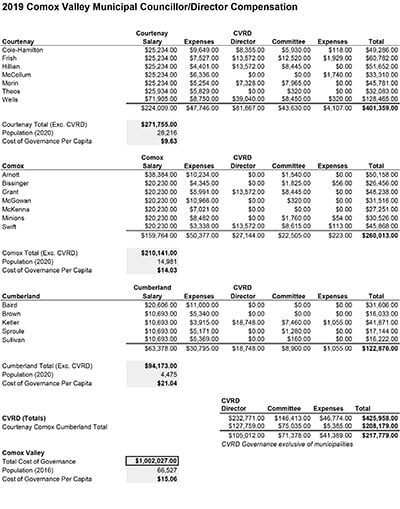
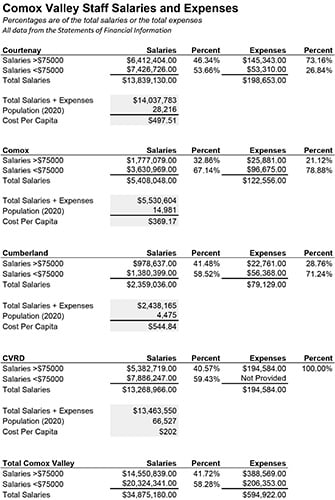
With the help of a few volunteers, Decafnation has compiled data from our local government’s financial reports and broke it down on a per capita cost and compared those numbers with two of our municipal neighbours: Campbell River and Nanaimo.
We used each government’s 2019 Statement of Financial Information (SOFI) and their corresponding 2019 Annual Report as the basis for our information. The 2020 reports are not yet available.
Readers can look through all of our collected data by clicking the links elsewhere on this page, or by clicking the links to each government’s financial reports.
ELECTED OFFICIALS SALARIES
All Comox Valley municipal elected officials are considered part-time positions. That includes the three mayor positions and regional district directors.
Courtenay Mayor Bob Wells was the Comox Valley’s highest-paid elected official in 2019, earning $128,465 in salary and expenses from the city and the Comox Valley Regional District. The next highest mayor or councillor earned less than half of that amount.
Courtenay Mayor Bob Wells
On top of his $71,905 mayor’s salary, Wells took home another $47,810 from the regional district in director wages, committee compensation and expenses. He served as chair of the regional district board in 2019.
Courtenay Councillor David Frisch earned the second-highest amount of $60,782 from his salary of $28,021 as a CVRD director in addition to his $25,234 city council remuneration.
However, all three electoral area directors earned slightly more than Frisch because electoral area directors receive a higher base salary as their area’s only elected representatives.
Area C Director Edwin Grieve and Area B Director Arzeena Hamir both took home $64,849 in salary and expenses, while Area A Director Daniel Arbour earned $63,3472.
Comox Mayor Russ Arnott was the third highest-paid council member in 2019 at $50,158 — $38,384 from Comox and another $11,774 from his regional district duties.
On the expenses side, the top three were Cumberland Mayor Leslie Baird who claimed slightly more in expenses ($11,000) than Comox Councillor Stephanie McGowan ($10,966) and Comox Mayor Arnott ($10,234).
But all three of those expense totals were higher than any single councillor in the City of Nanaimo (highest $10,251) and all Campbell River councillors except for Charlie Cornfield who claimed $11,782 in expenses.
ADMINISTRATION COSTS
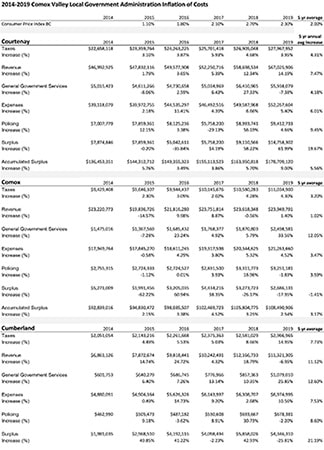
In a separate spreadsheet, the Decafnation volunteers broke out some of the key administrative costs of running a local government.
One of the highlights on this spreadsheet is that all jurisdictions have increased revenues year over year, in part due to the growth of the Comox Valley.
But it also shows that tax rate growth has exceeded the Consumer Price Index for British Columbia. This is also true for Nanaimo and Campbell River. Could this be because expenses have increased faster than new growth on Vancouver Island can support?
Tax rate growth is one area where public involvement in the budgeting process can directly affect the outcome.
The chart also shows that municipal expenses — the bulk of which are labour costs — have also increased year over year and exceeded the CPI in the municipalities. But not at the Comox Valley Regional District where expenses were kept a half-point lower than the five-year CPI average.
In Comox, the five-year average shows the town’s expenses outstripping revenue by more than two percent.
MAKING SENSE OF SURPLUSES
One of the tricky areas of municipal budgeting involves accumulating surpluses. Provincial legislation requires regional districts and municipalities to account for surpluses differently.
Courtenay, Comox and Cumberland may accumulate “unspent surpluses” that in theory can be used for any purpose in the future. There are also reserves for an intended service, such as water and sewer reserves. These can only be used for their stated purpose, and cannot be transferred for something like road improvements.
And, there is also another type of reserves that are created by council policy and not a legislative requirement. Courtenay’s Infrastructure Renewal Reserve is one example. These types of reserves could be moved from one purpose to another, but it would require a council resolution and is not a common practice.
By contrast, the regional district may only have reserves set aside for a specific service that it provides and these are usually attached to a plan for anticipated expenditures.
As you can see in our spreadsheets, the three municipalities of Courtenay, Comox and Cumberland have a combined accumulated surplus of more than $348 million and the regional district has an additional $178 million in reserve. That compares to $305 million in Campbell River and $831 million in Nanaimo.
POLICING COSTS
The data shows that Courtenay clearly bears the burden of protective services in the Comox Valley. It may mean that the city has been subsidizing protective services in the other areas.
Part of this anomaly occurs because Courtenay’s population qualifies it as a city, whereas Comox has been classed as a town. Those designations may change this year. If so, Comox’s share of policing will increase and Courtenay’s share will decrease.
But it is interesting to note that policing costs increased in Courtenay last year, while they decreased in Comox and Cumberland.
The RCMP manages the Comox Valley as a single detachment. The same officers respond to calls in all jurisdictions.
Courtenay paid $9,412,733 in 2019 of the Comox Valley’s total RCMP cost of $17,869,053, or 53 percent. That was an increase of 5.5 percent over 2018 and nearly triple what the Town of Comox pays.
Comox paid $3,251,181 in 2019 or 18 percent of the total policing costs. Cumberland paid four percent and the regional district paid 25 percent.
We noted that while Courtenay pays more per capita for policing than Nanaimo, policing costs represented close to the same percentage of revenue and expenses for both cities.
MUNICIPAL EMPLOYEES
All local governments’ financial statements include a break out of employees paid more than $75,000 per year and those paid less.
In all three municipalities and the Comox Valley Regional District, the percentage of salaries under $75,000 is greater than those paid more. But that’s not the case in Campbell River and Nanaimo. Nanaimo’s over-$75,000 salaries are 15 percent greater than those paid less. In Campbell River, the two numbers are almost even.
BROWSE OUR DATA
Click these links to view the data compiled by Decafnation volunteers.
The Comox Valley Regional District has formally recognized its commitment to reconciliation with Indigenous Peoples in a statement adopted by the board last week
Decafnation volunteers have compiled key financial information from Comox Valley local government reporting. Are tax increases, policing costs and accumulated surpluses in line with other communities?
Comox Valley electoral area directors told land applications of biosolids pose a danger to humans and a legal risk for the regional district, but the CVRD has invested heavily to produce a more highly treated Class A composting product
Anonymous petition launched to convince Courtenay Council to annex 3L Developments property to save Stotan Falls; critics call the petition a “trojan horse” and urge people not to sign. Meanwhile, 3L notices homeowners it will start logging in two weeks
Nanaimo-Ladysmith MP Paul Manly writes that British Columbia could advance reconciliation with First Nations on southern Vancouver Island next year and at the same time protect watersheds, endangered species and create sustainable economic opportunities.
With logging threatening several large natural assets, the Comox Valley Regional District voted this week to begin a process to re-activate a regional parks service. It could 12 months or more.
All four Comox Valley governments apply for one-time, 100% provincial funds for ready-to-go infrastructure projects that can create immediate jobs and help communities recover from the economic impacts of the pandemic.
3L Developments signalled to the Comox Valley Regional District today that it would like to sell its nearly 500 acres of property in the Puntledge Triangle and warned that there was only a small window of opportunity before it proceeds to log the timber and extract gravel from the site