
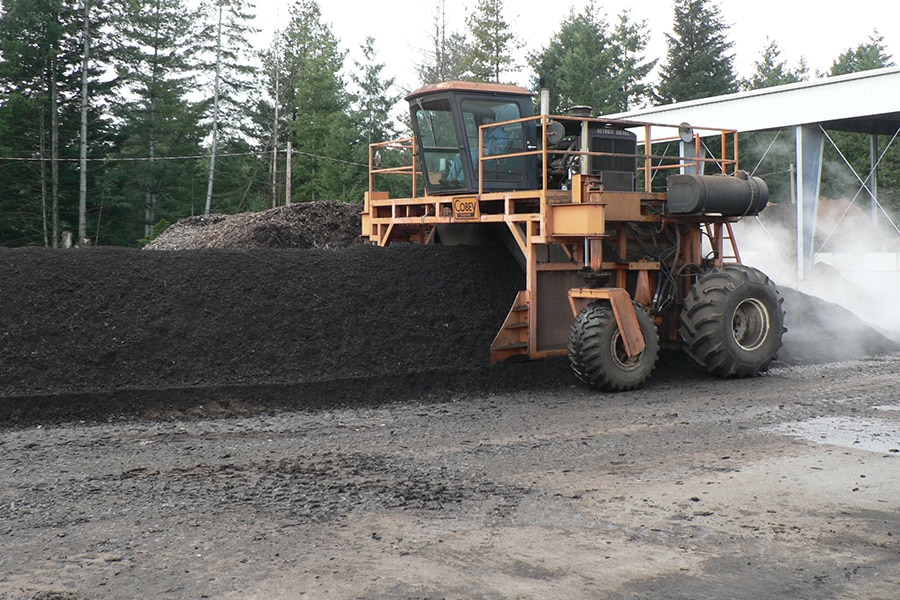
Creating Coal Hills Class A compost at the CVRD | Comox Valley Regional District photo
Another environmental dilemma: Do biosolids pose a public health risk?
Members of the Comox Valley Electoral Areas Services Commission came face-to-face with yet another environmental dilemma this week: sewage sludge.
Sewage sludge is the concentrated residue of everything Comox Valley residents flush down their toilets or pour into their sinks after the wastewater has been separated, treated and piped into the Strait of Georgia.
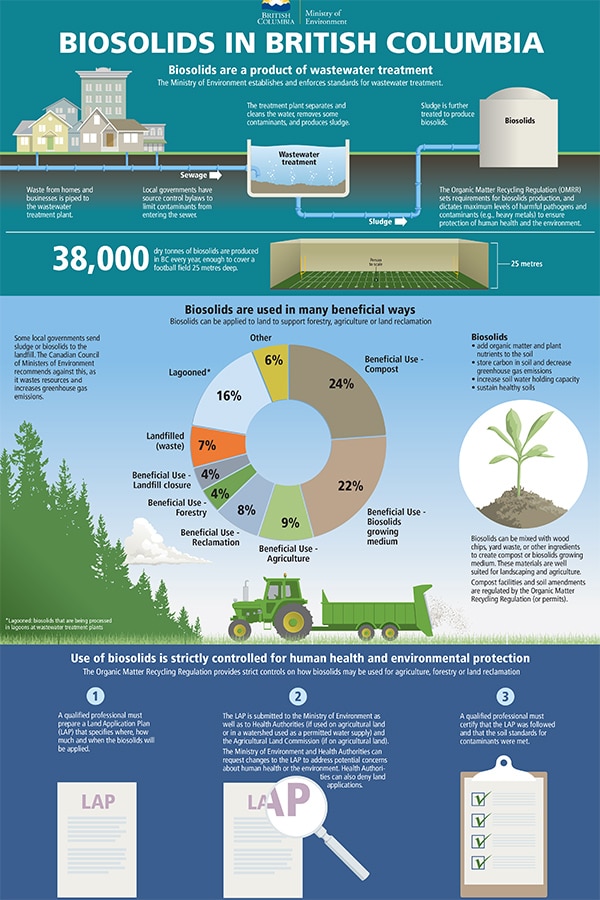
Unlike most other regional districts, the Comox Valley Regional District treats its sewage sludge to a level that qualifies it as a Class A compost, according to provincial Ministry of Environment regulations. That means the sludge has met certain Organic Matter Recycling Regulation (OMRR) levels of pathogens and other contaminants, such as heavy metals.
The CVRD then sells the compost to local homeowners as Skyrocket and to companies outside of the Comox Valley for large scale land applications for agriculture, forestry and other industries.
Most other BC regional districts either dispose of their sludge in landfills or treat it to Class B (raw biosolids) or to Class A biosolids products (sterilized sludge). Only Ladysmith, Kelowna and Vernon produce a Class A compost equivalent to the CVRD.
The CVRD says it is, and staff point to studies embraced by the BC Ministry of Environment.
But after a large-scale land application of Class B treated sludge from the Powell River sewage treatment plant on a Hamm Road property in the Black Creek area earlier this year, a Campbell River environment group has challenged the safety of biosolids.
In a presentation to the Electoral Areas Services Commission Monday, Philippe Lucas said land applications of biosolids are dangerous because they pose a health risk to humans and legal liabilities for the regional district.
Lucas, a PhD student at the University of Victoria and a former Victoria city councillor and Capital Regional District director, represented the Campbell River Environmental Committee.
“After years of debate, academic studies examining the impact of sewage sludge on the local marine environment confirmed what many of us have long suspected: sewage is unquestionably harming the health of our oceans and subsequently threatening human health as well,” he told the commission.
The Capital Regional District recently stopped dumping raw sewage into the Strait of Juan de Fuca.
“So why would it be any safer to expose our local farms, fields and or forests?” Lucas said.
In a letter to the commission, Leroy McFarlane, president of the Campbell River Environment Committee, said even Class A sludges pose health risks.
“If you walk through Canadian Tire, be aware that every liquid on their shelves could potentially find its way into the sewer system and therefore show up in biosolids,” McFarlane wrote. “A similar walk-through London Drugs will remind you that pharmaceuticals and chemicals sold there might also become a part of biosolids being applied to fields and gardens and show up in our food supply and enter our water and in some cases become airborne.”
Lucas said that some European countries have banned the use of biosolids. And he said that some grocers, including Thrifty Foods, refuse to carry products grown on land fertilized with biosolids.
He said First Nations bands, the Sierra Club of BC and others, including the Island Organic Producers Association (IOPA), all oppose land applications of biosolids.
The IOPA certifies organic farms on Vancouver Island. It has certified about a half-dozen farms in the Comox Valley as organic growers. It is supported by local businesses such as Seeds Food Market in Cumberland, Edible Island Whole Foods Market, the Atlas Cafe, Locals Restaurant and Buckerfields.
The commission took no action, but directors suggested the CVRD staff review the science and assess the legal liabilities.
Area A Director Daniel Arbour noted the difference in the CVRD product versus the Hamm Road application but said the discussion would be informative for the public.
“My view is that the skyrocket product is a highly processed composted material, and staff report low levels of contaminants. Granted it is not pure and free of pharmaceuticals, but we need to report on levels so people understand the level of risk, which could prove minimal compared to alternatives,” Area A Director Daniel Arbour told Decafnation after the meeting.
MINISTRY AND CVRD SAYS IT’S SAFE
The Lucas presentation focused on Class B and Class A biosolids, as did the studies his presentation relied on.
The BC Ministry of Environment website doesn’t clearly differentiate between Class B and A biosolids and the Class A compost product produced by the CVRD. It appears to lump all biosolids together and labels them safe.
“Biosolids are the stabilized products that are recovered at the end of the wastewater treatment process. Biosolids are rich in nutrients that may be beneficially used to improve soil conditions and provide nutrition for plants. Because of the biological components of biosolids, proper management is important to control the impact on the environment and human health,” the website says.
The website has links to multiple studies that support its statement.
But the CVRD has “invested heavily … to produce a product that has unrestricted use, and is a valuable source of recycled nutrients,” Kris La Rose, senior manager of water/wastewater services, told Decafnation.
And in a report to the EASC in April of this year, CVRD Chief Administrative Officer Russell Dyson noted the numerous standards and regulations that the regional district’s biosolids must meet.
“In comparison to other nutrient sources available to agricultural producers, such as manure or chemical fertilizers, land application of biosolids has a more stringent regulatory framework, while providing a similar soil amendment,” he said. An attachment to his report included a comparison of regulatory, product composition and environmental considerations for biosolids, manure and chemical fertilizers.
The regional district Skyrocket page on its website suggests the product is safe for use in landscaping, flower gardens and lawns. It does not mention using the product in vegetable gardens
Area B Director Arzeena Hamir, who operates a certified organic farm, told Decafnation after the meeting that she “could not and would not” use biosolids as fertilizer on the food products she sells.
That’s not the case in the United States, she said, where certified organic growers are allowed to use biosolids.
“This is a big societal question we have to address,” she told Decafnation.
COMOX VALLEY BIOSOLIDS
Mike Imrie, the CVRD’s manager of wastewater services, said the district sells between 7,000 and 7,500 cubic yards of Skyrocker per year, while the wastewater treatment plant generates about 1,375 to 1,500 tonnes of dry biosolids annually.
Every week a total of 800 yards is placed in one of five bunkers, which ends up as 160 yards of finished product for sale, after composting, screening and curing. The loss in volume comes about from evaporation, and screening out of oversize amendment, which is recycled back into the next batch.
“All of our Biosolids are used in the composting process and none are disposed of in any other way.” Imrie told Decafnation.
The wet biosolids are mixed with an amendment product, which is usually chipped and ground green waste from the landfill, Imrie says. Every four kilograms of wet biosolids is mixed with six kilograms of amendment.
The Class A composting process exposes the sludge to high temperatures for extended periods. The result is a higher level of sterilization of the end product and a higher extent of oxidation of contaminants of emerging concern.
La Rose says the regional district is keeping up with worldwide research on the presence of pharmaceuticals in biosolids.
“So far the conclusions are that pharmaceuticals that are present in our wastewater are more likely to be discharged in the liquid, and the pharmaceuticals that remain in the biosolids are more likely to be broken down during the composting process,” La Rose said.
He said they are following best practices known now that recycling nutrients and organic matter through composting the biosolids is the best way to recycle them.
“It’s interesting to note that there is increased discussion in Europe to allow biosolids from smaller communities with less industry to be used on organic farms,” he said. “The reason for this is that organic farms can only use rock phosphate or compost, and rock phosphate interestingly enough also contains heavy metals. It’s also of concern that our world supply of phosphorus is diminishing, so we need to recycle as much as we can.”
OTHER ALTERNATIVES?
During his presentation on behalf of the Campbell River Environment Committee, Lucas said regional districts have four other options for disposing of biosolids.
He said there are technologies to remove heavy metals, polycyclic aromatic hydrocarbons and pharmaceuticals, but other regional districts have found this too expensive.
Biosolids can be turned into energy through gasification. Also, biosolids can be shipped to cement kilns on the Lower Mainland for use as fuel (the Capital Regional District has been doing this).
Finally, he said, biosolids can be shipped to a biochar facility in Prince George where the carbon is sequestered and turned into a high-value end product.
But the list of alternatives didn’t resolve the issue for Area A Director Arbour.
“The question of what to do with such material is a good one, and I am not convinced that burning carbon is the best alternative either,” he said.
WHAT THE BC MOE SAYS ABOUT BIOSOLIDS
Biosolids are residual products from sewage treatment processes that have been treated to reduce pathogens and vectors. They are primarily used as a fertilizer to promote grass growth on rangeland, for forest fertilization and for site reclamation at sites like gravel pits and mines. Biosolids are not sewage sludge.
The land application of biosolids does not pose a risk to human health or the environment when they are applied in accordance with all of the requirements in the Organic Matter Recycling Regulation. Biosolids should be handled in the same manner as animal manure; efforts should be taken to minimize the risk of accidental ingestion or body entry. The primary method of reducing risk is to limit direct exposure to biosolids.
CLASS B BIOSOLIDS NOT SAFE SAYS STUDY
On July 2, the National Research Council of the National Academy of Sciences (NAS) concluded that there may be public health risks from using processed sewage sludge as a commercial fertilizer. Approximately 60 percent of an estimated 5.6 million tons of dry sludge is used or disposed of annually in the United States.
Sludge also includes traces of household chemicals poured down drains, detergents from washing machines, heavy metals from industry, synthetic hormones from birth control pills, pesticides, and dioxins, a group of compounds that have been linked to cancer.
SUBSCRIBE TO OUR NEWSLETTER
THE WEEK: Hamir to chair CVRD – Confusion at City Council – City crime down
Violent crime dropped 18 percent over last year in Courtenay, according to the RCMP’s second quarterly report. This week’s City Council meeting got bogged down with procedural missteps and a verbal attack in the gallery. CVRD directors elect Arzeena Hamir as chair of the board and there’s good news and bad news.
The “Seven-Day Building Permit Rule” in Comox, a flurry of motions in Courtenay
A Comox Valley developer has reportedly met the Seven-Day Rule for a building permit in Comox, most likely changing the Town Council’s consideration of downzoning the site. In Courtenay, notices of motion include a review of city operations, a deputy mayor position and freezing of council salaries for two years.
The Week: We’ve got the data! A look ahead at busy councils, and Good/Bad news
Any human with a computer has access to all the local government financial data they could ever want … and more. Unless you’re a financial statement nerd and need the real thing, check out our spreadsheets today that play your government’s greatest hits. Plus, tension-packed council meetings expected in Comox and Courtenay.
To frame the current zoning conflict in Comox about one property minimizes the democratic process
The whole timeline and background story about how the Town of Comox got into conflict with the owner of 1890 Comox Avenue is long and complicated, but the essence of the dispute is much simpler: the community at large does not want what this developer is offering and they couldn’t have made that point more clear than the Oct. 17 election results
The Week: The sun still rises every morning, just a lot later than usual, and other stuff
The Week looks at the time change chaos created by former BC Premier John Horgan’s sketchy poll and asks, “Why?” And then we turn to a candidate who this week announced her candidacy for the 2029 federal election and ask, “Why?” Finally we take a deeper dive into hospital boards with Doug Hillian and throw out some data about data centers
Inaugural meeting: Comox Council considers a six-storey project, Mayor Minions’s address
The Town of Comox held its inaugural council meeting Wednesday night so new councillors could take the oath of office and Mayor Nicole Minions could deliver her State of the Town address. But unlike traditional inaugural meetings, this one required the new council to address a development project approved by the previous council that conflicts with the election mandate opposed to six-storey buildings in the downtown core.
Courtenay City Council majority overrules new Mayor Theos’s appointments
Manno Theos may have won the Courtenay mayor’s office but he lost the first battle with the City Council this week, as four councillors objected to his proposed appointments to the regional district board and other assignments. Instead, the council majority passed their own list of appointments, leaving Theos off the CVRD board.
For a Liberal government, vote for the NDP in the North Island-Powell River riding
If you want to help the Mark Carney Liberals form the next federal government, then DO NOT vote for them in the North Island-Powell River riding. That sounds counter-intuitive, but only a vote for the NDP can save this riding from swinging to the Conservatives in 2025. Why? Read on for the full article.
On Merville groundwater extraction it’s deja vu all over again
Regional district staff recommend approving an amended application for groundwater extraction in Merville as a “home occupation,” but rural area directors want more clarity on its legal definition
Merville water bottling issue returns to the CVRD, highlights provincial water policies
The Comox Valley Electoral Areas Service Commission will consider on Monday an amended application for water bottling operations in Merville and draw attention to larger water policy issues in British Columbia
Microplastics and PFAS not even mentioned in this article, neither the dairy farms in the US, dead cows, permanently closed from toxic contamination from spreading biosolids. There’s also the risk of endocrine disrupting forever chemicals and phthalates that are present in all human activity and levels growing each year in our waste and in all of our blood. We wonder why 2 out of 3 of us will get cancer in our lifetime.
Recent research adds a potential harm from biosolids:
A Growing Concern: Microplastic Pollution on Farm Fields | NRDC
https://www.nrdc.org/stories/growing-concern-microplastic-pollution-farm-fields?utm_source=tw&utm_medium=tweet&utm_campaign=Health
“When people wash their synthetic threads, microfibers are released and flow into wastewater treatment plants. From there, up to 99 percent of the microfibers, Gavigan’s research finds, wind up in sludge that treatment plants offer to farmers who spread it on their fields as fertilizer. The researchers conclude that 92 percent of all microfiber emissions on land come from these biosolids.”
great article