
The idea for a pedestrian and cycling bridge at Sixth Street originated about 40 years ago and followed a roller coaster ride to completion. It might have never been built without the persuasive pleading from Downtown businesses in 2019. An effusive thumbs up from mayoral candidate Manno Theos might have helped, too.

These environment stories from 2018 could give us hope
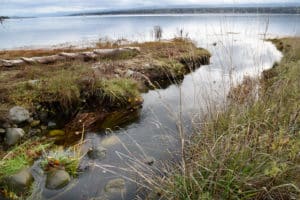
Perseverance Creek | George Le Masurier photo
These environment stories from 2018 could give us hope
By
Climate science reports released in 2018 all pointed to impending catastrophes unless humankind can pull off some miraculous reversal of climatological trends and its own bad behavior.
In just the last year, huge wildfires raged out of control, Antarctica lost three trillion more tonnes of ice, extreme heat waves warned of an eventual Hothouse Earth by 2040 and droughts and intense storms have become commonplace. Climate change could even cause a global beer shortage.
But not all the environment news in 2018 was depressing. There was good news to savor, some of it originating right here at home.
Comox Valley
The Comox Valley Lands Trust is purchasing a 55-acre parcel at the top of Morrison Creek, and announced plans to eventually acquire and conserve the waterway’s entire 550-acre headwaters. This is important for a variety of reasons: Morrison Creek has lively and thriving aquatic life, including several salmon species, it feeds the Puntledge River and the K’omoks Estuary and it’s the only stream in the valley whose headwaters remain intact (undeveloped) and pristine.
The Cumberland Forest Society is currently negotiating to preserve another 93 hectares (230 acres) of the Cumberland Forest, mostly wetlands and key riparian areas along Perseverance Creek. Since it formed in 2000, the society has conserved 110 hectares (271 acres).

Aerial view of some of the Morrison Creek headwaters — photo courtesy of the Comox Valley Lands Trust
On Dec. 19, the Comox Valley Lands Trust announced that Father Charles Brandt had signed a covenant to conserve his 27-acre Hermitage on the Oyster River. The covenant means the property “will be protected in perpetuity for the benefit of all things wild.” Brandt has told Decafnation he intends to donate his property to the Comox Valley Regional District as an undeveloped public park.
In a process mired in missteps and lawsuits, the CVRD finally denied an application by the 3L Development company that would have created more urban sprawl, increased long-term infrastructure liabilities for taxpayers and despoiled a critical area. But an outstanding lawsuit means this story isn’t over.
The Partnership for Water Sustainability in BC and the Brooklyn Creek Watershed Society completed an Ecological Accounting Process document, which shows the value of the waterway to the Town of Comox for stormwater conveyance. It’s the first EAP in BC on a creek flowing through multiple jurisdictions, and shows how all stakeholders must have a common goal in order to prevent the death of another fish-bearing stream.
Many of the candidates who sought public office this fall — and most who were elected — endorsed the passage of new development policies that permit and encourage infill development. This is important to minimize urban sprawl, and maximize utilization of existing infrastructure, thus preserving more rural areas and natural ecological systems.
Thanks to Breathe Clean Air Comox Valley, more people know the serious health hazards of poor air quality caused by particulates in smoke from wood burning devices. And local governments are responding with bands on wood burning devices in new homes and incentives to eliminate or upgrade existing ones.
Pacific Northwest
The sad sight of a mother orca carrying a dead calf around for weeks, as if to show humans what tragedies they are inflicting on the Earth’s other inhabitants, has sparked some positive change. Just not in BC, yet. Gov. Jay Inslee struck a task force that has recommended steps for orca recovery and the governor has earmarked over a billion dollars for the plan, which includes a ban on whale-watching tourism.
British Columbians got a sniff last summer of what climate change means for our future. One of the worst wildfire summers blanketed the south coast with smoke, haze and hazardous air quality. And with summers getting hotter and drier (it’s not just your imagination), wildfires will increase. It’s another step — albeit an unfortunate one — to wider spread public acknowledgement of climate change and the urgency of initiatives to maintain and improve our air quality.
The NDP government adopted a climate action plan this year calls for more electric vehicles and charging stations, requires all new buildings to be net-zero energy ready by 2032, diverts organic waste and other recyclables from landfills, while boosting the carbon tax and producing more hydroelectric power. It’s been criticized as being “just talk” and not going far enough, but the plan at least provides a blueprint for future climate action policies provincially and federally.
Global
Green energy is on the rise around the world. We had the largest annual increase in global renewable generation capacity in 2017 (most recent data), accounting for 70 percent of all additions to global power capacity. New solar photovoltaic capacity outsripped additions in coal, natural gas and nuclear power combined. As of 2016, renewable energy accounted for 18.2 percent of global total final energy consumption (most recent data), and modern renewables representing 10.4 percent.
Brooklyn Creek flows into Comox Bay — George Le Masurier photo
The Organization for Economic Cooperation and Development thinks that global economic growth has peaked. They worry about the slowdown, but it’s good news for the planet. That’s the view of the new Degrowth movement, a theory that first world countries should plan for economic contraction in order to achieve a just and sustainable world.
Carbon emissions are declining, according to BP’s statistical review of world energy. Ukraine showed the greatest decline in 2017 of around 10 percent, due to dramatic reduction in coal usage. Unfortunately, Canada was one of the worst nations (22nd). Canada actually increased emissions by 3.4 percent, contributing the ninth largest share of carbon dioxide into the atmosphere behind China, the US and Japan.
Community-based renewable energy projects lead the way in reducing greenhouse gases both in Canada and around the world. Scotland’s Community and Renewable Energy Scheme (CARES) provides communities, businesses and other organizations advice and funding to create local and community energy projects. And, even the province of Alberta has a Community Generation Program for small-scale ventures into wind, biomass, hydro and solar.
And here’s a video that shows more reasons for hope. The question is, are we moving fast enough? And what more could we do?
SOURCE LINKS
FOR THIS STORY
International Panel on Climate Change
Click here
Bulletin of the American Meteorological Society
Click here
Global Carbon Project
Click here
National Climate Assessment
Click here
Renewables 2018 Global Status Report
Click here
Organization for Economic Cooperation and Development
High uncertainty weighing on global growth
Click here
Degrowth
Click here
BP statistical review of World Energy 2018
Click here
Community-based renewable energy projects
Click here and here
The story of 2018 was climate change
Click here
More
Courtenay’s controversial Sixth Street Bridge: Whose idea was it?
Will Manno Theos win Courtenay in vote split? And are these candidates using AI?
What’s going on in this year’s local government elections? More candidates. More women candidates. Another possible vote split in Courtenay to favor the underdog. Many long-time veterans still hanging on. Fake social media posters and other trolls. And suspicions surfacing of plagiarism or AI use in candidate statements. Looks like a wild four-week ride. Buckle up!
Post-war attempt to ‘Run cities like a business’ by allowing sprawl failed miserably
After WWII, municipalities across Canada tried a private sector trick to generate revenue, but expanding a city’s tax base by allowing urban sprawl merely traded small temporary cash gains for the ticking time bomb of unfunded infrastructure liabilities … and the tax bill is now overdue
Fact: Courtenay property tax burden equal or lower than most same-sized BC cities
New candidates trying unseat Courtenay City Council incumbents claim the city’s property taxes are too high. But province-wide data shows that the city’s tax burden is the same or lower than same-sized municipalities. And City Council is leading the province with innovative fiscal policies
Retiring Courtenay City Councillors recap years of experience
Doug Hillian and Melanie McCollum will not be seeking re-election this for the Courtenay City Council. Hillian retired after 17 years on council. McCollum served for eight years.
The FINAL candidates for the 2026 local elections
A list of candidates for the 2026 municipal elections
Overwhelmed by so many candidates? Just vote for the ones you know and like
For many Valley residents, it’s difficult and time consuming to gather the necessary information to make thoughtful selections in municipal elections. And paid trolls and fake posters on social media pages make it even more difficult. Public candidate forums help, but there is a simple solution for frustrated voters
THIS WEEK: Election signs are everywhere; MLA Day joins the Findlay ship jumpers
Candidates for the Oct. 17 municipal elections start making it official next week. But it’s been obvious that the “unofficial” campaigns began on social media a long time ago. And MLA Brennan Day announces he’s jumping BC Conservative Party’s ship — but it was no difficult decision
“Liberal Rush” tricked voters in NDP ridings and exposed an electoral system flaw
Despite the positive big picture outcome, this election exposed a glaring vulnerability within our electoral system. And that vulnerability caused otherwise smart people to forget how our Canadian parliamentary system actually works. Namely: We do not have a proportional representation form of government. But there is a simple solution.
Battle of the North Island riding polls, does it really matter? A prediction
Progressives have found something new to squabble about: which poll of the North Island-Powell River (NIPR) riding is the accurate one? Some polls show the Liberals ahead of the NDP. Others show the NDP with an edge. But does it really matter if neither party can win?


