
The idea for a pedestrian and cycling bridge at Sixth Street originated about 40 years ago and followed a roller coaster ride to completion. It might have never been built without the persuasive pleading from Downtown businesses in 2019. An effusive thumbs up from mayoral candidate Manno Theos might have helped, too.
Directors challenge legitimacy of advanced recycling technologies
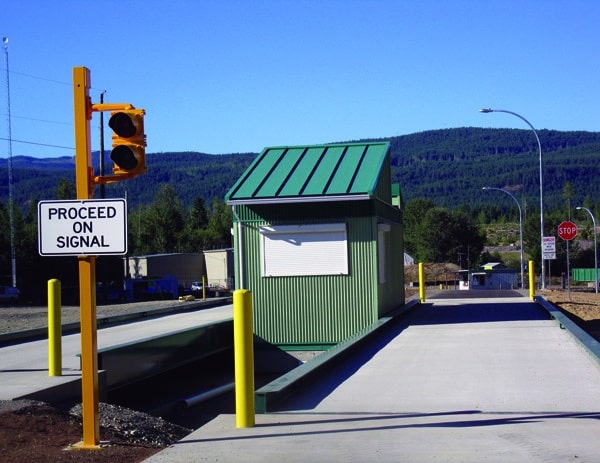
Entrance to the Comox Valley landfill, where tipping fees are calculated / George Le Masurier photo
Directors challenge legitimacy of advanced recycling technologies
By
New directors of the Comox-Strathcona Solid Waste Management Board have called into question the legitimacy of a special committee exploring new waste-to-energy (WTE) technologies.
And new Area B Director Arzeena Hamir has suggested some at least one of the WTE committee members met privately and inappropriately with one of the technology proponents.

Director Hamir
The committee, which originally named itself the WTE select committee but later changed its name to the Solid Waste Advanced Technologies (SWAT) committee, had explored methods of extending the life of north Island landfills at the Pigeon Lake dump.
Landfills are expensive to construct, and just as expensive to close when they are full.
The provincial Ministry of the Environment has ordered the closure of all existing landfills on the north Island at an estimated cost to taxpayers of just over $38 million. This includes landfills in Campbell River, Gold River, Tahsis and Zeballos.
All residential and commercial garbage that cannot be recycled or reused will be dumped into new high-tech landfills, also at Pigeon Lake, that minimize methane gas emissions and the leaking of toxic liquids into the ground. But each of these new landfills cost $10 million to construct and almost as much to close.
So new technologies that claim to reduce the amount of garbage dumped into landfills by 90 percent was obvious. Landfills would last longer, and the expense to taxpayers would decline.
But nothing is ever that simple.
The former SWAT committee members had leaned toward Sustane Technologies, a company that says it can recycle all forms of plastic and transform it into biodiesel pellets. They sell these pellets to other companies who burn it for energy.
Sustane does not yet have any functioning facilities using their technology, although Nova Scotia will pilot a project.
But Hamir and new Comox Director Alex Bissinger question whether that process — proven or not — constitutes any environmental benefit.
“What is the carbon footprint of these new technologies,” she said at the most recent solid waste management board meeting. “And shouldn’t we incorporate this (the net carbon footprint) into our analysis of them.”
Hamir wants the technologies re-evaluated to include climate change, carbon footprints and any impact on the entire solid waste management system, which includes recycling and a new organics composting facility.
Area A director Daniel Arbour said he supported a staff recommendation that ultimately passed to update the SWAT committee’s terms of reference to include emissions from burning the end product of the new technologies.
“If it really reduces the carbon footprint, then it should help reduce costs and increase diversion,” he said. “I wouldn’t expect the committee to recommend anything counter to the board’s mission.”
Hamir said the committee’s name change hides the fact that burning the product of any technology “is still waste-to-energy.”
Bissinger agreed and wanted clarification of whether such a technology actually achieved diversion under the Ministry of Environment’s definition and regulations.
Ministry officials told the solid waste management board in October that it must divert a minimum of 350 kg per capita of solid waste before the province would approve the use of any new technologies. And further, that the use of new technologies would require an amendment to the CSWM Solid Waste Management Plan. And that could trigger expensive studies and new regulations before implementation.
The previous SWAT committee, chaired by former Area B Director Rod Nichol, had operated on the assumption that the ministry’s diversion requirement was just a guideline, not a rigid number. But the October presentation and follow-up letter made it clear that was not the case.
Hamir also suggested that at least one member of the SWAT had met privately with Sustane Technologies, and did not declare the meeting or the substance of the meeting to the whole committee. She did not name the director.
Also, a budget issue
Area C Director Edwin Grieve supported the recommendation to update the SWAT committee’s terms of reference, and added a concern that Comox Valley taxpayers will pay an unfair share of the $38 million to close historic north Island landfills.
He raised the issue because some north Island directors oppose the use of a tax requisition to pay for the closure of historic landfills. They propose paying for the closures solely out of tipping fees (the charge individuals and commercial enterprises pay to dump garbage at the landfill).
The cost will be spread evenly among the 66,537 Comox Valley taxpayers and 43,000 north Island taxpayers. But the cost to close historic Comox Valley landfills totals just shy of $15 million, while north Island lands will cost more than $23 million to close.
“In terms of fairness, it appears that residents of the Comox Valley are paying the majority of the closure costs with the majority of the benefits going north of the Oyster river,” Grieve said in a personal letter to the CSWM board.
Grieve favors a tax requisition to pay for the closure of the historic landfills.
“The big cost facing us is the closure of the landfills and for that we must use taxation,” he said.
SUBSCRIBE TO OUR NEWSLETTER
More
Courtenay’s controversial Sixth Street Bridge: Whose idea was it?
Will Manno Theos win Courtenay in vote split? And are these candidates using AI?
What’s going on in this year’s local government elections? More candidates. More women candidates. Another possible vote split in Courtenay to favor the underdog. Many long-time veterans still hanging on. Fake social media posters and other trolls. And suspicions surfacing of plagiarism or AI use in candidate statements. Looks like a wild four-week ride. Buckle up!
Post-war attempt to ‘Run cities like a business’ by allowing sprawl failed miserably
After WWII, municipalities across Canada tried a private sector trick to generate revenue, but expanding a city’s tax base by allowing urban sprawl merely traded small temporary cash gains for the ticking time bomb of unfunded infrastructure liabilities … and the tax bill is now overdue
Fact: Courtenay property tax burden equal or lower than most same-sized BC cities
New candidates trying unseat Courtenay City Council incumbents claim the city’s property taxes are too high. But province-wide data shows that the city’s tax burden is the same or lower than same-sized municipalities. And City Council is leading the province with innovative fiscal policies
Retiring Courtenay City Councillors recap years of experience
Doug Hillian and Melanie McCollum will not be seeking re-election this for the Courtenay City Council. Hillian retired after 17 years on council. McCollum served for eight years.
The FINAL candidates for the 2026 local elections
A list of candidates for the 2026 municipal elections
Overwhelmed by so many candidates? Just vote for the ones you know and like
For many Valley residents, it’s difficult and time consuming to gather the necessary information to make thoughtful selections in municipal elections. And paid trolls and fake posters on social media pages make it even more difficult. Public candidate forums help, but there is a simple solution for frustrated voters
THIS WEEK: Election signs are everywhere; MLA Day joins the Findlay ship jumpers
Candidates for the Oct. 17 municipal elections start making it official next week. But it’s been obvious that the “unofficial” campaigns began on social media a long time ago. And MLA Brennan Day announces he’s jumping BC Conservative Party’s ship — but it was no difficult decision
“Liberal Rush” tricked voters in NDP ridings and exposed an electoral system flaw
Despite the positive big picture outcome, this election exposed a glaring vulnerability within our electoral system. And that vulnerability caused otherwise smart people to forget how our Canadian parliamentary system actually works. Namely: We do not have a proportional representation form of government. But there is a simple solution.
Battle of the North Island riding polls, does it really matter? A prediction
Progressives have found something new to squabble about: which poll of the North Island-Powell River (NIPR) riding is the accurate one? Some polls show the Liberals ahead of the NDP. Others show the NDP with an edge. But does it really matter if neither party can win?