No Results Found
The page you requested could not be found. Try refining your search, or use the navigation above to locate the post.

These are the written comments made by Comox residents who participated in Decafnation’s Local Government Performance Review. Comments that breached our journalistic standards, such as ad hominem attacks, have been eliminated. All other comments appear as entered into the online survey platform. Click on each image to view that councillor’s satisfaction rating.
⇒ Pepole are doing their best under the circumstances
⇒ I am frustrated that the council is not taking climate change seriously and how it will affect our town. That and the way they’ve handled Mack Laing and the development of the marina area.
⇒ They rolled up their sleeves, and got to work. They made a long overdue decision to show Richard Kanigan the door. The new CAO is a breath of fresh air. They are progressive and logical in their governance. Bravo!
⇒ Comox Town Council has continued to demonstrate a backward position towards conservation of municipal nature parks (e.g. Mack Lang Park) and an uncooperative approach towards a regional park management plan.
⇒ The council has made it clear that the priority of their mandate is to ensure that they are paid very well for having been elected.
⇒ They are too secretive about the budget and give no details about how they’re spending tax dollars, or how they are arriving at these decisions.
⇒ Council’s position on Shakesides and the Mack Laing property has been appalling.
⇒ 1) The consistency of garbage pickup has fallen since Arndt arrived. 2) Cycling is still a hazardous adventure, Noel, Lazo etc etc 3) No publicly available info on likely sea level rise in Comox, I was told to ask a realtor 4) inability to play nicely with our neighbours in Cumberland and Courtenay 5) no linkage of essential services , hospital beds for example, to palms for further development. 6) Poor air quality in winter. 7) people can still swim in our drinking water and log to close
⇒ The Council’s failure to honour the OCP, institute a Heritage Registry and legislation to protect local heritage sites and structures, insist on the inclusion of green space and adequate parking for new commercial and multi residential development, foster the protection of existing green spaces and parks as well as having a plan to acquire additional green space areas and especially having no apparent concept of climate change and the urgency of an adaptive plan for the fast arriving future have left me very dissatisfied this this councils performance.
⇒ Not enough has been done to address climate change, poor air quality in the winter months.
⇒ Election promises have been broken, respect for previous OCP has been lacking in follow through, lack of a heritage registry and building permits without proper parking allocations are issues. Using OCP designated parkland space to sell for a building site and not honouring an almost 40 year old trust agreement with Mack Laing are also issues for me. I could go on
⇒ I feel like the council is more of a boys club who would never stand up to the leader. I do not trust them.
⇒ Too little attention to taxpayer’s needs. Too much attention to individual council members “agendas”. It is a fact those least competent to govern are those most attracted to such offices.
⇒ Tough job, especially following the former Mayor and Town Administrator. Think the new council has terrific new people doing a hard job, and having to learn an awful lot on the job!
⇒ Local improvements for schools (e.g. Brooklyn Crosswalk) are very much appreciated. Happy with backyard chickens and food security progressive policies. The traffic calming steps in local neighborhoods are also appreciated.
⇒ They ignore the needs of youth and families in Comox. Apart from Marina Park and school playgrounds, there is nothing. We need a skate park and some spaces for 7-12 yro. And stop fighting over Shakesides and honour the original contract as intended by Mack Laing!!
⇒ I appreciate that the Comox Council has not embraced the panic of Covid and maintained an even keel thus far.
⇒ A Lot of things feel very progressive which is good, and on the other hand sometimes it feels like Comox is intentionally at odds with other municipalities and I wonder if that is necessary.
⇒ First thing they did was give themselves a raise. Garbage pickup is erratic and now less days per year pick up.
⇒ Comprising a majority of first time councillors, the group, I thought would bring a fresh perspective. I am afraid that in spite of moving from ‘an old boys network’ style of government, we have, instead, moved to one that gets mired in the minutia being on the side of political correctness.
⇒ I would like to see them put more work into prioritizing supporting local businesses and contributing to an affordable homeownership strategy
⇒ Lack of action taken, schedule change to garbage poorly handled
⇒ Mostly pretty good
⇒ There seems to be little effort to engage the community in preparing for the consequences of global warming.
⇒ They seem unfocused and leaderless. They seem to follow without thinking for themselves.
⇒ After spending the last couple of hours reviewing the minutes of the Town of Comox Council meetings I am left with the impression that the people who make the decisions and run the Town are Jordan Wall, Marvin Kamenz and Clive Freundlich. The mayor and council are essentially trained seals that nod in unison to the directions they are given by senior staff. 99% of all motions are carried without opposition. The role of the mayor and council members is primarily public relations. They justify their salaries by attending meetings hosted by special interest groups seeking council support and public money for their organizations. The Town of Comox has approved three large developments (695 Aspen Road, 2310 Guthrie, and 2309 McDonald road) without ensuring adequate recreational park space for residents. This has placed enormous strain on existing park space in the Comox Valley. The only economic development that the Town of Comox has supported is the mall renovation (Dollar Store) along with 3 pubs and 2 cannabis stores. While increasing taxes, they have cut back services (e.g., waste and recycling pick up to once every two weeks.) Their major contribution to the climate emergency and the environment was to ban plastic bags, build a couple of electric vehicle charging stations and approve the BC step code.
⇒ This Council is unable to think outside of the box that it built for itself. Because a number of the councilors are new to their positions, they seem unwilling to act or oppose the direction of the Council set by those who have past experience.
⇒ Their handling of the redevelopment planning for 1652 Balmoral was shockingly poor. I, along with almost all of the other neighbors provided similar feedback (not NIMBY, but lots of reasonable input provided on the circumvention of the OCP as well as design out of alignment, all ignored in the name of speed)
⇒ He’s not a team player and not transparent-a detriment to the council
⇒ The dinosaur in the room. Only in office for the paycheque.
⇒ Ken Grant is not much better than Russ Arnott in his paternalistic governance approach to the municipal electorate.
⇒ Councillor Ken Grant has done absolutely nothing to forward the actual needs of the taxpayers of the Town Of Comox. They after all only pay the council wages, (and bonuses, and expenses and…)
⇒ Voted for demolition of Shakesides and to continue designing a viewing platform to replace naturalist Mack Laing’s heritage home, rejecting any other proposals for the property,
⇒ Too dismissive of the female voices on Council.
⇒ Ken Grant’s jokes and comments are disrespectful. He is part of the “Old Boy’s Network “ of the last Council. He seems opposed to any substantial changes to Council’s past performance
⇒ Needs improvement. More governing less politicking.
⇒ Old guard
⇒ Mr. Grant, whose experience on council is welcome. He unfortunately also brings, I believe, baggage from the previous ‘old boys’ style of governance in the valley. I would vote for him again
⇒ It’s possible he’s been around too long
⇒ Ken Grant seems to represent the White male status quo.
⇒ Seems to parrot whatever Art Meyers feeds him.
⇒ Ken Grant just managed to get enough votes to be elected at the last election. His suggestion to increase the hotel tax from 2% to 3% in response to a request for additional funding for the homeless speaks volumes about Ken Grant’s character and abilities. Sadly, his friend and fellow incumbent, Russ Arnott, ensures that Ken Grant is the council member appointed to represent Comox at the CVRD.

⇒ A breath of fresh air. She is articulate and willing to listen. Her views on climate change and sustainability as well as her ideas on future capital projects are well informed with an eye to the future.
⇒ The smartest person in the room. Fearless and always happy to keep people accountable. Top shelf councillor.
⇒ I had high hopes for Alex Bissinger as a progressive new voice on town council, but have been somewhat disappointed. She has backed off from pressing for real change, such as resolving the Mack Lang nature park trust, and bringing the municipal engineering department into progressive environmentally responsible professional management.
⇒ Councillor Alex Bissinger has done absolutely nothing to forward the actual needs of the taxpayers of the Town Of Comox. They after all only pay the council wages, (and bonuses, and expenses and…)
⇒ Cannot say I’m impressed, but she hasn’t done anything terrible either. A bit disappointing for someone of her intellectual ability.
⇒ Voted to continue designing a viewing platform to replace naturalist Mack Laing’s heritage home, rejecting any other proposals for the property,
⇒ Councillor Bissinger has made a real effort to initiate some progressive and meaningful initiatives. Her strong awareness of the seriousness of climate change is appreciated as was her initial attempt to resolve the councils previous inability to honour it’s legal responsibility to uphold the terms of the Mack Laing trust. It’s disappointing and disquieting to see the “cone of silence” descend on her initial support for addressing this issue.
⇒ Bright and articulate woman who seeks innovative ways of addressing problems. It would be great if her voice was not stifled by males on Council.
⇒ Alex has brought several issues and motions to Council to promote meaningful changes or dialogue. She often misses the support she needs and can be overwhelmed by the “status quo” supporters to change her wording, table motions, etc. Lots of potential for meaningful changes
⇒ Needs improvement. More governing less politicking.
⇒ Alex is a true member of the community. She does this because she cares about Comox and the people that live here.
⇒ Ms. Bissinger, whom I thought would bring youth and pragmatism (an engineer), has, I think, not been able to bridge the gap between idealism and realism. Ms. Bissenger and Comox, may benefit from her being on council for another term.
⇒ Needs to do more to leave her mark.
⇒ Interesting ideas about arts and culture and performing spaces
⇒ Pat McKenna has maintained a low profile and generally goes with the flow.
⇒ Councillor Pat McKenna, though sometimes a lone voice, has occasionally spoken up to question council decisions.
⇒ He has done nothing of note.
⇒ It’s hard to tell what councillor McKenna actually stands for.
⇒ A team player who has great communication skills and takes the time to analyze the issue at hand.
⇒ I’m convinced Pat could help Council expand possibilities for our Community. He speaks up well for issues he’s concerned about. Unfortunately he often supports the status quo team as well.
⇒ Mr. McKenna, in my view, was the star on Comox Council. I believe that he showed measured independence and moderation. I witnessed his thoughtful and mature questioning and his attention to the job at hand. I would definitely vote for him again and support his effort to be our mayor if he so chooses.
⇒ I love that Pat brings knowledge of housing and homelessness issues to Comox Council.
⇒ I think the difference between what he said while running and how he has voted are significantly different.
⇒ Pat is a nice guy. But that’s about it.
⇒ I have been disappointed by McKenna’s “let’s-not-rock-the-boat” attitude. I wonder if, somehow, his leadership of a local non-profit makes him overly cautious about standing up with the more progressive arm of Council.
⇒ Only councilor that I’ve dealt with first hand who seemed to ready to make the hard decisions and do the work that I would expect from elected officials
⇒ His position on climate change, sustainability and developing marina lands are lacking. And his stand on Mack Laing.
⇒ He is a down to earth, approachable leader. He stood up for his Public Works staff when an awful fabricated story broke about interactions with the female public. His love for Comox is obvious….he cares about people.
⇒ Russ Arnott continues to display a reactionary governance approach to municipal services delivery, male chauvinism towards female councilors, and an adversarial approach towards citizen activists and non-profit advisory groups.
⇒ Mayor Arnott is careful to ensure that he makes absolutely no decision that would bring any sort of controversy. He will not make a decision that would actually take any kind of stand for anything.
⇒ He is merely parroting the previous administration and has not seemed to do much of anything. He has not been a positive factor in solving a very large – and legally expensive – outstanding issue – namely the Shakesides Trust. There is too much secrecy around this,
⇒ Failed to consult with KFN re: demolition of Shakesides.
⇒ Mayor Arnott’s disruptive and coercive interjections during council meetings to promote his own agenda is unacceptable.
⇒ He seems to have the greatest power in Council rather than sharing it with his Councillors.
⇒ The mayor’s behaviour in council meetings has been interruptive and non respectful to public speakers and his newer council members. He has not attempted to follow OCP guidelines. Though he campaigned on a community ocean walkway, he allowed property to sell that was designated park space and reassured the new buyer that the public walkway space adjacent to his land and Port Augusta Creek would not ever happen. He is a former member of council who continues to block resolution of a 40-year-old Trust that could have created a gem for Comox such as Campbell River has achieved with both the Sybil Andrews House and the Haig Brown house and property. He continues to block Heritage Registry for Comox, at a great loss for the community.
⇒ I have had 2 dealings with Arnott and found him pompous, arrogant and dismissive.
⇒ Needs improvement. More governing less politicking.
⇒ Believe Russ is doing a decent job, it is a hard job and he has had to try and clean up some of the mess left by the former Mayor and Adm.
⇒ Old guard
⇒ Russ does not hesitate to seek advice and input from constituents on major matters.
⇒ Does he listen to council members?
⇒ Mr. Arnot brings a steady and firm presence to the group. I hope that he can remain so. I would vote for him again.
⇒ Nothing stands out positive or negative.
⇒ He seemed to be bullying the young(er) women on Council at one point.
⇒ Seems woefully under qualified to lead.
⇒ Arnott is typical of a small-town, glad-handing, baby-kissing, superficial, vacuous politician. He has no vision for the future of this community and no idea how to deal with the enormous future challenges facing the community including economic development, affordable housing and climate change adaptation. After approving a 14% raise for himself in 2018 he is now seeking a further increase. In my opinion he isn’t worth the salary he is already receiving. The simple truth is his absence from council would have no impact whatsoever except to save the community more than $50,000.
⇒ While some experience on Council is good (see my comments to previous question), the lack of creative thinking by this mayor is beyond the pale. It’s all about the economy and growing the tax base, which will see all the local municipalities behind the curve as our climate and the pandemic (both related to each other) set the stage in the future.

⇒ Not a team player. Incapable of making her own decisions.
⇒ Needs to learn from the other women on council and get progressive.
⇒ Maureen Swift represents the elitist lobby of entitlement of the wealthy in Comox, where housing development, parks management, and municipal services delivery are there to serve the well-off establishment of Comox.
⇒ Councillor Maureen Swift has done absolutely nothing to forward the actual needs of the taxpayers of the Town Of Comox. They after all only pay the council wages, (and bonuses, and expenses and…)
⇒ Not a positive influence on any issue of importance, and often very negative about what should be of benefit to the town – growing attractions that will encourage tourism.
⇒ Voted for demolition of Shakesides
⇒ Seems to be committed to maintaining the status quo of the previous councils culture and lack of vision.
⇒ Focusing on an off leash dog park is not a top priority yet this issue still hasn’t been resolved after 2 years.
⇒ Maureen Swift is also past Counsellor with an apparent agenda to preserve the status quo without substantial changes. Many missed opportunities to be a more progressive council.
⇒ Needs improvement. More governing less politicking.
⇒ Old guard
⇒ Ms. Swift brings experience and a woman, who has managed to survive in the former, less diversified governance in the valley. I likely would vote for her again.
⇒ She seems to “go with the flow.”
⇒ Maureen Swift has been a councillor for long enough. No doubt she is an active member of the Comox community and takes her role as councillor seriously. However, the time has come for Maureen to pass the baton to someone with fresh ideas.
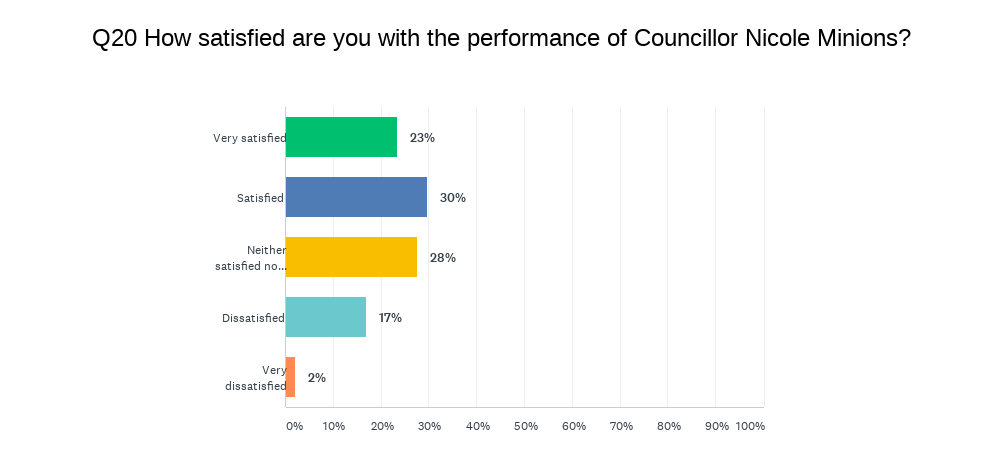
⇒ So so. She doesn’t stand out. Her views on amalgamation and air quality are limited. She tends to follow the middle road.
⇒ Good community person. Needs a dash of Bissinger’s fearlessness.
⇒ Nicole tries to improve municipal governance but has been overwhelmed and bullied by the municipal council old guard and its parochial administration.
⇒ Councillor Nicole Minions has done absolutely nothing to forward the actual needs of the taxpayers of the Town Of Comox. They after all only pay the council wages,(and bonuses, and expenses and…)
⇒ Again, does not speak out and seems to have very little opinion about anything.
⇒ Voted against designing a viewing platform to replace naturalist Mack Laing’s heritage home, was in favour of exploring other options
⇒ Councillor Minions is a welcome addition to this council. She has attempted to initiate some progressive ideas to the council despite the older members of the council’s entrenched resistance to considering new ideas. It’s disappointing that her initial support for a meaningful attempt to resolve the town’s situation in regards to the Mack Laing Trust has been silenced.
⇒ Collaborative with others and frequently seen trying to understand the issues at hand.
⇒ Nicole has a clear voice for advocating principles or ideas. She seems also the most responsive member to expressed concerns from locals. Good at dialogue.
⇒ Needs improvement. More governing less politicking.
⇒ Ms. Minion, another rookie on Council for whom I voted also disappointed me. Perhaps as a young working mother, the workload may have been too much. If Ms. Minion chooses to run again, I would vote for her in the hopes that on a more enlightened and experienced council, she would be able to bring her voice to the table.
⇒ I was at a Town Council meeting where she said electric vehicles and charging stations were a passion of hers. That was reassuring as it suggested to me that she takes global warming seriously.
⇒ I had higher hopes for her and she hasn’t seemed to gain her legs.
⇒ Of all of the current councillors, Nicole Minions is probably the most logical choice for the replacement (hopefully) of Russ Arnott at the next election. She is smart, has a business background and has been involved as a community volunteer. Even early in her first term, Nicole showed leadership by championing the disposable plastic bag issue. Her financial background gives her a solid grasp of Town finances. It is unfortunate that she hasn’t spoken up more about some of the questionable expenditures being made by the Town.
⇒ The same qualities mentioned above regarding Bissinger can be applied to Minions, without the science and data background. She stands up to the trio of “experienced’ councilors, but is hamstrung by her newness to the position. Still, she is doing the best she can, I think, and is showing signs, like Bissinger, of standing up and being counted as a progressive and a person concerned about the climate and pandemic.
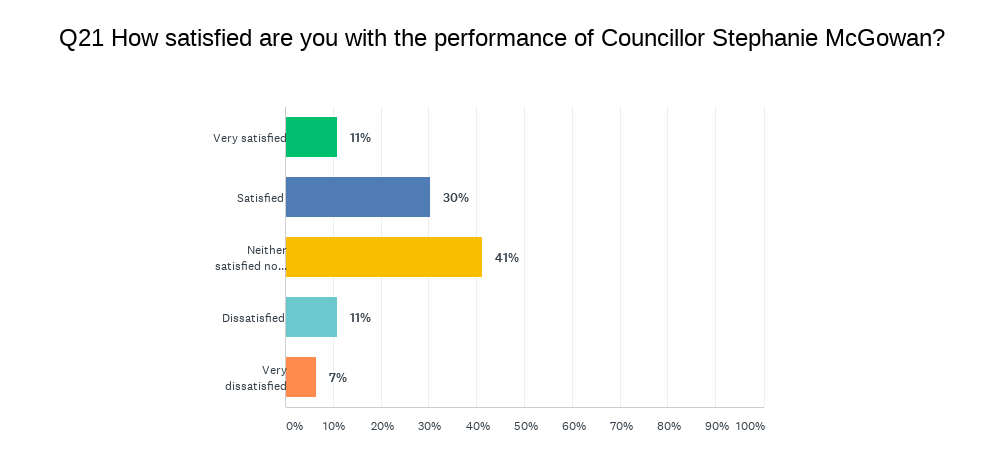
⇒ Don’t have a clear picture. Her position on tax increases was interesting- partnering up with other levels of gov’t to save dollars and her other responses re transparency( town hall meetings) and future projects were general. She supported Comox signing on to the BC Climate Action Charter.
⇒ She has also tried for the best but is usually bullied into submission.
⇒ Councillor Stephanie McGowan, though sometimes a lone voice, has occasionally spoken up to question council decisions…
⇒ She at least tries to address concerns of Comox citizens, but is often overridden by the others, who it seems are only interested in making as few waves as possible.
⇒ Voted against designing a viewing platform to replace naturalist Mack Laing’s heritage home, was in favour of exploring other options
⇒ Councillor McGowan has been a welcome addition to the council. Hopefully she will be successful in helping the town create a Heritage Registry and some protective bylaws to protect the town’s heritage properties and structures. Her initial support for a meaningful effort to resolve the Towns current impasse in regard to the Mack Laing Trust was appreciated. Hopefully the ember of that vision still remains.
⇒ Bringing forth the issue of homelessness and how it exists in Comox too.
⇒ Stephanie has great intentions in my opinion but again , can be overwhelmed by the blocking of change from the senior more experienced members of council. Good potential for future changes I think. She keeps bringing up the need for a heritage registry- yay and has a broader perspective of community members.
⇒ Needs improvement. More governing less politicking.
⇒ She’s engaged in important issues
⇒ I thought that Ms. McGowan, in spite of me not voting for her, was a disappointment and not good material for Comox Council. Too mired in idealistic beliefs for the level of responsibility. I would not vote for her.
⇒ I don’t have a sense of her politics.
⇒ Stephanie is best described as the “heart” of Comox Council. She cares about the “average Joe or Josephine”. She also cares about Comox history and our relationship to the K’omoks First Nation. Like the other novice councillors, Stephanie’s voice has been drowned out by the three former incumbents. She is not one to rock the boat and tends to conform to the direction being taken by the more dominant councillors.

The next municipal elections are scheduled for Oct. 15, 2022. That’s just 20 months away.
First of two parts
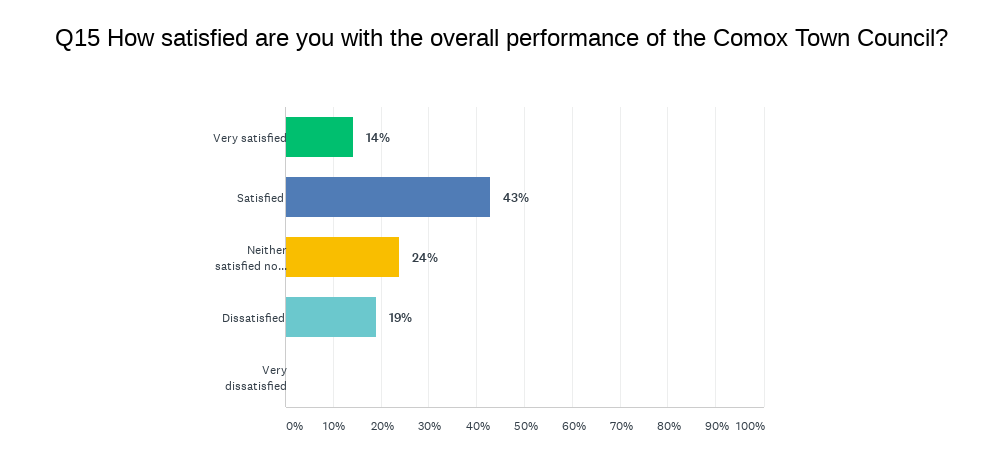
Comox Valley residents who participated in a Local Government Performance Review say they are generally satisfied with the performance of the Courtenay City Council and the Comox Valley Regional District board of directors. But they are mostly dissatisfied with the Comox Town Council.
With about a year-and-a-half to the next municipal elections, Decafnation conducted the survey over the last few weeks to measure how satisfied voters were with the performance of the councillors, directors and trustees they elected in 2018.
In addition to the distinctly different opinions about the Courtenay and Comox councils, the survey also found that when respondents were satisfied with most of their individual elected officials, they also approved of the whole council’s performance.
For example, the regional board directors in areas A and B received very high approval ratings and those electoral area respondents also expressed a corresponding satisfaction with the regional district board. In electoral area C, however, where most respondents said they were dissatisfied with their regional director, they were also less satisfied with the regional board as a whole.
Twice as many Courtenay residents said they are satisfied with their city council than dissatisfied. That level of satisfaction transcended all age groups
Among the Comox Valley’s 33 elected officials reviewed in the survey, Electoral Area A Director Daniel Arbour received the highest approval rating. Eighty-nine percent of his constituents said they were satisfied or very satisfied with his performance. Courtenay Councillor Doug Hillian had the second-highest rating at 68 percent and Electoral Area B Director Arzeena Hamir was third with a 65 percent approval rating.
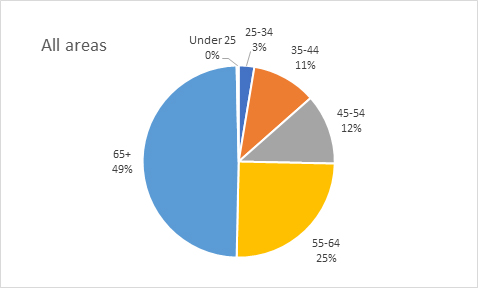
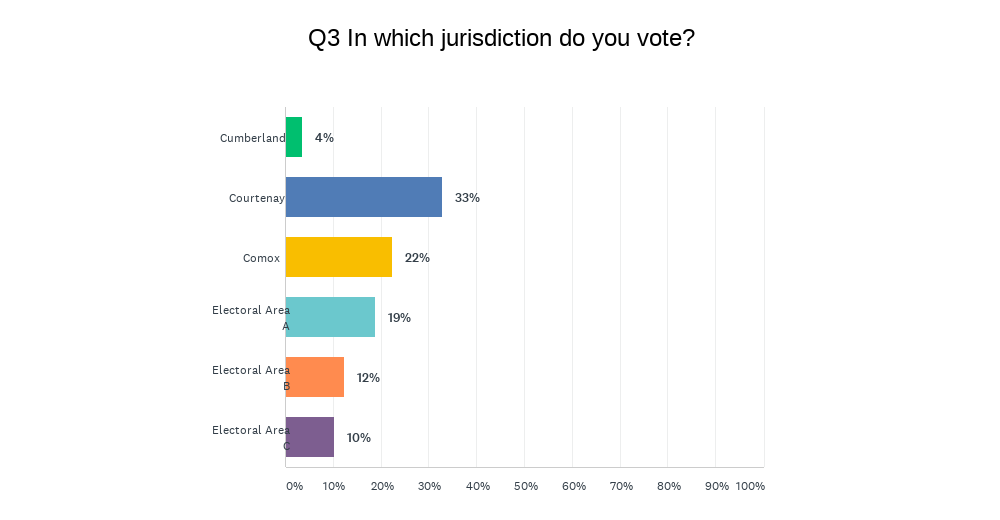
Few of the 314 respondents to the survey indicated a strong interest in District 71 school board matters.
When asked how satisfied they were with school board trustees, in most cases the respondents chose the mid-point (neither satisfied nor dissatisfied), a response that usually indicates a lack of knowledge or a lack of interest. The written comments about school trustees point to both.
And too few people responded from the Village of Cumberland to provide the data for meaningful analysis, although 80 percent of the villagers who did respond were decidedly satisfied or very satisfied.
It is interesting that roughly 20 percent of respondents felt neither satisfied nor dissatisfied with their councils and individual councillors. This may not be surprising given that a large majority of eligible voters were not sufficiently interested in local government to cast a ballot in the 2018 civic elections.
The survey also asked respondents to identify the top issues elected officials should address before voters go back to the polls on Oct. 15 of next year.
Although the list of top issues varied by Comox Valley jurisdiction, it was clear that respondents overall rated affordable housing as the number one issue. Traffic congestion and various other transportation issues collectively ranked second.
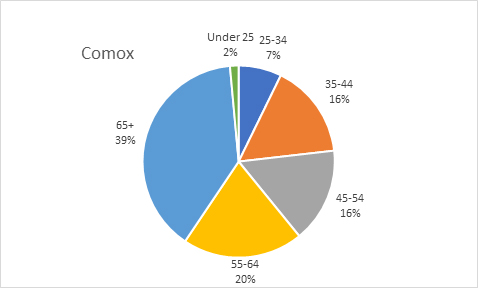
Comox respondents over age 55 were more dissatisfied with their town council than younger residents.
In the survey, Decafnation invited people to rate their level of satisfaction with the Comox Valley’s four local governments as well as their individual municipal, school district and Island Trust elected officials. The survey was conducted over a three-week period via Survey Monkey and the results independently analyzed by several community volunteers not associated with Decafnation.
Respondents could choose among five levels: very satisfied, satisfied, neither satisfied or dissatisfied, dissatisfied and very dissatisfied. For this story, in most instances, we have combined the top two satisfied ratings and also the bottom two dissatisfied ratings. We refer to the results as ‘satisfied,’ ‘neutral’ or ‘dissatisfied.’
Many of the survey respondents included written comments to help explain their satisfaction ratings. These can be found elsewhere on the Decafnation website starting today with Courtenay and Comox. The comments help to explain and interpret the respondents’ satisfaction levels.
This article takes a close look at the results for Courtenay and Comox. Readers can click all images for enlargement.
Twice as many survey respondents from Courtenay said they are satisfied (55%) with their city council than dissatisfied (27%). And that sentiment was mirrored in respondents’ impression of individual council members.
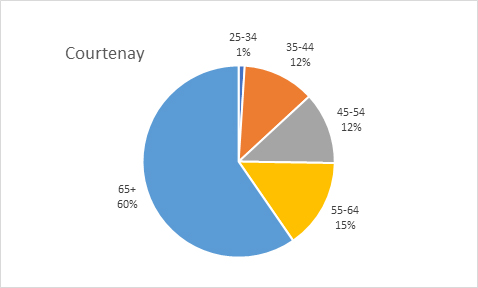
That level of satisfaction also transcended all age groups. Respondents who are 54 years old and younger had approximately the same satisfaction level as those over age 55.
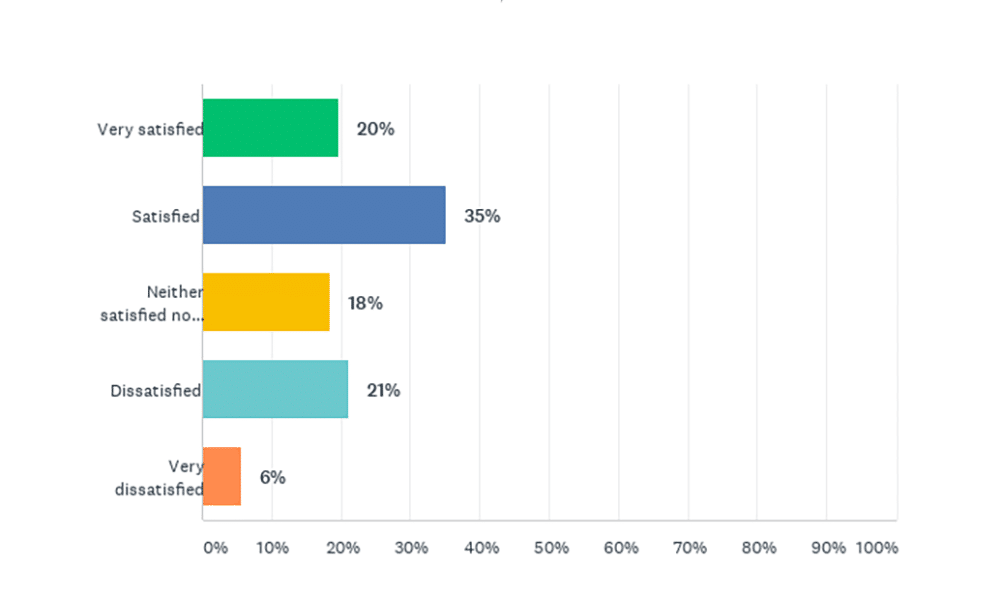
How satisfied are you with the Courtenay City Council? — click to enlarge
Respondents in age groups from 18 to 54 were satisfied (59%) and dissatisfied (30%), while respondents in the age groups from 55 to 65-plus were satisfied (54%) and dissatisfied (26%).
Many of the respondents’ comments praised specific council action.
“I am relieved the council was not taken in by 3L Developments, and also that it supports the bike/pedestrian bridge to 6th St. I do wish the council would consider more green space for every new development. Everyone needs a small area of greenery, preferably a few trees and flowering bushes, a bench or two, whether for a lunch break or just to rejuvenate.”
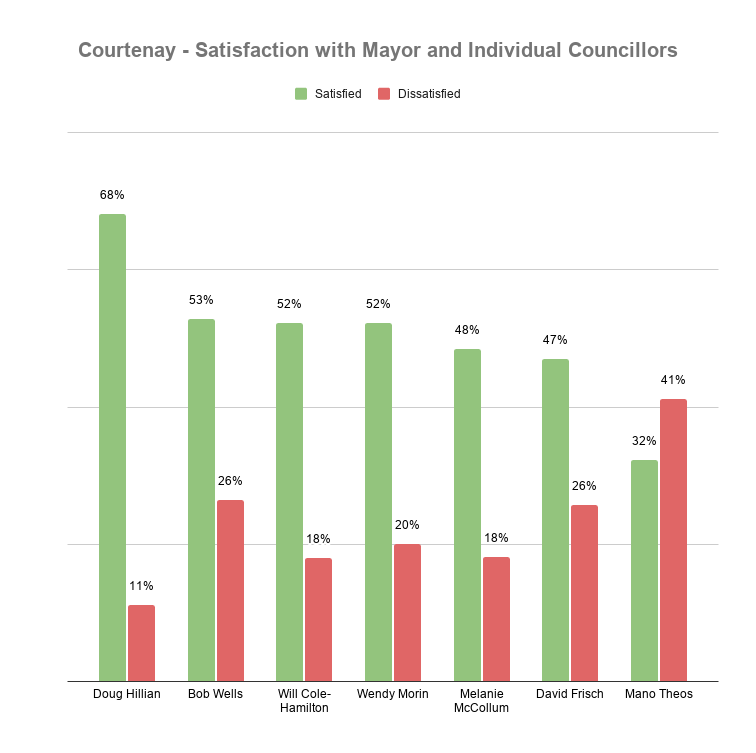
Mayor Bob Wells received a 53 percent satisfied rating, compared with 26 percent who were dissatisfied with his performance. The percentage who gave him the top ‘very satisfied’ rating (18%) was about the same as the council as a whole (20%) and all other council members except for Manno Theos (9%).
Wells received both praise and criticism from survey participants.
You can read all the comments about city councillors and the council itself here.
“It’s a difficult job trying to lead the way and find common priorities to address civic issues and sustain a vision of an inclusive community that values people of all income groups/ages. He (Mayor Wells) hears what people say! He seems to work at building consensus when possible,” said one respondent.
But some respondents disapproved of his communication style.
“Never hear from the guy,” said one. While others said, “Never hear from him except when he is at a public function with a high attendance,” and “I have sent him a few emails and have yet to receive a reply! Not even an acknowledgement.”
Courtenay respondents were most satisfied with Councillor Doug Hillian, who got a 68 percent satisfied rating, with 44 percent rating his performance at the top very satisfied level.
Hillian’s very satisfied level ranked higher than all other Comox Valley council members. Only Electoral Area A Director Daniel Arbour (60% very satisfied) and Electoral Area B Director Arzeena Hamir (58% very satisfied) eclipsed his 44 percent mark.
One respondent said Hillian was the council’s “Elder statesman. Eloquent. Ever diplomatic. Grateful to have him.”
Another person wrote, “Councillor Hillian is very knowledgeable and experienced, he’s empathetic, cares about the environment and related issues, and is responsive to taxpayers.”
Manno Theos was the only city councillor to receive an overall dissatisfied rating (41%). Although 32 percent of respondents said they were satisfied.
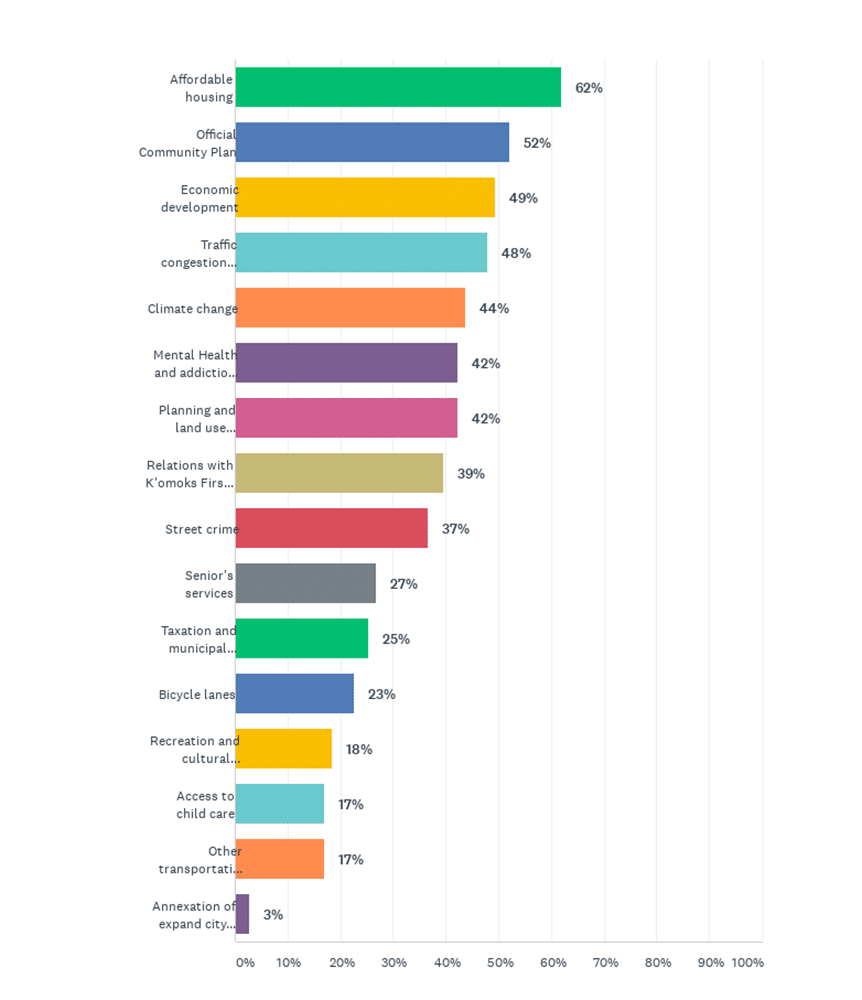
What are the top issues council should address? — click to enlarge
“I have always felt that of all councillors, Manno is the least invested in helping the little guy and the most invested in watching out for larger money sources. It is good to have a counter-voice to balance the primarily progressive council, but I feel he is less invested in meetings and he often sounds distracted behind the zoom camera and has less in-depth comments.” said one respondent.
Respondents gave similar approval ratings to the remainder of the council members. They also received mostly positive comments.
Will Cole-Hamilton (52% satisfied) was called the “Best of the bunch. True leader. Could be more influential and “not as nice” when driving the necessary culture changes at City Hall.”
A respondent commented that Wendy Morin (52% satisfied) has “A lot of heart and insight which has at times been sorely lacking on council.”
A respondent said Melanie McCollum (48% satisfied) “is a very good listener and … also seems to give issues a lot of thought and, so far at least, she looks for ways to resolve long-standing problems such as unhealthy air quality in the Valley due to overuse of woodsmoke. I see her as promising and hope she lasts.”
More than one respondent mentioned David Firsch’s (47% satisfied) impact on the cycling community. “I think he has some good ideas. He is definitely a positive for the cycling people in Courtenay.”
Courtenay residents who took the survey said affordable housing (62%) was by far the most important issue for the council to address before the 2022 elections. Completing the city’s update of its Official Community Plan was second at 52 percent, followed by economic development (49%) and traffic congestion and/or parking (48%).
It was interesting to note that respondents nixed the idea of annexation or otherwise expanding city boundaries. Only 3 percent of respondents ranked it as an important issue.
“Council needs to build a consensus for new initiatives flowing from the OCP. ‘Building back Better’ will require engaging the community from the neighbourhood up instead of ‘top down’ policies. Support for Neighborhood Associations is one way to start engaging people where they live. Staff will need reorienting to community engagement. Add a Community Development function of Social Planning and coordinate with agencies,” said one respondent.
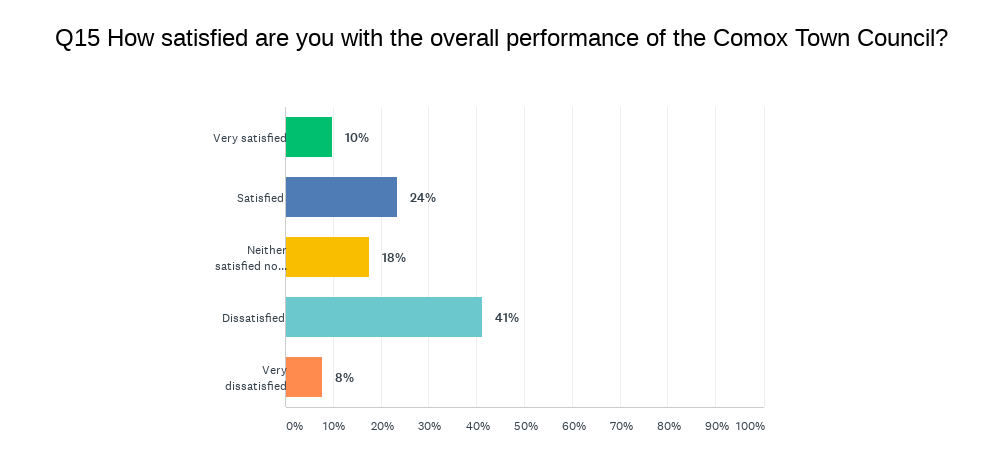
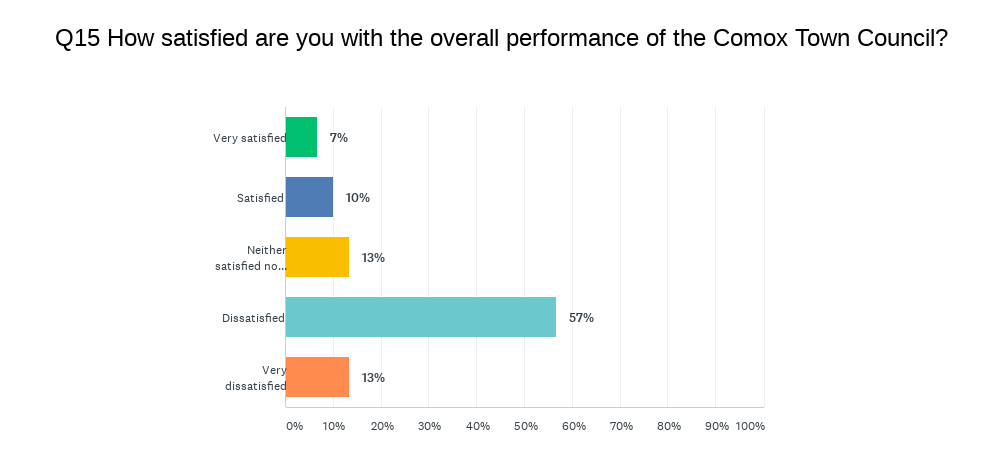
Almost half of the Comox respondents (49%) said they are dissatisfied with the performance of their Town Council, while a third expressed satisfaction (33%). And only 10 percent said they were very satisfied.
But that level of dissatisfaction did not transcend all age groups among Comox respondents as it did in Courtenay. Younger Comox residents surveyed said were much more satisfied with their council’s performance than the older residents.
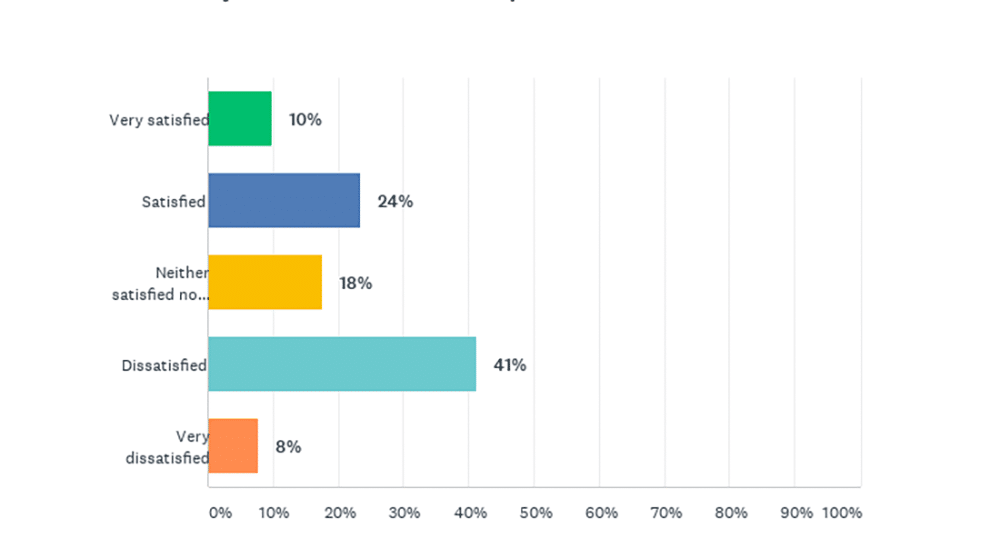
How satisfied are you with the Comox Town Council? — click to enlarge
Comox respondents in age groups from 18 to 54 were mostly satisfied (57%) and only 19 percent were dissatisfied. But in the older age groups, those trends were reversed. Respondents in the age groups from 55 to 65-plus were largely dissatisfied (70%). Only 17 percent of this older age group said they were satisfied.
Respondents noted the reasons for their overall dissatisfaction with Comox Council in the written comments. You can read all the comments here.
“This Council is unable to think outside of the box that it has built for itself. Because a number of the councilors are new to their positions, they seem unwilling to act or oppose the direction of the Council set by those who have past experience.,” said one respondent.
“Election promises have been broken, respect for previous OCP has been lacking in follow through, lack of a heritage registry and building permits without proper parking allocations are issues. Using OCP designated parkland space to sell for a building site and not honouring an almost 40-year-old trust agreement with Mack Laing are also issues for me. I could go on,” said another.
But there were some less critical comments. “People are doing their best under the circumstances,” said one person.
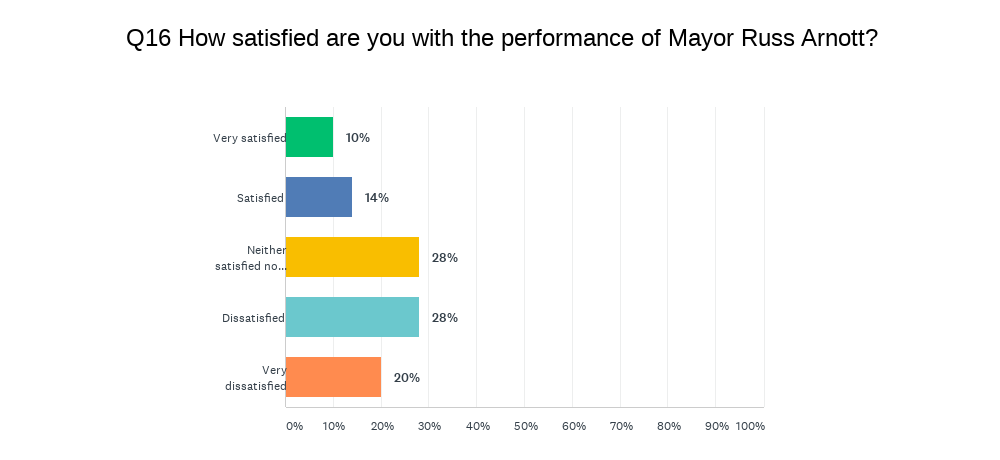
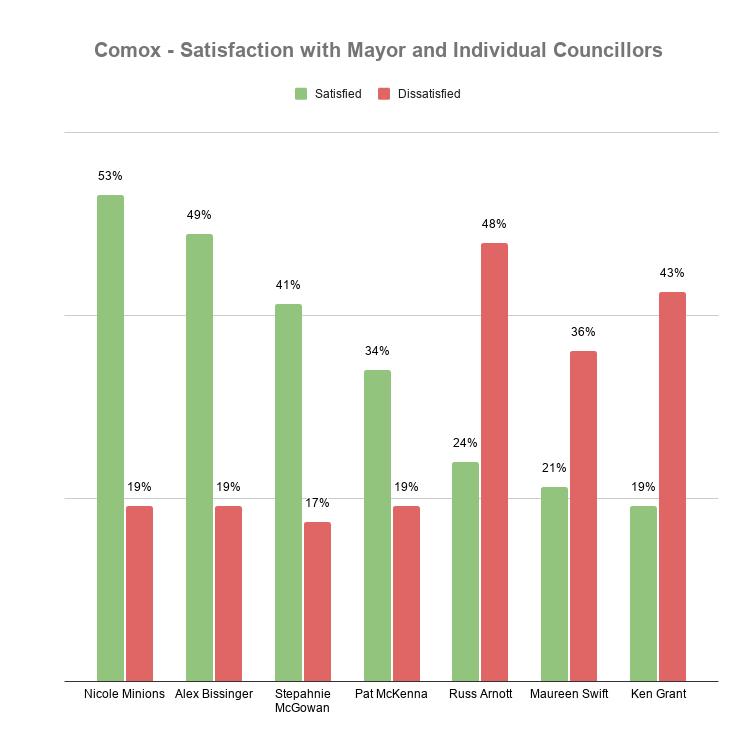
Respondents gave Mayor Russ Arnott an approval rating similar to the council as a whole: 48 percent said they were dissatisfied with his performance while 24 percent were satisfied. In the extreme ratings, 10 percent said they were very satisfied with Arnott and 20 percent were very dissatisfied.
Arnott had the highest dissatisfaction rating of all council members and the respondents’ comments reflected this.
“The mayor’s behaviour in council meetings has been interruptive and not respectful to public speakers and his newer council members. He has not attempted to follow OCP guidelines … He is a former member of council who continues to block resolution of a 40-year-old Trust that could have created a gem for Comox such as Campbell River has achieved with both the Sybil Andrews House and the Haig Brown house and property. He continues to block a Heritage Registry for Comox, at a great loss for the community,” said one respondent.
But there were other opinions, too. “He is a down-to-earth, approachable leader. He stood up for his Public Works staff when an awful fabricated story broke about interactions with the female public. His love for Comox is obvious. He cares about people,” said another person.
At the other end of the scale, first-term Councillor Nicole Minions topped council members with a 53 percent approval rating, 23 percent of respondents giving her the top level rating of very satisfied.
“Councillor Minions is a welcome addition to this council. She has attempted to initiate some progressive ideas to the council despite the older members of the council’s entrenched resistance to considering new ideas. It’s disappointing that her initial support for a meaningful attempt to resolve the town’s situation in regards to the Mack Laing Trust has been silenced,” said one respondent.
Another first-term councillor, Alex Bissinger posted the second-highest satisfied rating (49%) and had the highest percentage (34%) of very satisfied respondents. Stephanie McGowan, also in her first-term, received a 41 percent satisfied rating.
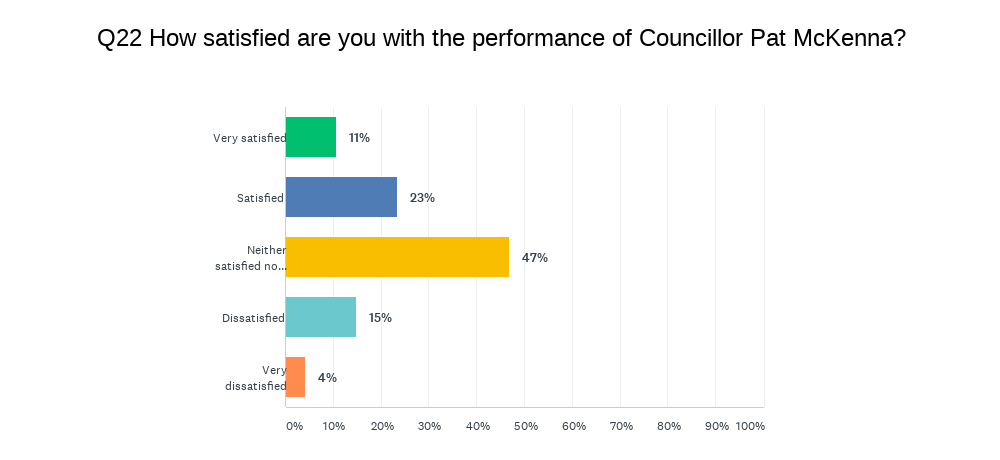
Respondents kept Councillor Patrick McKenna in positive territory with a 34 percent satisfied rating, although he had the highest dissatisfied rating (19%) of the four newcomers on the council and the highest indifferent rating (47%).
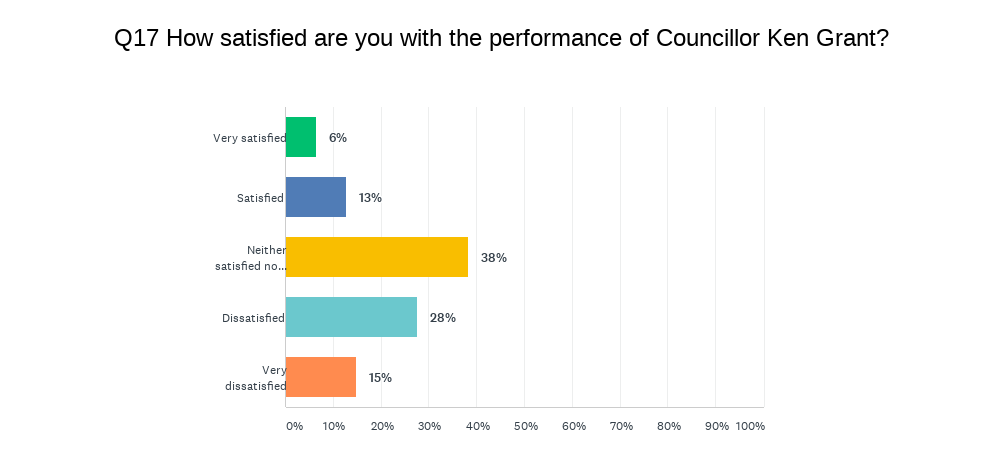
Councillors Ken Grant and Maureen Swift received mostly dissatisfied ratings at 43 percent and 36 percent respectively. Grant got the lowest satisfied rating (19%) of all Comox council members.
“Ken Grant’s jokes and comments are sexist and disrespectful. He is part of the “Old Boy’s Network “ of the last Council. He seems opposed to any substantial changes to Council’s past performance,” said one respondent.
“Ken Grant seems to represent the white male status quo,” said another.
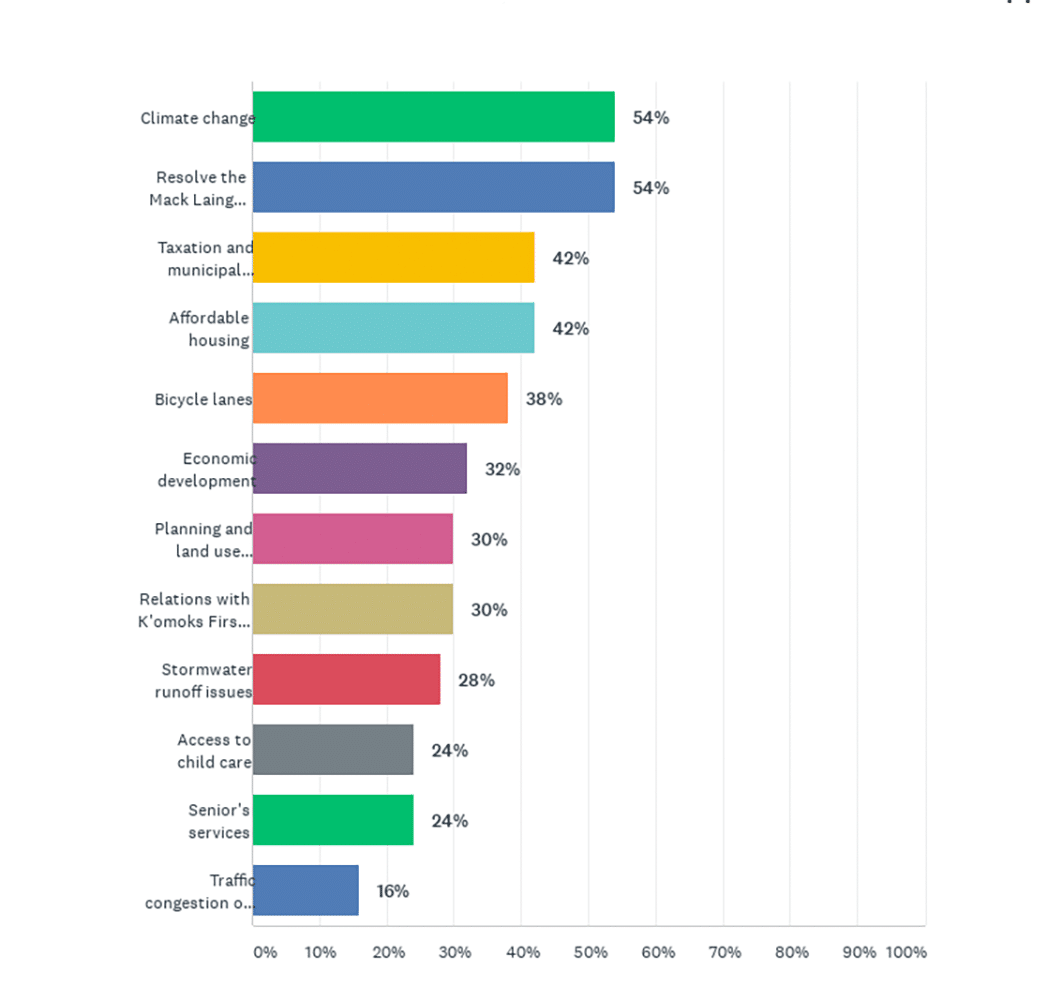
What are the top issues council should address? — click to enlarge
Comox residents who responded to the survey said the top two issues for the town to address are climate change (50%) and resolving the Mack Laing Trust issue (50%)
Taxation and municipal finance issues and affordable housing were both important to 42 percent of respondents. Economic development was important to less than a third of respondents (32%).
The comments made by survey participants reflected these issues.
“Comox town council’s continued obstruction and delay towards responsibly resolving the Mack Lang Trust debacle is a municipal disgrace,” said one respondent.
“There’s a general lack of discussion on this town about how poorly developed the waterfront is. There’s a huge opportunity here and we have great waterfront doctors offices (which is a complete waste). It should be filled with waterfront restaurants, cafes and hotels. Again, some vision is seriously lacking here. Also a boardwalk connecting marina park to goose spit park should be a thing,” said another.
And this, “We don’t need hotdog stands on the marina park pier, nor do we need any more empty buildings. keep up the splash park, enhance the boat launch area, and, as has been promised for years, build a walkway along the shore like almost every other waterfront community on Vancouver Island. It’s embarrassing,” said a respondent.
Next time, we look at the survey results for the Comox Valley Regional District and the three electoral areas. We’ll also review the satisfaction levels of the Denman and Hornby Island representatives to the Islands Trust and District 71 school board trustees.
The page you requested could not be found. Try refining your search, or use the navigation above to locate the post.

It’s stormy weather this week down at the Comox Public Marina | George Le Masurier photo
Well, folks, another week has passed so that must mean another new controversy has erupted over the Comox Valley Economic Development Society. And this one has pulled back the cloak — just a tiny bit — on the behind the scenes politicking at the regional district and the lockstep march of the Comox Town Council.
In the midst of what appeared to be a collaborative attempt to reach a shared vision for the future of regional economic development, Comox Town Councillors have unanimously decided to derail that process by triggering a section of the Local Government Act. That section is often used as the first step in withdrawing from a service.
It’s no secret that the CV Economic Development Society, known as CVEDS, has become a focal point that epitomizes the Comox Valley’s geopolitical polarization. And it’s a red hot point right now.
The region’s remaining old guard, epitomized by Comox Council and Electoral Area C Director Edwin Grieve, love the CVEDS status quo. The new blood of elected officials in Cumberland, Courtenay and Areas A and B do not.
So now, with changes afoot, no one is complaining more about proposed reforms to the regional district’s relationship with CVEDS than Comox councillors. There’s a reason for that.
The old guard loves CVEDS because it has historically done their bidding. A case in point: no Comox Valley jurisdiction has benefited more from CVEDS activity than the Town of Comox.
This imbalance has rankled everyone else. And it’s one reason why Cumberland and Hornby and Denman islands have withdrawn from regional economic development services.
But that’s not the only factor driving the new blood’s desire to transform CVEDS. These elected officials want economic support services that accommodate the community’s shift toward social and environmental values.
The new blood sees the old CVEDS as promoters of environmental projects like the Raven Coal Mine and bullish land developers such as 3L Developments. They see CVEDS undermining a proposal by an active Exhibition Grounds user in order to promote a convention centre on ALR land. They see a lack of accountability, a lack of interest in the social issues that affect economic vitality and a lack of attention to non-profit organizations that contribute to economic readiness.
They also see the regional district’s reprehensibly long history of a lack of meaningful oversight of an organization funded with public money.
It’s not surprising that the Town of Comox would object to any reforms of the regional economic development service that might divert staff attention and funding to other beneficiaries. Like the agriculture community. Or the arts and cultural community. Or some other physical location of the valley.
But the extent of Comox Council’s territorial protectionism is confusing and conflicted.
This was evident at a recent CVRD workshop solely focused on economic services. Comox Councillor Ken Grant objected to any funding or initiative to promote mountain biking or improve the sport’s infrastructure because it might benefit Cumberland, where the most trails and amenities exist, but who no longer participates in the service.
Other directors were quick to point out that being known Islandwide as a mountain biking mecca brings economic benefit to all kinds of businesses across the entire Comox Valley.
In fact, it was a Comox business — the former Simon’s Cycles, now known as the Comox Bike Company — that practically invented mountain biking in the Comox Valley. There are still two bike stores in Comox and residents/taxpayers/voters often go to the Cumberland Community Forest to ride.
And yet, Comox wants support for its own marina and Comox Valley Airport projects.
Here’s the problem. Everything was working fine for Comox until the new blood turned its attention to the CV Economic Development Society. Now, no longer in the majority, the town sees its influence and benefits drifting toward other areas of the community. And they don’t like it.
So, they’ve started a statutory service review of the regional district’s economic development service under the Local Government Act. But the regional district had already scheduled a complete review and reimagining of the service for next year.
It doesn’t seem to make sense. Except, the formalized service review includes a provision for Comox to withdraw from the service if it doesn’t like the outcome, which it probably won’t. This is the same process requested by Cumberland when it decided to withdraw.
Comox Mayor Russ Arnott implied in a statement to Decafnation this week that the town doesn’t intend to withdraw. But what other benefit exists for going the formal route over the already planned informal route?
Well, the public can’t discern the town’s motive or long-term goals of this action because Mayor Arnott has locked up his pack of councillors from speaking about it without his permission.
When Decafnation asked councillors for more explanation and for their personal opinion on what they hoped this action would achieve, they refused to talk.
Councillor Alex Bissinger said the council decided that only the mayor could speak on the topic to avoid “mixed messages.” In other words, any slight deviation from the company line might cause trouble.
Heaven forbid that a Comox council member might have an opinion that differs from the rest of the council or whose feelings about an issue might present a perspective that hasn’t been pre-vetted. Imagine the chaos that would ensue!
By comparison, Courtenay council members regularly disagree with each other and express their views openly for public consumption. By Comox council standards, it’s a wonder the city gets anything accomplished. But they do and their constituents usually know what they’re doing and why.
So the CV Economic Development Society drama will now play out in a formalized setting without all the voices at the table. Only one representative from Comox and Courtenay will be able to participate.
Even the recently formed Economic Development Select Committee will meet this week to fold up its tents. It had been charged to investigate efficiencies and cost savings from integrating CVEDS activities and office space with the regional district.
But that committee’s effort was probably going nowhere anyway. CV Economic Development Society Executive Director John Watson has arranged for new office space in … wait for it …
Comox Town Hall.
Go HERE to read all of our stories on the Comox Valley Economic Development Society
The Comox Valley Economic Development Society pulled the plug on next week’s BC Seafood Festival after public health officials stepped in this week to ensure pandemic protocols were being followed
North Island Medical Health Officer steps in to avert potential COVID super-spreader event in the Comox Valley
Local governments are taking oversight seriously and pushing the CV Economic Development Society toward new directions that will benefit broader sectors of the community. Comox Town Council doesn’t like it.
The Town of Comox and Electoral Area C have asked the Comox Valley Regional District for a formal service review of the regional economic development function even though regional directors were already headed toward their own informal review
This week we talk about how the reduction of healthcare services at North Island Hospitals continues to worry North Island citizens, plus elections, politics and why so many Comox Valley people refuse to wear masks inside local stores
Conflicting views about sustainable economic growth have caused Comox Valley Regional District directors to initiate discussions that might reform or replace an organization that it created in 1988
Observations about the provincial election: Do the BC Liberals walk away with the Courtenay-Comox riding?
The Comox Valley Regional District may have signed a two-year agreement with the Economic Development Society but the work of reforming that 32-year-old entity carries on through a select committee and board-wide workshops
Many Eastern Canadians who normally go south for a warmer climate during the winter months may be headed for Vancouver Island and the Comox Valley
A changing political climate that brought new faces and fresh perspectives to the Comox Valley Regional District boardroom has thrust the three-decade-old Comox Valley Economic Development Society into an uncertain future.

The Comox public marina | George Le Masurier photo
Another controversy has erupted over the Comox Valley Economic Development Society, highlighting once again how the community’s political shift has caused turmoil behind the scenes.
In a move that surprised many Comox Valley Regional District directors and staff, the Comox Town Council along with Area C Director Edwin Grieve have disrupted a plan to start discussing the best method of providing a regional economic development service.
Two weeks ago, CVRD directors held a special workshop as a first step toward finding consensus among the board about whether the existing Comox Valley Economic Development Society is still the best method for providing economic development services or if the 32-year-old model needed some reforms.
Although there are hard-line differences of opinion between Comox and Area C and the rest of the regional district board, directors appeared to leave the workshop thinking they had made progress on a path forward.
But just 10 days after the workshop, the seven-member Comox Town Council voted unanimously to initiate a formal service review of the regional economic development function. It’s unclear who Director Grieve consulted, but he also sent a similar letter to the CVRD.
The Local Government Act allows participants in a municipal service to initiate a review of the service or to withdraw from it. The act also specifies the process for both and for dispute resolution.
Part 10, Division 6 of the act specifies that “a preliminary meeting must be held within 120 days” of the written notice to establish the process for the review. It states further that negotiations must begin within 60 days of the preliminary meeting.
The long end of those timelines would delay discussions about how to deliver economic development services for six months.
At the workshop, directors were urged by the consultant facilitator to begin discussions immediately about whether they wanted to continue with the Comox Valley Economic Development Society as it’s currently structured, reform it or replace it with a new service delivery model.
The facilitator pressed directors to have a preferred option for going forward by next December, a year before the current CVEDS two-year contract expires on Dec. 31, 2022.
It’s unknown at this time how this formal service review might affect the board’s plans unofficially made at the workshop. Directors could carry on concurrently with the formal review or wait for the outcome at its conclusion.
One major factor that differentiates a formal service review from the board’s own informal considerations is who gets to participate. The whole board attended the workshop and all directors had input into their agreed-upon strategies.
But The Local Government Act specifies that during a service review only one representative from each participant engages in the negotiations. That means just one director from Courtenay, Comox and Areas A, B and C. It’s not clear who would represent the CVRD, if anyone, as Board Chair Jesse Ketler is a Cumberland Councillor and the Village is not a participant in the service.
The Village of Cumberland and Hornby and Denman islands followed the service review process when they individually withdrew from the economic development function.
But in a statement to Decafnation, Comox Mayor Russ Arnott denied the town was preparing to withdraw.
“Our current staff have full-time jobs and commitments, so the idea that they could take on the economic development portfolio is just not realistic,” he said.
However, neither Area C Director Grieve or any of the Comox councillors contacted by Decafnation have responded to questions about why they took this formal action rather than working through the process discussed at the recent workshop.
But Comox Mayor Arnott said his council started the review because he believes there has been a breakdown in governance and direction of the economic development service.
“For the past few years select members of the service have been constantly criticising the independent work of CVEDS,” he told Decafnation Tuesday. “This has led to dysfunction and inefficiency during the most important economic development challenge in a generation as well as a major loss in experience with staff and board members resigning.
“Our goal is to make this service once again work for Comox and the communities in the valley.”
Three CVEDS board members have recently resigned. Three staff members were laid off and one, Lara Greasly, quit to take a job with the Town of Comox.
In its press release, the Town of Comox noted five achievements it attributed to CVEDS work that “have added countless jobs, enjoyment, and prosperity to the entire valley.”
They were: expansion of the Comox Valley Airport, the evolution of the BC Seafood Festival, enhancements of Marina Park in Comox, the Fixed Wing Search and Rescue training centre at CFB Comox and the redevelopment of Comox Mall.
In his letter to the regional district, Area C Director Grieve also noted the society’s three decades of “bringing benefit to the region.”
“However, over the past two years, this independence has been severely eroded leading to resignations from members of the society’s staff and executive alike,” he wrote. “This in effect puts it at odds to the “Society Act” and doing so turns it into yet another arm of local government exposing it to vagaries the local politics.”
Disagreement at the regional district board has historically often split along the border between Comox and Courtenay. This has become a sharper line since the 2018 municipal elections brought new and more progressive directors to the CVRD board table, and including changes in Areas A and B.
CVRD Director Ken Grant, a Comox councillor, has been vocal at recent board meetings about his disapproval of the changes made to the CVEDS contract and the active role directors have taken toward integration of shared services and setting the society’s work plans.
Sources close to the board say Grant has talked behind the scenes about withdrawing from the economic development function and putting that money into the town’s marina development plans. And he has publicly expressed hostile views about economic development funds going into projects promoted by other directors, such as agriculture, arts and culture and mountain biking infrastructure.
Other directors have starkly different views of economic development that include social and environmental values that they say better represent the shift in community priorities. These directors have pressed CVEDS to include projects in their work plan that address, for example, child care and support for non-profit organizations.
The CVRD board has always had contractual final approval over CVEDS work plans, although past boards have provided almost no oversight or input.
That this board has been more aggressive in setting CVEDS work plans and demanding accountability, and cut its $1.2 million budget by a third, has rankled those who were happy with the status quo.
The CVRD board will likely get a report from its staff about the service review process at either the Nov. 17th Committee of the Whole meeting or at the full board meeting on Nov. 24.
This article has been updated to include portions of Area C Director Edwin Grieve’s letter to the regional district asking for a service review of the economic development function.
The page you requested could not be found. Try refining your search, or use the navigation above to locate the post.
It appears that the BC Attorney General’s office may have changed its view of the Town of Comox’s desire to alter the Mack Laing Trust. How else to explain the last eight months of dead silence?
It’s been so long ago you may not remember that the town wants to tear down Laing’s historic home, called Shakesides, and spend the life savings that he gifted to the people of Comox on something other than what the trust agreement allows.
But in early May, the Attorney General surprised both the town and the Mack Laing Heritage Society by announcing a delay that they said could last about five months. The AG gave no reason for the delay. The town had hoped to go to trial during the court’s June sessions.
FURTHER READING: More about Hamilton Mack Laing and Shakesides
That five-month delay has now turned into eight months and counting. And the AG’s office still refuses to explain why or what it’s doing to bring the case to a resolution. Even town councillors have no idea what’s going on at the AG’s office.
Has the Attorney General reconsidered its support of the Town of Comox after taking the District of West Vancouver to court in July? The AG argued in that case that the municipality broke a similar agreement with two residents who had bequeathed their property.
Or, did the town’s failure to properly consult with the K’omoks First Nations set off alarms in the AG’s office?
Perhaps the Mack Laing Heritage Society’s comprehensive business plan that shows widespread community support for restoring Shakesides — more than two dozen individuals and construction companies have volunteered labor and materials — has caught the Attorney General’s attention.
Or maybe the AG’s office has finally realized how badly the town has handled Mack Laing’s generous gifts, especially the finances.
We can only hope one of these issues have given the Attorney General a crisis of conscience.
For nearly three years, a 5-2 majority of Comox councillors have been trying to ram their application through the BC Supreme Court. They spent the first two years, and three expensive Supreme Court hearings, attempting to block the Mack Laing Society from presenting evidence at trial.
Ex-mayor Paul Ives led this charge and current Mayor Russ Arnott has happily carried the torch. They have cost Comox taxpayers huge amounts of money trying to justify their actions.
Meanwhile, Shakesides sits in disrepair. But as Craig Freeman and the Merville Community Association have proved, it’s neither difficult nor expensive to preserve and rejuvenate a historic building, and give it a new life for public enjoyment.
— The minority Liberal government announced a new cabinet post this week: Mona Fortier was appointed Minister of Middle-Class Prosperity and Associate Minister of Finance.
Does that term ‘middle-class’ bother anyone else? Don’t we really mean middle-income? Does Canada have a class system?
Giving middle income families the label of ‘middle-class’ suggests there is an upper class and a lower class.
I don’t know about you, but in my world, people who have higher incomes don’t necessarily warrant a ‘higher class’ status than anyone else. In some instances, I’d argue the opposite. Likewise, people who have had less financial success in their lives don’t warrant ‘lower class’ status.
I’m nitpicking, perhaps. But how we use language affects people and reveals a truth about how we see the world. Doesn’t assigning a ‘class’ to our income levels say something unfavorable about our sense of social justice and personal worth?
Local governments are taking oversight seriously and pushing the CV Economic Development Society toward new directions that will benefit broader sectors of the community. Comox Town Council doesn’t like it.
This week we talk about how the reduction of healthcare services at North Island Hospitals continues to worry North Island citizens, plus elections, politics and why so many Comox Valley people refuse to wear masks inside local stores
Observations about the provincial election: Do the BC Liberals walk away with the Courtenay-Comox riding?
Many Eastern Canadians who normally go south for a warmer climate during the winter months may be headed for Vancouver Island and the Comox Valley
The last two remaining general pathologists in the Comox Valley have resigned as Island Health increases its pressure to take away more onsite medical services from North Island hospitals.
As the Vancouver Island Health Authority reduces health care services to north islanders and deflects accountability, the public looks to the Comox Strathcona Regional Hospital District board for advocacy
The Comox Valley will march at 1 pm today for changes to slow down climate change. But are we really just giving lip service when bolder actions are needed to save the planet?
Has the BC Attorney General’s office may have changed its view of the Town of Comox’s desire to alter the Mack Laing Trust? How else to explain the last eight months of dead silence?
What is really going on within the Town of Comox? With several high-cost lawsuits and disgruntled public works employees, it’s clear that everyone is not generally happy
The Vancouver Island Health Authority plans to eliminate medical laboratory testing at the Comox Valley and Campbell River hospitals next year, but a group of citizens are fighting the change for better patient services