The Stolen Church now repaying history with new life in Merville

The Stolen Church now repaying history with new life in Merville

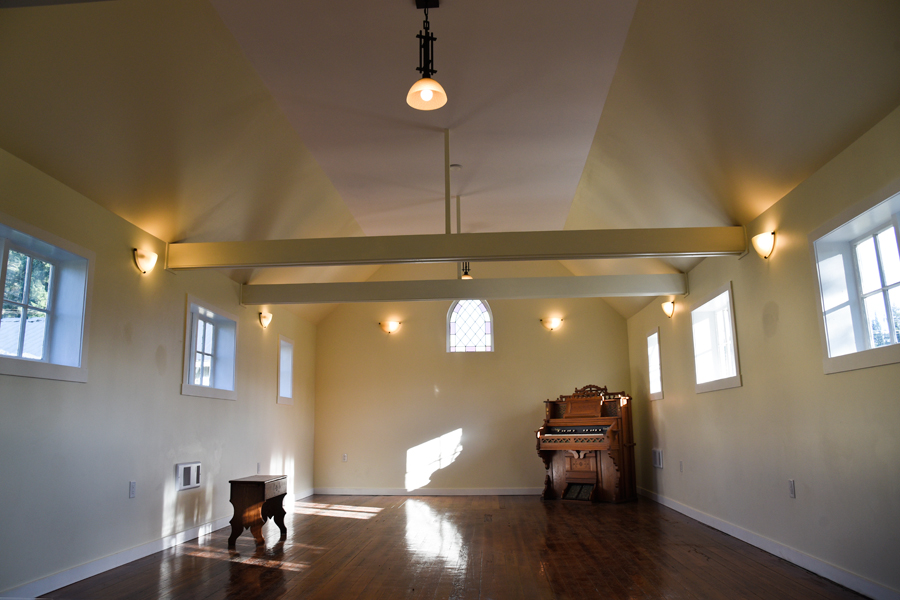
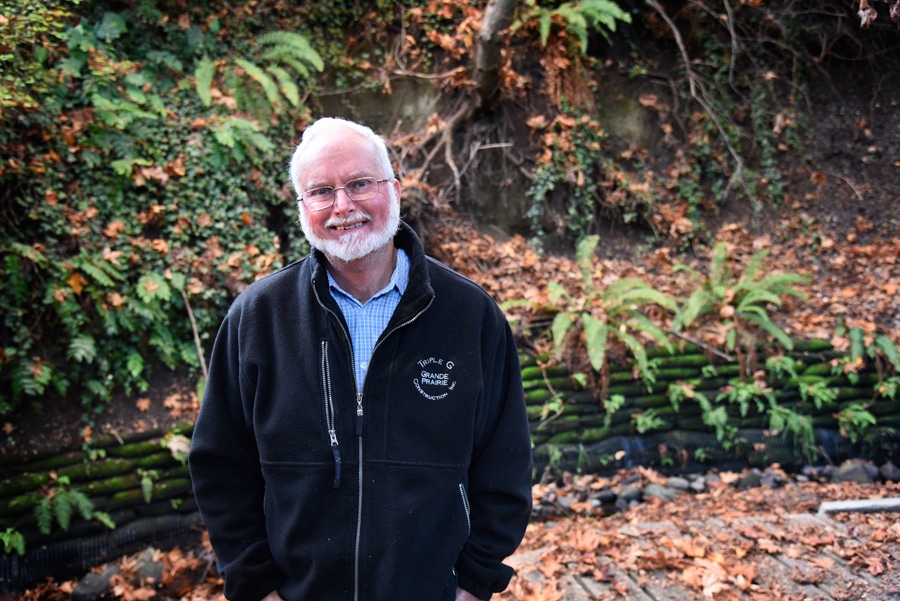
The Stolen Church at the Merville Community Association  |  George Le Masurier photos

The Stolen Church now repaying history with new life in Merville

By

Who says historic Comox Valley buildings from the early 1900s can’t be fully restored and recommissioned for future generations?

Not Craig Freeman.

The president of the Merville Community Association just points to the second relocation and recent restoration of St. Mary’s Church, which made its debut in September during the community’s 100-year celebration.

“There’s a lot of things you can do with an old building,” Freeman told Decafnation this week. “They get dilapidated, sure, but we can repair them. It’s no big deal.”

Freeman is one of the board members of the Merville Community Association who works in the construction industry and oversaw the move and renovation of the church and its companion building that once housed a Sunday school. Pete Birch is a recent board member who also helped on the church renovation.

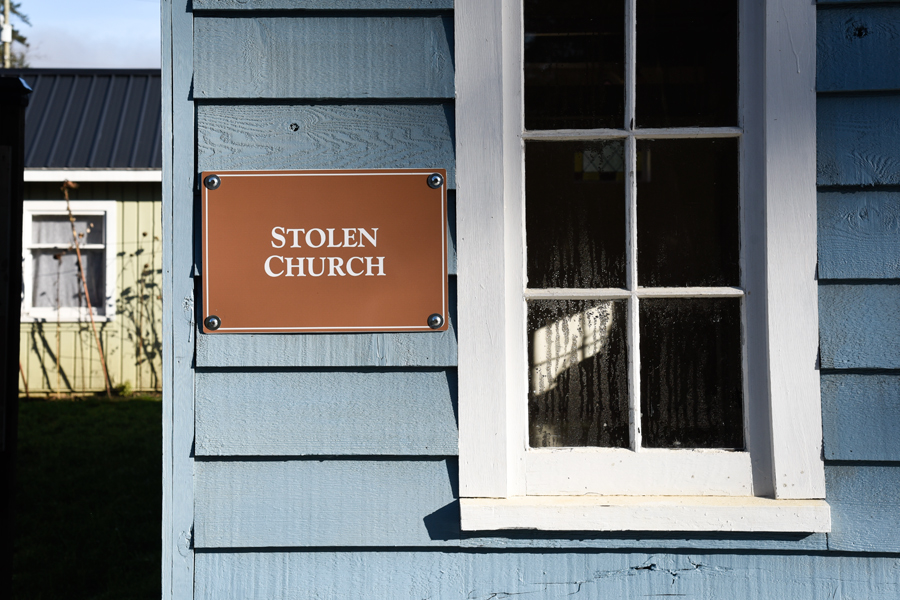
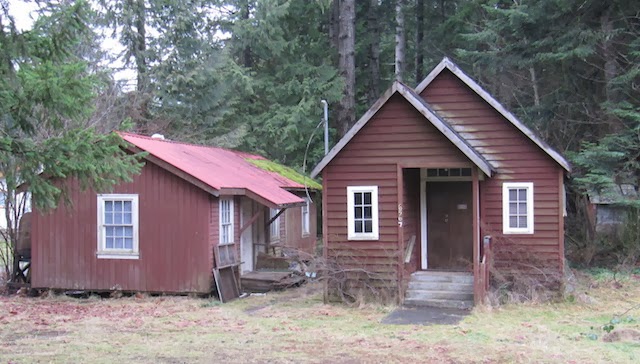
The “Stolen Church” — so named because it was originally built in Tsolum in 1915 and moved to Merville in 1919 to serve WWI veterans residing in the soldier settlement there — has shed its worn down condition and its barn red colour.

Today, the church is painted a bright blue with a new metal roof, refinished original wood floors and original stained glass window all sitting on top of a sturdy concrete and foam block foundation. The interior has been double insulated and rewired.

Outside, local craftsman Bill Enns made a new custom solid cedar door with handmade old-style wrought iron hinges.

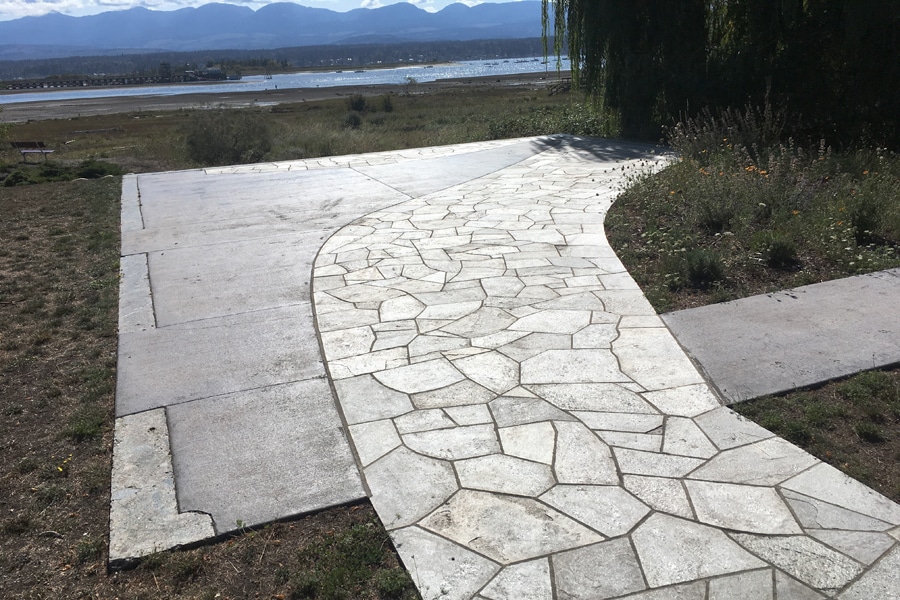
The Stolen Church sits on the community association’s three-acre property just north of the Merville Store. The property also hosts a playground, a site for a future community garden and, of course, the iconic Merville Hall, which itself has undergone a major renovation.

A solar grid on the hall’s new metal roof captures enough energy to power the church for a net positive energy consumption.

“I don’t know why people let these buildings go,” Freeman said.

He got involved with the community association 15 years ago because a musical group he plays with, Fiddlejam, had been using the Merville Hall for concerts and dances. He wanted to see the hall maintained and not lost to the community.

The main hall has been fixed up, too, with a bright yellow exterior paint job — courtesy of volunteers from local scout troops, musicians and painters in 2010 — its own metal roof, a solar power array installed on the roof and multiple interior improvements.

Freeman sees other historic buildings around the Valley that are worthy of saving and put back to public uses.

A couple of years ago, he wrote a letter to the editor offering the Town of Comox an alternative to their plan to tear down the heritage home of famous naturalist Mack Laing, called Shakesides.

“I just don’t understand why they don’t renovate that building so we (Merville Community Association) offered to do that and give it a home up here, if they wanted to move it,” Freeman said. “The Valley has lost too many historic buildings already.”


HISTORY OF STOLEN CHURCH

Grantham area farmers built the church in 1915 near where the Tsolum School stands today. For $200, the church served the Anglican community. But soon, in 1919, there was a greater need in the Merville area, where the Canadian government had offered land to WWI vets through the Soldier Settlement project.

So volunteers pulled the church on skids with a tractor up the gravel road. An unused army hut was later moved to the church site from the WWII Sandwick Camp and became a place to hold Sunday school classes.

The Anglican diocese finally gave up on the little church in 2003. It went through several ownerships until Alison and Brad Orr purchased it in 2013.

Not wanting the buildings to decay beyond saving, Freeman offered to move both to the Merville Hall site and restore them. The Orrs sold them for a dollar apiece in 2015.

The community association raised funds and acquired grants for the project. They hired Nickel Brothers to move them and, with the help of community volunteers, prepared foundations and made the move up the Island Highway into a nightime parade-like event.


WHAT IT COST

Although Freeman has the skills to have done most of the work himself and a few friends, the association contracted out the drwall, concrete entrance and electrical. He says they wanted to get it done in time for the Merville 100 Years Celebration in September, 2019.

It cost $15,000 to move each of the two buildings, and they spent another $10,000 or so on the foundations, electrical and drywall. Even including the new roof, Freeman estimates the whole project has cost less than $50,000.

This year, in preparation for the launch of the Dancing in Gumboots book and the 100 years eventr, Wonder Womem volunteers did landscaping with fruits trees and sunflowers; they removed rocks, pulled weeds and kept watering all summer long.

Freeman anticipates that rentals of the Stolen Church for weddings, yoga classes, meetings and other small functions will eventually make it a profitable venture.

The community association has a small membership that survives through its rental of the main hall, a small grant-in-aid for insurance from the Comox Valley Regional District, a summer farmer’s market and fundraising spearheaded by Freeman and consultant Dawn Ringrose.

But changes are coming.

Kymme Patrick’s TheatreWorks for the Performing Arts is in the process of moving her production and teaching school from Tin Town to the Merville Hall. The company provides theatre programs for youth and has been instrumental in using theatre as an educational tool with schools and organizations in the Comox Valley.

And they have fenced a large plot of their land for a future community garden. It already has water access and piles of skyrocket compost waiting for gardeners to spread and enhance the soil.




SUBSCRIBE TO OUR NEWSLETTER

Enter your email address to subscribe to the Decafnation newsletter.

More

Who’s monitoring water quality at Island beaches?

The Vancouver Island Health Authority announced last month that it planned to drop a public health responsibility and dump it onto BC municipalities, but it apparently forgot to inform municipal officials

Did the Comox Town Council pay their CAO 0,000 just to go away? Why?

Did the Comox Town Council pay their CAO $350,000 just to go away? Why?

Winter is coming  |  George Le Masurier photo

Did the Comox Town Council pay their CAO $350,000 just to go away? Why?

By

“Nothing makes me more nervous than people who say, ‘It can’t happen here.’ Anything can happen anywhere, given the right circumstances.”
— Author Margaret Atwood, quoted in The Daily Telegraph (U.K.)


The firing of Chief Administrative Officer Richard Kanigan is just one part of the turmoil surrounding the Town of Comox. And it might not even be the town’s most expensive headache.

Unhappy public works employees, false allegations carelessly publicized, two expensive Supreme Court lawsuits, a road project that won’t end and a fired CAO walking away with a pile of cash.

Comox Town Council must have been desperate to get rid of their long-time CAO. According to a reliable source within town hall, councillors gave him a whopping severance package totalling $350,000.

Council members aren’t talking about why or how much, and definitive confirmation of the amount won’t come until at least the town releases its 2019 financial statements. But our source is somebody who would know.

The provincial Public Sector Employers Act generously caps severance pay at 18 months after five years of service. That only applies to executives in health authorities, K-12 and post-secondary education institutions and Crown corporations. It doesn’t apply to municipalities. Small towns like Comox should be much further down the pay-out scale.

But even on that basis, Kanigan’s 2018 salary of $140,028, plus $8,056 in expenses, would have put his golden parachute around $210,000.

So what was the extra $140,000 for?

Did Kanigan have some good buddies in high places who approved a sweet deal in his contract? Did counmcil just want him gone in a hurry and they didn’t have a strong enough case to warrant or withstand a protracted wrongful dismissal suit? Did they pay him extra so some dirty laundry didn’t get hung out publicly? We don’t know.

One thing we do know is that Kanigan’s firing had nothing to do with the fake allegations that the town’s public works employees were harassing Highland High School students. That story should have never been splashed across the front page of the local newspaper. It was an anonymous letter and the paper did no investigation that corroborated any of the allegations.

It was probably written by someone with a motive to cast nefarious suspicions on public works employees, and it wasn’t worth the space or time spent on it.

That said, there have been personnel problems in the town’s public works department that may yet end in the courts. And the basic road reconstruction of Noel Avenue has taken way too long — so far, all summer and most of the fall. It continues to disrupt a private school and a residential neighborhood.

Somebody seriously miscalculated something.

Kanigan’s departure also creates some problems for the town. Foremost, it makes the town’s petition to the BC Supreme Court to alter Mack Laing’s trust agreement quite a bit more tenuous. The town wants to tear down Laing’s iconic home, called Shakesides, and spend the famous naturalist’s money on other things.

But only two people have submitted affidavits to the court defending the town against the mountain of evidence compiled by the Mack Laing Heritage Society: Richard Kanigan and former finance direct Don Jacquest. And guess what? Neither of them are still employed by the town.

That alone might not be fatal to the case. But what if the BC Attorney General’s office suddenly realized that among the hundreds of pages of documents submitted by the Mack Laing Society there was evidence of questionable handling of procedure and critical information? And what if that also happens to be something similar to the reasons council fired their CAO and paid him a king’s ransom to keep whatever it is a secret?

Last spring, the Attorney General requested a hiatus in the Mack Laing court case. That delay has now turned into five months and counting.

What makes that so odd was Comox Mayor Russ Arnott’s anxiousness to settle the matter. He railroaded a quasi public hearing last March to rubber-stamp the town’s plan, although he forgot to consult with the K’omoks First Nation. And then the mayor was in such a rush to get back into the courtroom that he didn’t even want to finish the 90-day abeyance agreed to by council.

Yet, here we are eight months later, going on nine, and no court dates are scheduled. No negotiations are taking place. Nothing. It’s dead air.

Except, of course, there’s the matter of the huge legal bill the town rang up trying — and failing — to keep the Mack Laing Heritage Society evidence out of the Supreme Court’s hands. That bill could be getting close to what Kanigan’s golden parachute should have been.

And then there’s the matter of the $250,000 lawsuit over the town polluting Golf Creek and failing to take corrective measures in how its deals with stormwater, despite repeated recommendations from more than one consulting firm.

So, who knows what’s really going on? But it has begun to look like a more deeply rooted problem.


SUBSCRIBE TO OUR NEWSLETTER

Enter your email address to subscribe to the Decafnation newsletter.

More
Why did Comox boot its CAO? No shortage of speculation around town

Why did Comox boot its CAO? No shortage of speculation around town

Some things are just not acceptable anymore  /  George Le Masurier photo

Why did Comox boot its CAO? No shortage of speculation around town

By

This article has been updated to correct when Cumberland parted ways with its CAO.

In a special Town of Comox Council meeting this week, councillors voted to dump their long-time chief administrative officer, Richard Kanigan. But rumours are that the vote wasn’t unanimous.

Council members aren’t answering questions about the firing, but there has been plenty of speculation around town and no shortage of issues behind that gossip.

Some believe town staff morale has been at an all-time low ever since the town tried to break up union employees with a two-tiered wage proposal in 2017. The town brought in an out-of-town hired-gun to force the issue and employees responded with a unanimous strike vote and multiple flash mobs waving signs of discontent.

More recently, there are whispers about an alleged suspension and demotion of a public works manager who reportedly hasn’t returned to work. There may be formal grievances to settle in that case.

And then there are the multiple legal actions that have run up some whopping legal bills for taxpayers.

The town faces a $250,000 lawsuit in BC Supreme Court over erosion and pollution of Golf Creek that could have been avoided a few years ago for about $25,000. And the town’s legal costs for the protracted saga over how the town has mishandled the Mack Laing trust agreement may be north of $100,000.

Or, there could be completely different reasons for Kanigan’s departure.

One thing is for sure: Municipal CAO positions in the Comox Valley have been a revolving door recently. Cumberland parted ways with its CAO in July. Comox Valley Regional District hired new CAO Russell Dyson in 2017 after Debra Oakman retired. Courtenay CAO Dave Allen now has the longest tenure of all his local peers. He was hired in 2013.

— Judging by the diversity of reactions to the revelation that Justin Trudeau wore black and brown faces while dressing up in costumes, his indiscretion may not affect the outcome of the current federal election. In the heat of a political battle, people in all political parties can find the justification they need to overlook their favoured candidates’ flaws.

But nobody feels sorry for Trudeau. Dressing up in costumes wasn’t uncommon in the 1990s, and is still popular among some. But adding the blackface is a genuine disappointment for a prime minister who has carefully built his brand around diversity, reconciliation and tolerance.

Of note, in the late 1980s, a prominent group of Comox Valley professionals performed a Supremes lip sync song wearing blackface at a private party. Wanna bet they’re hoping no photos of that will ever surface?

— The bus accident on a logging road near Bamfield that killed two University of Victoria students led most newscasts this week. And Premier John Horgan promised to fix the road.

CBC Radio did a whole program on the topic of whether we need to pave or otherwise improve well-used logging roads around the province. But to the surprise of the show’s producers, not many of the call-in listeners were sympathetic.

Acknowledging the tragedy of the Bamfield accident, listeners pointed out that other fatal accidents had also occurred recently, most of them on paved and well-maintained roads. For example, within days of the Bamfield accident a crash on Highway 19 north of Campbell River killed two Washington state people.

Many of the show’s  listeners called in to say drivers must take responsibility when traveling on roads of any description, and that each stretch of road requires unique precautions.

Driving a large highway coach bus loaded with passengers on a twisting, narrow gravel road on a dark and rainy night was not a responsible act, some callers said. Nor was it okay to put university students on that bus at that time.

The unintentional question the program left in many listeners’ minds was this: Should taxpayers fund the paving of these roads because people wanting to reach remote locations are ill-informed and poorly equipped? And would paving, which allows people to drive faster, just create tragic accidents of a different sort?

— Many US colleges and universities now offer free tuition. The state of New Mexico announced this week that it would waive tuition at all of its public colleges and universities for residents, regardless of family income. Cornell University’s medical school also said this week that students who qualify for financial aid would receive free tuition. They aren’t the first to do so.

It’s a trend to relieve students from the burden of crushing debt. Something many European nations did a long time ago. Will Canadian colleges and universities follow suit?


SUBSCRIBE TO OUR NEWSLETTER

Enter your email address to subscribe to the Decafnation newsletter.
More
Heritage BC joins fight to save Shakesides, warns AG of dangerous precedent

Heritage BC joins fight to save Shakesides, warns AG of dangerous precedent

Is this the future of Shakesides? Photo shows the site of Mack Laing’s original home, Baybrook  /  George Le Masurier photo

Heritage BC joins fight to save Shakesides, warns AG of dangerous precedent

By

Demolition of the famous naturalist Mack Laing’s heritage home could have reverberations throughout British Columbia for heritage conservation.

That’s the message from the province’s leading heritage conservation organization, which has thrown its weight behind the Mack Laing Heritage Society’s effort to stop the Town of Comox from demolishing the house, known as Shakesides.

Paul Gravett, executive director of Heritage BC, has urged BC Attorney General David Eby not to condone the “demolition by neglect” practice being used by the Town of Comox.

“If the court allows the terms of Mr. Laing’s trust to be altered, a precedent could be established that would discourage future donors, who fear their wishes could be altered or ignored, from making important gifts of real property. This poses a threat to the conservation of B.C.’s heritage,” Gravett wrote in a letter to the attorney general.

“The current state of Shakesides is a form of ‘demolition by neglect.’ this is a wholly unacceptable and irresponsible practice that results in the slow degradation of our historic environment. It should not be condoned,” he wrote.

Gravett has also filed an affidavit in the BC Supreme Court case that will decide Shakesides’ fate. The Town of Comox has petitioned the court to alter the terms of their trust agreement with Mack Laing, which would allow them to demolish the house and spend the sizable monetary trust Laing left the town in other ways.

The Mack Laing Heritage Society has opposed the town’s petition and will be a party to the case when it is heard. No court date has been set, but the case will likely go to trial this fall.

Gravett said the building, which still stands on its original site, is restorable.

“The proposal (by Comox) to demolish the structure is antithetical to heritage conservation and environmental conservation,” he wrote to AG Eby. “Shakesides should not be allowed to become landfill.”

In his affidavit, Gravett notes that he urged the town two years ago to reconsider its pursuit of court permission to demolish Shakesides. At the same time, he offered the town his organization’s “advice, capacity building training and assistance with conservation planning” to save the building.

Gravett also offered financial assistance through grants from the Heritage Legacy Fund program.

The Town of Comox rejected both offers.

“The replacement of Shakesides with the proposed viewing platform is inappropriate,” Gravett wrote to AG Eby. “The viewing platform would not stand as a memorial to Mr. Laing or the values of a community, but as the neglect of our history and heritage and the disregard of a philanthropist’s wishes.”

The BC Association of Heritage Professionals has also written to the attorney general in opposition to the Town of Comox petition.


SUBSCRIBE TO OUR NEWSLETTER

Enter your email address to subscribe to the Decafnation newsletter.

More

No Results Found

The page you requested could not be found. Try refining your search, or use the navigation above to locate the post.

Comox passes 0,000 lawsuit over to global insurance firm

Comox passes $250,000 lawsuit over to global insurance firm

Ken McDonald, where Golf Creek flows through his property  /  Decafnation file photo

Comox passes $250,000 lawsuit over to global insurance firm

By

The Town of Comox has handed off Norine and Ken McDonald’s $250,000 lawsuit to one of the world’s largest independent providers of claims management solutions, Crawford and Company.

The Municipal Insurance Agent of BC was handling the town’s case, scheduled for the BC Supreme Court, but earlier this year moved their liability insurance to AON Canada. Now, it’s been passed on to Crawford and Company, which may be best known for handling liability claims with regard to the 2000 E.coli outbreak in Walkerton, Ontario. As of 2018, some of those liability claims are still pending.

Meanwhile, the McDonalds’ stress level builds as the two-year battle over the pollution and excessive stormwater flow in Golf Creek, which runs through their property and has eroded chunks of it.

The McDonalds have decided to take up arms against the Town of Comox because, as McDonald says, “We can’t un-know what we know” about Golf Creek.

They know that Golf Creek, which now, in late summer, is a trickle, will become a torrent during the winter rainy season because it flows through pipes laid by the Town that reach from the Comox Golf Course to Comox Bay. The creek flows under the Comox Mall and the Berwick Retirement Community, and resurfaces again as it passes through seven riparian properties privately owned by Comox residents, including the McDonalds.

When they purchased their home, they knew about the erosion problem caused by stormwater run-off that swells Golf Creek.

The little bit of Golf Creek that remains natural disappears into large stormwater pipes and a torrent of flow during rain storms

“There’s only about three metres, about 10 feet, between our back door and the sheer drop down to Golf Creek” and it’s eroding more with each heavy winter rain event, he says.

Nevertheless, since the town laid the pipes that turned a peaceful meandering creek into a powerful rush of water swelled by 23 separate municipal stormwater pipes, the McDonalds thought the town should pay some of the cost they incurred when they shored up the portion of their property next to Golf Creek.

The town disagreed. The McDonalds took up arms by taking the town to small claims court.

The erosion is one thing. But the pollution in the creek is another.

Once filled with fish and shellfish, Golf Creek is now dead and, in fact, deadly. The McDonalds had the creek waters professionally tested and the tests interpreted by a biochemist who found “high concentrations of nine metal ions, including mercury and copper…an extremely high fecal coliform count,” which translates into “E. coli counts exceeding provincial maximums by 500 percent.”

This information, and the fact, they say, that Comox staff and Town Council have refused to discuss their small claims court filing, drove the McDonalds to upgrade their small claims court filing to an actual suit against the Town for an amount that equals the loss in value of their property affected by Golf Creek.

But what drives the McDonalds to face off against the deep taxpayer pockets of the town is more complicated than personal property loss. According to Ken, “We are speaking for other creatures who can’t speak and for the next generations.”

The Town commissioned numerous reports, one dating back 26 years, suggesting ways to mitigate Golf Creek’s flow rates and volume and to help settle contaminants, all of which were ignored by the town. One report suggested the construction of a retention pond above Comox Golf Club.

“Just dig a hole,” McDonald says, his frustration bubbling to the surface.

The Town has missed other opportunities, he says. For example, the recent rehabilitation of the Comox Mall and the expansion of the Berwick. He wonders why the town didn’t recommend working with developers to daylight portions of Golf Creek, as has been done with Bowker Creek, which runs through portions of Saanich, Victoria, and Oak Bay.

“Why doesn’t Comox vote to suspend legal action and have a conversation with us about how to settle our claim?” McDonald said.

The McDonalds claim they want to talk with council and even asked for a postponement of a trial date to do so. The judge hearing the case agreed, even though the town opposed the postponement and, to date, has not met with the McDonalds.

“Who makes decisions like this?” McDonald said. He wonders who is advising council to steer clear of the McDonalds even though talking with them may be the best way to resolve their suit as well as the issue of Golf Creek and stormwater run-off?

Contacted for comment on this story, neither Mayor Russ Arnott or Town CAO Richard Kanigan responded.

But many municipalities receive advice from the Municipal Insurance Association of BC (MIABC), which provided the Town’s liability insurance up until January 1, 2019.

Up until that time, Comox has had very little incentive to settle claims against it. In fact, because of its membership in the MIABC, it has been disincentivized to settle claims, even ones as small and as reasonable as the McDonalds’ original small claims court filing.

The MIABC rewards municipalities that have few liability claims through its Experience Rating Program. This translates into $190,000 in premium subsidies being applied to Comox’s MIABC liability insurance rate.

Additionally, the MIABC delivers training to member municipalities that directs town staff on how to handle liability claims, which basically counsels staff to not engage with claimants. That training also makes clear that elected councillors should not communicate with claimants.

“It’s very undemocratic the way no one is listening to us,” McDonald said.

If the McDonalds’ suit is heard by a judge and if the suit is decided in the McDonalds’ favour, then a legal precedent is set which could allow other claimants in other BC municipalities to seek reimbursement for their properties and could force municipalities to rehabilitate creeks that they’ve covered over and polluted.

McDonald said he wonders why the Town, the insurance provider and defense counsel want to litigate rather than settle out of court.

Pat Carl, a Comox residents, is a contributor for the Comox Valley Civic Journalism Project. She can be reached at pat.carl0808@gmail.com


SUBSCRIBE TO OUR NEWSLETTER

Enter your email address to subscribe to the Decafnation newsletter.

More

No Results Found

The page you requested could not be found. Try refining your search, or use the navigation above to locate the post.