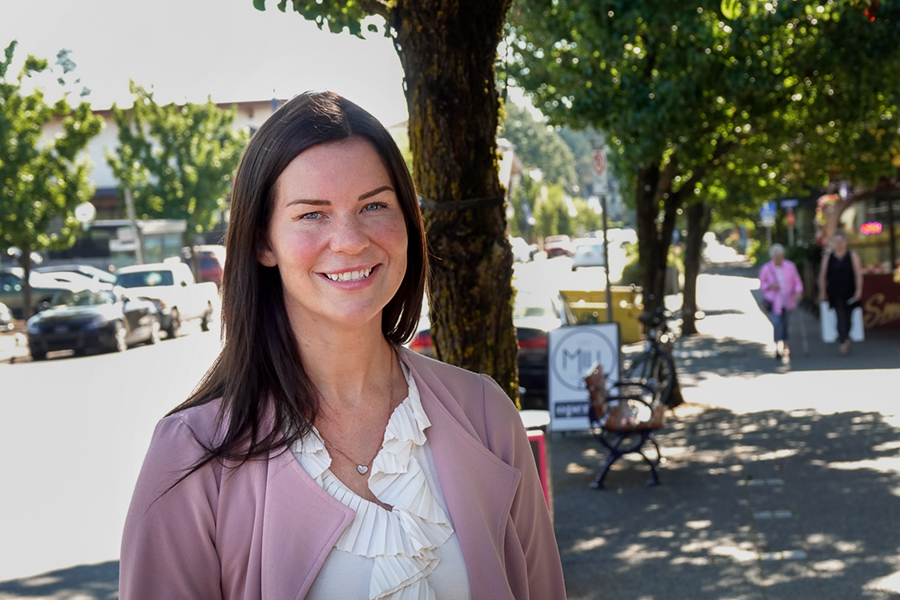
Four first-time candidates seek council positions in Comox

Four first-time candidates seek council positions in Comox

Photo Caption

Four first-time candidates seek council positions in Comox

By

E leven candidates are seeking Comox Town Council seats in this year’s municipal election. In addition to the six incumbents, the slate has four serious challengers and all of them are first-time council candidates.

Comox Mayor Nicole Minions has already won her race by acclimation. But the six council chairs are up for grabs and these four well-qualified candidates hope to unseat the incumbents.

Here are short profiles of the new candidates.


Jessica Wegg

This may be Jessica Wegg’s first foray into municipal politics, but she is no newcomer to campaigning. She ran for Parliament in the last two federal elections in the North Island-Powell River riding (which includes Comox) on the Green Party ticket.

A criminal defence and Legal Aid lawyer, and a partner in the Saeed & Little law firm, Wegg is licensed to practice in both British Columbia and the U.S. She also has a Master’s degree in clinical psychology and taught at the college level.

Wegg says her campaign platform in this election is all about fostering the idea of ‘community’ and building resiliency.

“A town that knows its neighbours handles hard things better,” she says. “And council’s job is to make that easier.”

Wegg has served as chair, vice-chair and secretary of the Brooklyn Elementary School Parents Advisory Committee. Making the community better for young people is one of her passions.

Wegg says Comox area young people “need more safe places to socialize, play and get off their screens.” She promises to promote free and accessible recreation infrastructure for the town’s youth.

She’s also an advocate for climate change resiliency and the environment.

“Climate change reaches everything from the water we drink and the air we breathe to grocery bills and home insurance premiums,” she says.

Wegg wants more transparency in town finances.

“I will work for the people of Comox ,rather than the corporations and developers who stand to profit from us,” she says.


Neil Ladell

Neil Ladell is no stranger to engaging with people and multiple levels of government on complex policy and regulatory issues.

As the Regional Manager for Fisheries and Oceans Canada, Ladell says he’s committed to “improving community participation in local decision-making processes and the fair treatment of all voices.”

Ladell earned his PhD degree in Resource and Environmental Management from Simon Fraser University. He also holds a Master of Science in Environmental Policy and Regulation from the London School of Economics, and a Bachelor of Arts (Honours) in Development Studies and Women’s Studies from the University of Calgary.

He recognizes that Comox faces increased financial and environmental pressures brought on by population growth.

“There will be a lot of big decisions for the next council: rezoning applications, infrastructure upgrades, tight finances and environmental change like droughts,” he said. “I want community members to have their say on addressing these types of issues.”

Ladell believes his expertise in federal government consulting on policy and running funding programs will enable him to contribute strategic thinking, a collaborative approach to governance and “a strong moral compass.”

“My priorities for building a more resilient Comox include planning for affordable and innovative housing while conserving the community’s character, supporting arts and culture, local business, sustainable urban forest management, youth recreation and inclusive spaces and managing the Town’s finances responsibly,.” he says.


Lisa Bourgeois

After two years of experience in the inner workings of local government at the City of Courtenay, Lisa Bourgeois is ready to try the other side of the table.

Bourgeois has lived around the world with her husband, a sound recordist for films and documentaries. She moved to Comox in 2022 from Burnaby, with her husband and two children, after first getting to know the area on a camping trip. She was drawn to the town’s setting, sense of community and quality of life.

Having left her job in the tech industry, the City of Courtenay hired Bourgeois as its Deputy Corporate Officer and later for a new position as Manager, Change Management.

Those positions suited her education and professional background. She studied at the Kellogg School of Management at Northwestern University and the University of Georgia.

She is a Certified Change Management Practitioner, who has worked with both startup and large organizations to move through change in a structured way. She’s focused on clear communication and “making sure people understand what is changing, why it matters and what they need to do differently.”

At Courtenay city hall, a key part of her job was helping citizens and staff understand a process, policy or decision. And, in her Change Management position, she worked alongside planners, engineers and other municipal staff on complex initiatives, usually involving development and the Official Community Plan.

“That experience strengthened one of my core beliefs about local government: communication is a public service,” she told Decafnation.

Communication has to be clear, but the timing also has to be right.

“Governments often start communicating too late, when most of a project’s work has already been done. The engagement becomes a formality and thus a waste of time and money,” she told Decafnation. “Engagement has to happen with an open mind and with enough time to make changes in direction.”

Bourgeois sees this as an important reason for entering the political side of local government. “Residents should be better informed and more meaningfully included in the decisions that shape their community.”

She was inspired to run for office after attending a two-day session with Comox business owners, developers and residents to share visions for the future of the town. And it raised questions for her.

“Who’s planning the town?” she said. While planners are working on zoning details and things that matter today, “who’s drawing up the plans for 50 or 100 years from now?”

Bourgeois knows the town can’t stop people from moving here, so it will continue to grow.

“But we can build the town to support this evolution. People just haven’t been sold a vision of what that could be.


Vivian Chislett

Vivian Chislett knows about zoning requirements and Official Community Plans and how the municipal approval process works for developments. She has managed the Chislett Architecture and Planning firm for 20 years, half of its life in the Comox Valley.

So she knows that Town Council work has become increasingly complex by mandated housing targets, aging infrastructure, affordability, environmental resilience and rapidly changing technology.

“Times like these call for fresh faces at the Council table,” she told Decafnation. “People who bring a depth of experience, new perspectives and a broader range of skills.”

Her work has ranged from project feasibility, pro formas and to serving as lead project manager for large consultant teams and guiding a wide range of applications through municipal approval processes.

Over the past two years, she has been actively helping neighbours understand proposed changes in Comox — sharing information, bringing neighbourhoods together and advocating for meaningful public participation.

“I advocate for balanced growth that encourages the housing types our current residents need, supports our vibrant local economy, and respects what we love about Comox,” she said. “Our neighbourhoods, our incredible natural surroundings and the quality of life we are fortunate to have here.”

If elected, Chislett says she would “Bring integrity, compassion and transparency, hands-on experience, a fresh perspective and a strong neighbourhood lens.”


ADVANCE VOTING STARTS NEXT WEEK

IN COMOX:
Wednesday, October 7 — 8 a.m. – 8 p.m. — Comox Community Centre
Saturday, October — 10 a.m. – 2 p.m. — Genoa Sail Building at Comox Marina
Monday, October 12 — 10 a.m. – 2 p.m. — Genoa Sail Building at Comox Marina
Wednesday, October 14 — 8 a.m. – 8 p.m. — Comox Community Centre

SUBSCRIBE TO OUR NEWSLETTER

Enter your email address to subscribe to the Decafnation newsletter.

More

Four first-time candidates seek council positions in Comox

From a law firm partner, to the DFO Regional Manager, to a Certified Change Agent to an architectural firm manager, four first-time well-qualified candidates seek council seats in the Town of Comox. These are the new faces hoping to win seats in the Oct. 17 municipal election.

Courtenay, Cumberland candidates respond to our seven-part questionnaire

So many candidates, so little time and opportunity to get to know them. With 47 people seeking mayors’s chairs or council seats, deciding who to vote for can boggle the mind. Don’t worry. The Decafnation traditional candidate questionnaire continues today with the responses from Courtenay and Cumberland candidates.

Provincial general election feels imminent — will the writ drop this week?

There are lots of signs pointing to Premier David Ebby calling for a BC general election as early as later this week. MLA Brennan Day will make an announcement in the next few days about whether he’ll run as an independent. And Courtenay Councillor Will Cole-Hamiltion withdrew his municipal re-election bid last Friday.

Courtenay’s controversial Sixth Street Bridge: Whose idea was it?

The idea for a pedestrian and cycling bridge at Sixth Street originated about 40 years ago and followed a roller coaster ride to completion. It might have never been built without the persuasive pleading from Downtown businesses in 2019. An effusive thumbs up from mayoral candidate Manno Theos might have helped, too.

Will Manno Theos win Courtenay in vote split? And are these candidates using AI?

What’s going on in this year’s local government elections? More candidates. More women candidates. Another possible vote split in Courtenay to favor the underdog. Many long-time veterans still hanging on. Fake social media posters and other trolls. And suspicions surfacing of plagiarism or AI use in candidate statements. Looks like a wild four-week ride. Buckle up!

What does your vision of Comox look like? Six storey buildings down Comox Avenue?

What does your vision of Comox look like? Six storey buildings down Comox Avenue?

Photo Caption

What does your vision of Comox look like? Six storey buildings down Comox Avenue?

By

W hen a local government election comes around, candidates roll out the usual suspects, the issues they think will get them elected, or re-elected. So the political chatter tends toward property taxes, housing shortages, public safety and, with increasing urgency, climate preparedness.

Those are all important election topics. But after speaking with a sampling of incumbents and challengers in the Town of Comox, the key topics in this year’s campaign should focus on managing growth and shaping community identity.

As in, What is Comox? A quaint little village on the water, or the next White Rock? Does Comox even have a shared community identity? How will population growth and mandating housing targets affect that identity?

The town, like other municipalities, must meet provincially mandated housing starts and the target of 801 new housing units that came with a Canadian Mortgage Housing Corporation grant. And, it must work within the Regional Growth Strategy to increase density rather than create sprawl.

These questions are rising as election issues now, in part, because last year Comox updated its Official Community Plan, which initially  increased the allowable height of buildings in the downtown core and in some residential areas to six storeys.

Having six-storey buildings popping up everywhere got some people excited during the OCP process, and not often in a good way.

In theory, the OCP represents a common vision, one in which all residents feel they have an equal voice in shaping. But not everyone in Comox does.

The OCP’s pumped up building heights and developers’ proposals for even taller structures have become hot topics among councillors and in some neighborhoods. That’s particularly true in the Pritchard Road area, along Buena Vista Avenue and the Beaufort Avenue area.

But on Election Day Oct. 17, voters get to have the biggest voice of all: Choosing who they want on the Town Council to make the decisions to manage that growth and form or maintain the town’s identity?

Let’s take a closer look.


SETTING THE OCP TIMELINE

Comox started the process to update its Official Community Plan in 2024, with a public survey on community vision, land-use scenarios and growth priorities. That was followed a few months later in 2025 by an open house.

A town summary of the survey results showed that the majority of respondents wanted a small-town Comox feel.

After that, the town held three separate invitation-only focus group meetings. One of them for property developers, one for businesses and one for representatives from the school district, other organizations and provincially-connected individuals.

“The town focuses on information sharing. Residents want engagement. People want a voice before it’s too late to make a difference.”

The town then held an open house on the OCP on June 24, 2025. The town’s presentation, however, did not mention that a developer had applied for a 10-storey building at the Mariner Apartments site or that another developer had applied for a 12-storey building near the marinas.

After the open house and before the town held its first public hearing, the maximum height limits in the draft OCP were changed from four to six storeys.

The first public hearing was held on Nov. 26, 2025 at the d’Esterre Seniors Centre. More than 300 people showed up (exceeding the fire limit 115 capacity). People sat on floors, while public speakers focused on height limits, setbacks and downtown density.

Council then held the second Public Hearing on Feb. 4, 2026. Citizens provided feedback on a final draft of the plan.

That culminated what the town says was more than 50 hours of public engagement sessions over an 18-month period.

Four days later, the Town Council adopted the plan, but not unanimously. The voting split 4-3 on the same ongoing ideological lines as most votes have split the Town Council over the last four years.

Councillors Ken Grant, Maureen Swift, Steve Blacklock and Chris Haslett voted to approve the plan. Mayor Nicole Minions, Jonathan Kerr and  Jenn Meilleur voted against it.


OCP CONCERNS

One of the crucial dividing issues among councillors concerned raising maximum building heights from four storeys to six, and where these taller buildings should be allowed. And how they can be designed to better fit into existing neighborhoods. The final OCP plan also includes pre-zoning, which allows developers to build to the zone rules right away, without going through a rezoning process.

Early drafts of the OCP showed a 10-storey building on the Mariner apartments site, at the top of Comox Hill and later a 12-storey building showed up on the OCP’s maps as a future project in the marina area.

Citizens showed up at council meetings to oppose both projects and Town Council voted them down. But allowable maximum building heights were still going up to six storeys.

Do six-story buildings lining the south side of Comox Avenue fit with that vision? Do three-storey multi-family units fit with Buena Vista and Beaufort?

Early versions of the OCP planned for six-storey buildings on both sides of Comox Avenue from Ellis Street to the Filberg Lodge. It also planned six-storey buildings on both sides of Beaufort and Buena Vista avenues.

But council made changes after citizens vocally opposed those plans at the public hearing.

The Town Council changed the building heights to six storeys on the north side of Comox Avenue from Comox Hill to Pritchard. Six storeys are also allowed on the south (water facing) side, except from Rodello to Ellis streets. Buena Vista and Beaufort went down to three and three.

The maximum building height was left at six storeys for the “cabins” property on the north side of Comox Avenue near the Anderston Road intersection. The developer and town staff had apparently progressed too far into the permitting process to shift direction.

Those building heights lasted through the second public hearing and are now enshrined in the OCP. But it does not include options for building designs, such as step backs on the upper floors.


DEVELOPERS TRY AGAIN

In between the two public hearings on the updated OCP, Cameron Contracting applied to build a five storey 100-unit apartment building on a property at 1533 Cedar Avenue that backs onto Brooklyn Creek.

But the quickly formed Pritchard Neighborhood Association and the Brooklyn Creek Watershed Society joined forces to successfully oppose the project. They had help from the OCP itself, which had not designated the west side of Pritchard Road as one of the town’s six growth areas.

That might have been the end of the issue.

However, two weeks after adopting the OCP, the Town Council agreed on the usual 4-3 vote to consider two amendments to the brand new document.

In the first, Cameron Contracting re-applied to build the five-storey apartment building at 1533 Cedar. But at its April 22 meeting, council killed the project based on its non-compliance with the OCP growth designated areas and neighborhood character.

In the second, Arpeg Holdings, of Victoria, applied to build a 10-storey rental building at the Mariner Apartments site at 2181 Comox Avenue. Council also rejected the developer of the Mariner site. Under the new OCP, a six storey building remains possible.


WHY THEY VOTED AGAINST

Comox Mayor Nicole Minions — acclaimed for another term — told Decafnation that she voted not to approve and adopt this OCP for two main reasons: first, because the council majority would not consider step backs for the top 1-2 floors of buildings; and, second, because the plan includes pre-zoning.

“The above two points I felt we heard strongly from the community and did not incorporate, I was compelled to vote against, ” Minions said. “It was good we revisited the Buena Vista area and reduced the height there. It’s a living document and so it will evolve in future years.”

Councillor Jenn Meilleur says the debate became polarized around height and project viability, but that she doesn’t believe growth and (community) character have to be mutually exclusive.

“I voted against … because it didn’t include the guidelines or safeguards to reflect the values around ‘human scale’ that hundreds of people in our community said mattered most to them,” she told Decafnation. “My motion to create a short, focused process to develop (building) design guidelines didn’t pass this time, but the conversation it sparked is exactly the one we need to keep having.”

Councillor Jonathan Kerr said he voted against the OCP as written for several reasons, which “all come down to this: the other four (councillors) weren’t listening to the community.”

Kerr said 77 percent of the speakers at the two OCP public hearings opposed six-storey buildings, and that 32 of the 33 letters sent to council were also opposed.

“For many issues like that, embedded in the OCP, the community voice wasn’t heard by the four (councillors) who voted for it,” he told Decafnation. “This isn’t an Official Council Plan or an Official Developers Plan, this is an Official Community Plan.”


WHAT DO VOTERS WANT?

Throughout the OCP process, public feedback consistently favored retaining a small-town ambience. The town kept pushing toward taller building heights, pre-zoning and would not consider step-backs for the top floors.

The town must try to create more housing for new residents. Comox population continues to increase. It grew by 5.5 percent from 2021 to 2025, according to census data. And it’s not expected to slow down in the near future. 

Are those new residents moving to Comox because it has a small town ambience? 

Do six-story buildings lining the south side of Comox Avenue fit with that vision? Do three-storey multi-family units fit with Buena Vista and Beaufort?

On Election Day, Comox voters have the ultimate voice on blending taller buildings with their vision of community identity. They will do that by electing the candidates they think will best manage these growth issues over the next four years.

This article was updated at 6 pm Sept. 24 to correct the heights of buildings along Comox Avenue.


ADVANCE VOTING

Advance voting begins on Oct. 7, to find locations and times for your jurisdictions, click these links:

Comox Valley Regional District

Courtenay

Comox

Cumberland

SUBSCRIBE TO OUR NEWSLETTER

Enter your email address to subscribe to the Decafnation newsletter.

More

Courtenay, Cumberland candidates respond to our seven-part questionnaire

So many candidates, so little time and opportunity to get to know them. With 47 people seeking mayors’s chairs or council seats, deciding who to vote for can boggle the mind. Don’t worry. The Decafnation traditional candidate questionnaire continues today with the responses from Courtenay and Cumberland candidates.

Provincial general election feels imminent — will the writ drop this week?

There are lots of signs pointing to Premier David Ebby calling for a BC general election as early as later this week. MLA Brennan Day will make an announcement in the next few days about whether he’ll run as an independent. And Courtenay Councillor Will Cole-Hamiltion withdrew his municipal re-election bid last Friday.

Courtenay’s controversial Sixth Street Bridge: Whose idea was it?

The idea for a pedestrian and cycling bridge at Sixth Street originated about 40 years ago and followed a roller coaster ride to completion. It might have never been built without the persuasive pleading from Downtown businesses in 2019. An effusive thumbs up from mayoral candidate Manno Theos might have helped, too.

Will Manno Theos win Courtenay in vote split? And are these candidates using AI?

What’s going on in this year’s local government elections? More candidates. More women candidates. Another possible vote split in Courtenay to favor the underdog. Many long-time veterans still hanging on. Fake social media posters and other trolls. And suspicions surfacing of plagiarism or AI use in candidate statements. Looks like a wild four-week ride. Buckle up!

What’s dire: the lack of Comox subdivisions or climate change and gradual deforestation?

What’s dire: the lack of Comox subdivisions or climate change and gradual deforestation?

“This land is an ecosystem, with worth just because it exists.”

What’s dire: the lack of Comox subdivisions or climate change and gradual deforestation?


By JEN GROUNDWATER

Look, I’m not into otherizing and demonizing people. Call me naïve, but I think most people are trying to do the right thing in life, based on their own particular way of looking at the world.

It’s human nature to assume, “The way I see things is the way things really are.” But it’s all a question of perspective.

Take a simplistic example: 18 acres of forest. One set of people will see it as “undeveloped.” To them, it’s an opportunity waiting to be grabbed: some empty, unused land that they can turn into a nice neighbourhood with nice homes where a bunch of nice people will live. In the process, they’ll provide income for themselves, their employees, and many different tradespeople, retailers, and other people in the business of real estate.

Seen through the lens of a developer, we should waste no time developing this valuable asset.

Another set of people sees these 18 acres as a critical part of the fight against climate change. Intact forests and mature trees improve air quality, reduce energy costs, sequester carbon, reduce greenhouse gas emissions, improve water cleanliness, and increase property values. This land is an ecosystem, with worth just because it exists. It’s home to many species of animals, plants and other organisms. It belongs to the community.

Seen through the lens of the climate crisis, we should make every effort to safeguard this valuable asset

.

A QUESTION OF WHAT IS DIRE

On December 7, Comox Council heard from developer Shawn Vincent of Simba Investments and his associate Russ Tibbles. They’re wondering what the holdup is with Simba’s most recent PLR subdivision application for an 18-acre parcel of land on Pritchard Road near Cambridge Road in Comox.

Tibbles said, “The situation is dire.” He said Simba has put in three applications so far and has been waiting for a reply since February 2022 on the third one. The developer is now taking the town to court.

Vincent explained that he was “not here to create friction; we’re trying to follow all the rules, and it’s not happening.” He mentioned several others who have also waited a very long time to replace portions of the woods in Northeast Comox with roads and buildings: Rob Leighton, Bill Toews, Chris Gage and Brian McLean. Vincent said, “We just want to do business.”

It was presented as a simple enough request. But development in 2022 should not be business as usual. When Tibbles said, “The situation is dire,” he was talking about the lack of response to Simba’s application. He seems unaware that the truly dire situation is climate change. We can’t avoid it: we’re in a climate emergency. And it literally gets worse with every new subdivision that goes in where a forest or other natural area used to be.

A particular concern of Russ Tibbles’ was the access trail through the development. Apparently, the town has asked for a 20-metre right-of-way for the trail, and this is a major sticking point. This, said Tibbles, would make the right-of-way the same width as Noel Avenue.

I’ve got to be honest here: that seems a pitifully small green space, compared to the amount of forest that Simba is planning to knock down. Again, perspective. Another way to look at it: 18 acres is 72,843.4 square metres, so a 20-metre strip of greenery doesn’t seem like a terribly huge amount to ask for.

But from Tibbles’ perspective: “It serves no purpose! It wastes valuable residential land…increases the cost of housing, decreases affordability…” and, by forcing Simba to drop another two lots, it adds another $700,000 to the cost of the remaining lots.

Wait, what? Just how much are these properties going to cost, when the lots are that expensive?! We’re clearly not talking about housing that’s affordable in any sense of the word.

So now we’re taking down a forest to build single-family homes that only a tiny percentage of people will be able to afford? And how many homes are we talking about? Forty-eight homes, at last count (the first PLR was for 64 homes). But I digress.


A DIFFERENT POINT OF VIEW

At the end of the council meeting, Joanne McKechnie of Save Our Forests Team Comox Valley presented Council with almost 400 signatures from citizens asking for stronger protections for Comox’s trees.

Her comment: “The 2011 OCP was approved at a time when the global climate crisis was not quite as dire as it is today. The zoning for development of forested parcels of land in the 2011 OCP no longer reflects what is best to preserve the environment in our community, nor does it reflect the best interests of the community.”

Shawn Vincent wrapped up his pitch by saying, “The conversation tonight is about 20 metres, but it’s not just about that… It’s about how we do business together and right now, it’s not great.”

Interestingly, I agree with him on this point. Just for completely different reasons.

Jen Groundwater is a professional editor and writer and a Comox resident.


SUBSCRIBE TO OUR NEWSLETTER

Enter your email address to subscribe to the Decafnation newsletter.

More

Overwhelmed by so many candidates? Just vote for the ones you know and like

For many Valley residents, it’s difficult and time consuming to gather the necessary information to make thoughtful selections in municipal elections. And paid trolls and fake posters on social media pages make it even more difficult. Public candidate forums help, but there is a simple solution for frustrated voters

“Liberal Rush” tricked voters in NDP ridings and exposed an electoral system flaw

Despite the positive big picture outcome, this election exposed a glaring vulnerability within our electoral system. And that vulnerability caused otherwise smart people to forget how our Canadian parliamentary system actually works. Namely: We do not have a proportional representation form of government. But there is a simple solution.

THE WEEK: Let the people have a larger voice at Comox Valley council meetings

THE WEEK: Let the people have a larger voice at Comox Valley council meetings

An unusually dry fall raises concerns about sufficient water supplies next summer

THE WEEK: Let the people have a larger voice at Comox Valley council meetings

By

If you hear people talking about last month’s local government elections at all, it’s usually about the low voter turnout. Fewer voters turned out this year in every municipality and electoral area, driving the average of votes cast to total eligible voters down to around 27 percent. Even in Cumberland, where the number of registered voters doubled over 2018, fewer people voted.

In the Comox Valley’s three municipalities, 3,970 fewer people voted in 2022 than in 2018. That’s pretty dim considering our population increased over the same four years.

Or think about it this way. If a candidate won a seat on the council with 41 percent of the votes cast by 27 percent of eligible voters, that means they were supported by a mere 11 percent of eligible voters.

This is what passes for a representative democracy? If you’re that candidate, how do you represent the 90 percent of eligible voters who don’t give a damn about you?

This is a malaise affecting most municipalities. But what can the Comox Valley do to interest more people in local government, which arguably has a greater impact on your daily life than anything bubbling out of Victoria or Ottawa?

It’s a complex problem, but there is one simple thing that every local council and board could do that would spark public interest almost overnight.

People don’t vote for many reasons. They don’t think it’s important. They don’t see a direct impact on their lives. They don’t really know what councils are doing. They don’t care who gets elected. Their lives are already busy with jobs and families and there just isn’t enough razz-a-ma-tazz excitement about municipal campaigns to compete with that.

Our local governments fulfill their obligations for public engagement under provincial law, of course. They hold public hearings when it’s required. They invite feedback about specific issues online and at public information sessions. Council meetings are open to the public and streamed live and recorded for viewing at people’s convenience. You can watch them on cable television.

You can watch. But every council makes it difficult for any citizen to stand up and speak directly to the council face-to-face. Think the commercial tax rate is unfair? Think there are too many bike lanes? Think we need another soccer field before we need a pump track, if you even know what that is?

Well, you can’t just go down to city hall and get it off your chest. And if you can’t give the council a piece of your mind in the flesh, maybe you say, “Screw it,” and you give up. You don’t care anymore. You don’t vote.

So, what’s the one thing that could change some people’s attitudes? Allowing open public comment at the beginning of every council meeting.

The Parksville-Qualicum City Council just voted “to improve dialogue and transparency” by adding a 15-minute public question period at the start of every meeting. People can sign up as they come in the door and each person gets two minutes to address the council.

In our experience with council meetings in a variety of U.S. cities, this is the standard. But not in Canada. Parksville is breaking the mold in a good way.

Right now, if you want to speak to the Courtenay City Council, you have to give notice four days in advance. You get to speak for 10 minutes and they limit speakers to three per meeting. You have to fill out a form a week in advance to speak to the Comox Valley Regional District Board.

The Town of Comox does have public comment on its agendas, but you have to wait until the end of the meeting and after any in-camera session, which could take an indeterminate amount of time. By that time, everybody has usually gone home.

Cumberland does its best by allowing delegations to make a written request on the day of the meeting and it also allows a public question period at the end of the meeting. But citizens can only ask questions about items on that day’s agenda and have to email them in ahead of time. The councillors simply respond to the emails. People cannot speak in person to the council.

The Comox Valley’s councils and boards couldn’t make it any more difficult for citizens to speak to their elected representatives. It makes you wonder if they intend to discourage public engagement.

Maybe that’s a little unfair, if you really want to address the council in person you can. But you’ll have to fill out forms, send in written requests up to a week in advance and only about current agenda items, or you have to stay late with the patience of Job.

Why not make it easy, as Parksville has done?

—

The Town of Comox plans to add two new traffic circles to Comox Avenue as part of the major construction next spring to relocate the main pipe of the Courtenay-Comox sewerage system.

The town will construct one roundabout at the Rodello St. intersection, where that frustrating pedestrian signal light is currently located. They will build a second one about a half-mile away at the Glacier View (Back Road) intersection at the top of Comox Hill. Both have been in the town’s transportation plan since 2011.

This is good news. Roundabouts keep traffic flowing more smoothly than traffic lights provided they are large enough not to slow vehicles down unnecessarily, especially big trucks with wide turning radiuses.

The existing roundabout at Knight Road has a circle diameter of 40 meters. The two new roundabouts will be smaller: Rodello will be 35 meters and Glacier View will be 34.5 meters.

On those numbers alone, it might seem like the town is underbuilding traffic circles on the major artery between Comox and Courtenay. That could cause congestion, especially if one of the semi-tractor trailer trucks gets stuck or has to slow down so much to make the turn that traffic piles up. That could have serious consequences for vehicles climbing Comox Hill in a snowstorm.

But Comox Public Works Manager Craig Perry has confidence that the roundabouts will accommodate even the largest semi-trucks that travel Comox Avenue. He says both roundabouts are being designed by an engineering firm with experience and in accordance with all applicable standards and guidelines.

Although the BC Ministry of Transportation guidelines recommends a circle diameter range of 40 meters to 60 meters to accommodate semi-trucks, the town is meeting the guidelines by reducing the size of the inner circle island to achieve the appropriate turning radius requirements.

Why not just build them larger? Perry says the town has had to work with a large number of limitations, including available property. The town has worked with the firms designing the roundabouts to minimize the land acquisition required. “We are trying to impact neighbouring properties as little as possible,” he told Decafnation.

—

We noticed a Facebook post by Meaghan Cursons recently. “I do not like skipping autumn. Plus we need this year’s water to fill the lake and flow to the rivers and the salmon. Not snow yet. Snow is next year’s water. We need his year’s water.”

Cursons was spot on and BC Hydro’s data shows just how dry it has been.

Hydro spokesman Stephen Watson says the total precipitation in the upper Comox Lake watershed was 21 percent of normal in August, 16 percent in September and 41 percent in October. November dropped back down to just 23 percent of normal, which should be the wettest month of the year.

A normal November brings about 375 mm of precipitation. As of today, we’re sitting at about 60 mm. While it’s a little rainy this week, more cold, dry weather is expected.

Inflows into Comox Lake during October and November were just 24 percent of normal. Watson says that is the lowest in 55 years on record.

–

At the Comox Council meeting last week, Coun. Ken Grant took issue with the adoption or rejection of the Code of Conduct policy developed for local governments by the Union of B.C. Municipalities, the province and the Local Government Management Association.

Designed to provide a quasi-authoritative path for local governments to follow in the event of conflicts involving councillors or staff, the code was made optional — sort of — by the province in 2021. The Community Charter now requires municipal governments to either adopt — or provide reasons for not adopting — a code of conduct within six months of their inaugural meeting.

This was deemed necessary after several well-publicized examples of councillors and or staff in various municipalities heatedly airing their differences to the point of distracting councils from conducting business. Work began on the code of conduct in 2017 as a way of cooling down such debates.

“Is there a cost for such a thing?” said Coun. Ken Grant. “I’m not aware of ever having a need for this ever . . . so I’m wondering if (there’s) any value in it.”

Nevertheless, he voted for a motion approving the code. On a secondary motion asking the province to appoint a commissioner to oversee such complaints throughout the province, Coun. Grant again said that he didn’t see the need for a commissioner or a code of conduct.

“I just don’t see the point, frankly,” he said, adding, “I’m sure that they don’t do it for free.”

After some discussion about whether the province or the municipality would be liable for any funding requirements, the council then defeated the motion pending further inquiries by Coun. Jenn Meilleur.

— with reporting by Shane McCune

—

YAY – Christmas festivities abound at Filberg Park: There are bake sales, seasonal door swags and winter table posies. Santa will visit. The gift shop has longer hours. The main lodge will feature local artists. Every one of these events raises money to support the lodge.

BOO – Isn’t it interesting that the Town of Comox has restored and maintains the heritage home of a lumber baron, Robert Filberg, but wants to tear down and forget about a famous naturalist and ornithologist, Hamilton Mack Laing, who also left his property to the town.

It’s a peek into where our town’s priorities regarding heritage have been and still are considering that a BC Supreme Court Justice is currently reviewing the town’s application to tear down Laing’s home, Shakesides. The court’s decision in this taxpayer-funded $200,000-plus legal action is expected sometime early next year.


SUBSCRIBE TO OUR NEWSLETTER

Enter your email address to subscribe to the Decafnation newsletter.
More

Overwhelmed by so many candidates? Just vote for the ones you know and like

For many Valley residents, it’s difficult and time consuming to gather the necessary information to make thoughtful selections in municipal elections. And paid trolls and fake posters on social media pages make it even more difficult. Public candidate forums help, but there is a simple solution for frustrated voters

“Liberal Rush” tricked voters in NDP ridings and exposed an electoral system flaw

Despite the positive big picture outcome, this election exposed a glaring vulnerability within our electoral system. And that vulnerability caused otherwise smart people to forget how our Canadian parliamentary system actually works. Namely: We do not have a proportional representation form of government. But there is a simple solution.

No fireworks as Comox Council approves mayors’ appointments

No fireworks as Comox Council approves mayors’ appointments

Nicole Minions was sworn in as the Town of Comox’s 11th mayor since 1946 and the second woman to hold the position

No fireworks as Comox Council approves mayors’ appointments

By

An anticipated disagreement among Comox Town Council members over appointments to the Comox Valley Regional District board gave way last night to lovey-dovey unanimity. 

After councillors and new Comox Mayor Nicole Minions were sworn in at the Nov. 2 inaugural council meeting, Minions delivered her inaugural address in which she asked for “respectful conversations” around the table and said that she has faith the new council will collaborate to put the “community first.”

Then the six-member council voted on Minion’s six appointments to the regional district board. And all were approved unanimously.

Ken Grant and Jonathan Kerr were appointed to the Comox Valley Regional District Board and the Comox Valley Recreation Commission, the Comox-Strathcona Waste Management Board and Comox-Strathcona Regional Hospital Board, with Maureen Swift and Nicole Minions as alternates.

Ken Grant, Jonathan Kerr and Maureen Swift were appointed to the Comox Valley Sewage Commission, with Jenn Meilleur, Steve Blacklock and Chris Haslett as alternates.

To the Comox Valley Water Committee, Ken Grant was appointed with 2 voting units and Jonathan Kerr with 1 voting unit, with Nicole Minions and Maureen Swift as respective alternates.

Jenn Meilleur and Ken Grant were appointed to the Comox Valley Regional Parks and Trails Committee, with Jonathan Kerr and Maureen Swift as alternates.

Minions also made other non-regional district appointments.


SUBSCRIBE TO OUR NEWSLETTER

Enter your email address to subscribe to the Decafnation newsletter.

More

Comox Valley local government elections ramping up for Oct. 15 vote

Comox Valley voters will elect new councilors, mayors, regional district representatives, school board members and Island Trust reps on Oct. 15. Find out who’s running for what … and why. Decafnation returns to shine more light on local government issues and candidates